India’s Northeast Transformation
#GS-2 #GS-3 #Government Policies & Interventions #Growth & Development #Infrastructure #Inclusive Growth #Economy #Current Events
Key takeaways
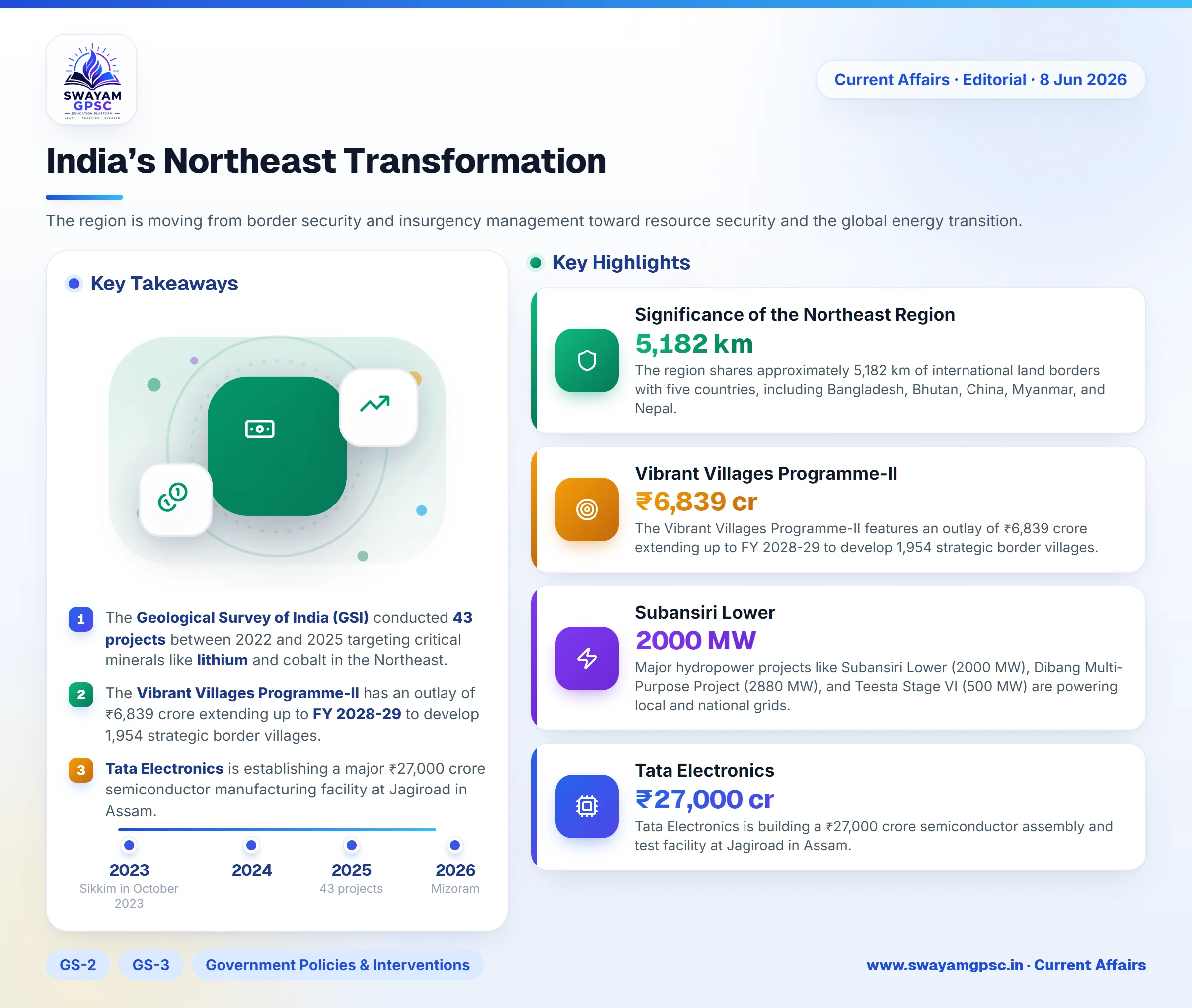
- The Geological Survey of India (GSI) conducted 43 projects between 2022 and 2025 targeting critical minerals like lithium and cobalt in the Northeast.
- The Vibrant Villages Programme-II has an outlay of ₹6,839 crore extending up to FY 2028-29 to develop 1,954 strategic border villages.
- Tata Electronics is establishing a major ₹27,000 crore semiconductor manufacturing facility at Jagiroad in Assam.
- Between 2014 and 2022, extremist incidents in the Northeast dropped by 76% following the signing of more than 12 major peace accords.
Why in News
- The Indian government is transforming the Northeast from a security-centric borderland into a critical mineral and industrial powerhouse.
- By integrating infrastructure, border management, and peace-building, the Ashtalakshmi region is becoming the anchor of India’s Act East Policy, 2014.
- Experts emphasize that this strategic reimagining must prioritize inclusive development and local institutional trust.
Significance of the Northeast Region
- The region is moving from border security and insurgency management toward resource security and the global energy transition.
- The Geological Survey of India (GSI) conducted 43 projects between 2022 and 2025 targeting lithium, cobalt, graphite, nickel, vanadium, and rare earth elements.
- The North East serves as India’s gateway to the ASEAN region, transforming from a landlocked area into a land-linked trade route.
- The India-Myanmar-Thailand (IMT) Trilateral Highway physically links Moreh (Manipur) to Mae Sot (Thailand).
- The region shares approximately 5,182 km of international land borders with five countries, including Bangladesh, Bhutan, China, Myanmar, and Nepal.
- The Vibrant Villages Programme-II features an outlay of ₹6,839 crore extending up to FY 2028-29 to develop 1,954 strategic border villages.
- Major hydropower projects like Subansiri Lower (2000 MW), Dibang Multi-Purpose Project (2880 MW), and Teesta Stage VI (500 MW) are powering local and national grids.
- The region holds an estimated one-fifth of India’s total potential for petroleum and natural gas.
- The strategic Sela Tunnel in Arunachal Pradesh provides all-weather tactical mobility for military hardware right up to the border.
- Tata Electronics is building a ₹27,000 crore semiconductor assembly and test facility at Jagiroad in Assam.
- Cross-border trade utilizes digital public infrastructure (DPI) and the internationalization of UPI networks.
Challenges
- High-altitude mountains and dense forests make infrastructure maintenance difficult, while floods and landslides frequently disrupt transport routes like NH-6 and NH-37.
- A devastating Glacial Lake Outburst Flood (GLOF) occurred in Sikkim in October 2023 when the South Lhonak Lake burst its banks.
- Annual budgetary allocations increased from ₹24,819 crore in 2014-15 to over ₹1,00,000 crore in 2023-24, yet execution delays persist.
- The region is home to over 200 tribal communities, leading to identity claims and territorial disputes between states like Assam-Nagaland and Assam-Arunachal Pradesh.
- Ethnic violence erupted in Manipur in May 2023 between the Meitei and Kuki-Zo communities, displacing more than 60,000 people.
- Porous borders expose the region to security challenges, with Mizoram hosting nearly 30,000 refugees from Myanmar as of June 2026.
- Recent enforcement actions in Tripura, Mizoram, and West Bengal uncovered a ₹142 crore cross-border narcotics laundering network.
- Credit-deposit ratios in states like Nagaland and Manipur remain lower than the national average.
- Youth unemployment rates in the Northeast remain higher than the national average according to EPW.
Government Initiatives
- PM-DevINE is a fully funded government initiative providing 100% funding aligned with the PM Gati Shakti framework.
- A total of 48 projects worth Rs 6044 crore have been sanctioned under PM-DevINE across eight states.
- Non-exempted central ministries must spend at least 10% of their annual budget on the North Eastern Region under the Gross Budgetary Support (GBS) mechanism.
- Cumulative expenditure reached ₹3.46 lakh crore against an allocation of ₹3.20 lakh crore over the four financial years from 2022 to 2026.
- Between 2014 and 2022, extremist incidents dropped by 76%, while security personnel and civilian casualties fell by 90% and 97% respectively.
- More than 12 major peace accords were signed in the last 12 years, facilitating the return of over 10,800 youth to the mainstream.
- Railway budget allocations for the Northeast increased from ₹2,122 crore in 2009-14 to ₹11,486 crore in 2026-27 with ongoing projects totaling ₹72,468 crore.
- Mizoram’s 51 km Bairabi-Sairang railway line put Aizawl on India’s railway map.
- The 73rd Plenary Session of the North Eastern Council (NEC) in June 2026 focused on the North East Vision Plan 2047.
- The Uttar Poorva Transformative Industrialization Scheme (UNNATI-2024) accelerates industrialization across all eight states.
- The Mound-Burial System of the Ahom Dynasty became Northeast India's first UNESCO World Heritage Site in 2024.
- The Ashtalakshmi Mahotsav (2024) promoted the region's cultural heritage, traditional textiles, and GI-tagged products.
Way Forward
- Prioritize multi-modal riverine corridors like the Brahmaputra-Barak waterway integration with Bangladesh to reduce reliance on single-point land routes.
- Adopt a Border-as-a-Gateway policy by upgrading border haats into high-tech trade checkpoints and creating Border Economic Zones (BEZs).
- Mandate climate-proofing for all strategic assets by integrating AI-based early warning systems for landslides and floods.
- Promote regional energy sovereignty through micro-grids by utilizing the region's 130 GW potential.
- Institutionalize civilizational diplomacy with ASEAN nations to build robust people-to-people ties.
- Transform the North Eastern Council into an Inter-State Resource Council to manage binding arbitration for resource-sharing.
- Redirect corporate social responsibility funds toward strategic border development using tax credits.
- Establish a North East Skills University with satellite campuses in all eight states focused on future-ready fields like AI and data analytics.
- Position Northeast India as a hub for sustainable, eco-friendly industries utilizing bamboo, tea, rubber, and hydropower.
- Create integrated tourism circuits managed through a centralized platform to boost the regional economy.