India's New Mineral Exchange Framework Explained
#GS-2 #GS-3 #Indian Polity & Constitution #Governance & Social Justice #Economy #Government Policies & Interventions #Industrial Policy #Infrastructure #Mines and Minerals
Key takeaways
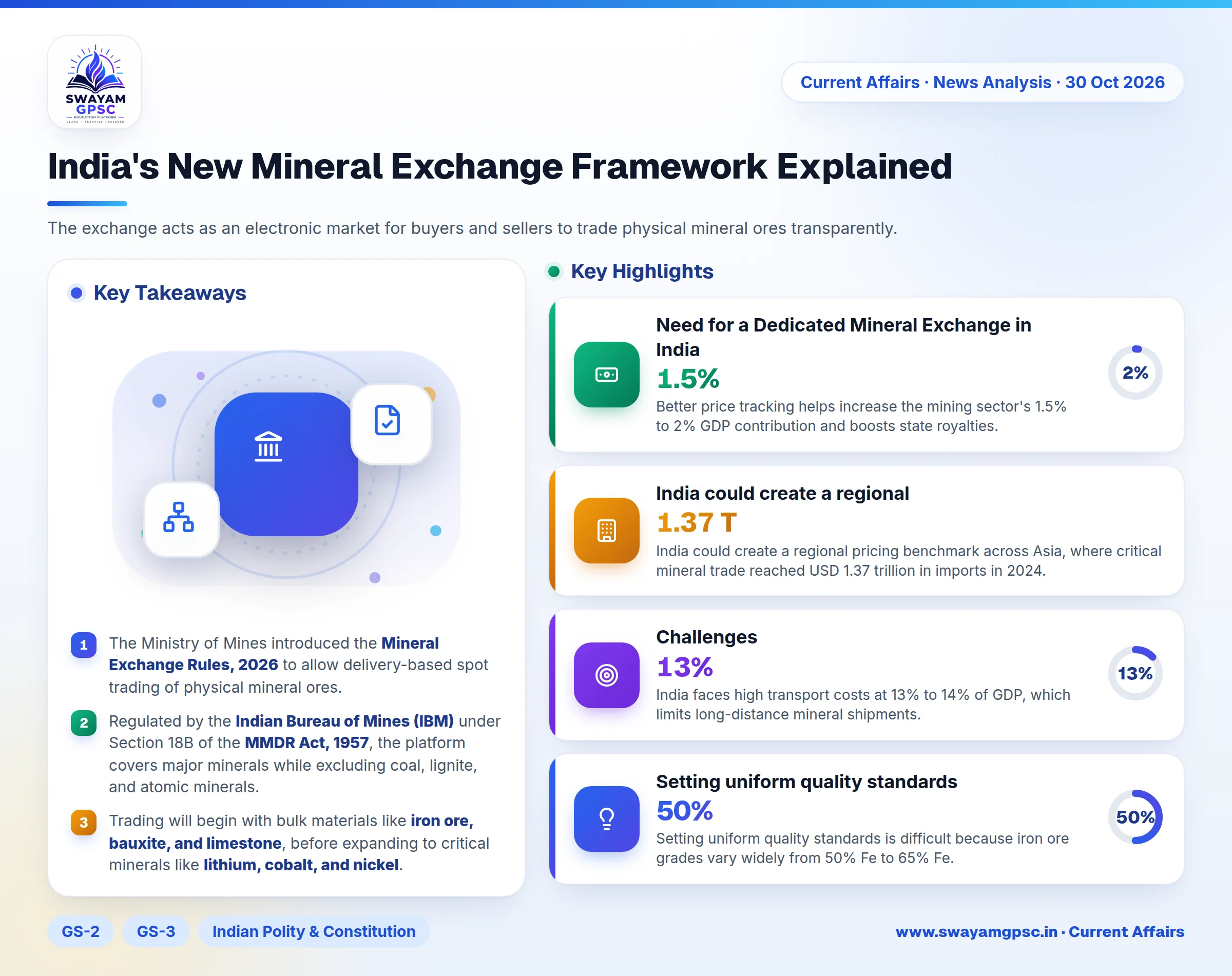
- The Ministry of Mines introduced the Mineral Exchange Rules, 2026 to allow delivery-based spot trading of physical mineral ores.
- Regulated by the Indian Bureau of Mines (IBM) under Section 18B of the MMDR Act, 1957, the platform covers major minerals while excluding coal, lignite, and atomic minerals.
- Trading will begin with bulk materials like iron ore, bauxite, and limestone, before expanding to critical minerals like lithium, cobalt, and nickel.
- The market aims to modernize a sector that contributes 1.5% to 2% of India's GDP by creating a transparent National Mineral Index.
- Key setup hurdles include high domestic logistics costs running at 13% to 14% of GDP and wide quality variations in ores like iron, which ranges from 50% Fe to 65% Fe.
Why in News
- The Ministry of Mines formally notified the Mineral Exchange Rules, 2026 to establish structured trading for physical minerals.
- Following this notification, the Indian Bureau of Mines (IBM) called for applications from entities interested in setting up these exchanges.
- The board of PTC India Ltd. approved an equity investment to build a wholly-owned subsidiary to operate a Mineral Exchange.
What is the Mineral Exchange?
- The exchange acts as an electronic market for buyers and sellers to trade physical mineral ores transparently.
- Unlike stock or commodity markets that focus on financial futures, this platform focuses on delivery-based spot contracts for physical mineral quantities.
- This model shifts the sector away from state auctions toward a competitive market with multiple buyers and sellers.
- Section 18B of the MMDR Act, 1957 gives the Central Government legal power to promote mineral exchanges.
- The Indian Bureau of Mines (IBM) serves as the main regulator responsible for overseeing these exchanges.
- IBM regulates all minerals under this framework except Part A items like coal and Part B atomic minerals.
- Financial derivatives on commodities remain under the oversight of the Securities and Exchange Board of India (SEBI).
- The platform will first trade bulk ores like iron ore, bauxite, limestone, and manganese ore.
- Later phases plan to list critical minerals like lithium, cobalt, nickel, and rare earth elements.
- Global examples of similar platforms include the London Metal Exchange (LME) and China's Dalian Commodity Exchange (DCE).
Need for a Dedicated Mineral Exchange in India
- A national exchange helps create a transparent National Mineral Index to prevent local monopolies.
- Better price tracking helps increase the mining sector's 1.5% to 2% GDP contribution and boosts state royalties.
- The platform supports initiatives like the National Green Hydrogen Mission by simplifying access to critical minerals.
- Small businesses can use standardized warehouse receipts as collateral to secure bank loans for working capital.
- Mandatory quality testing and origin tracking help stop illegal mining activities and black-market sales.
- Small mine owners gain direct market access, which gives them equal bargaining power with large corporate buyers.
- India could create a regional pricing benchmark across Asia, where critical mineral trade reached USD 1.37 trillion in imports in 2024.
Challenges
- India faces high transport costs at 13% to 14% of GDP, which limits long-distance mineral shipments.
- New platforms need high trading volumes to attract enough traders and remain financially viable.
- Regulators must watch the market closely to prevent large companies from fixing prices or colluding.
- Setting uniform quality standards is difficult because iron ore grades vary widely from 50% Fe to 65% Fe.
- Large mining firms may prefer traditional long-term agreements over a spot-market model with fluctuating prices.
- Rules for these platforms must fit existing laws without creating extra paperwork or regulatory burdens.
Way Forward
- The government should roll out these exchanges in structured stages to allow the market to adjust smoothly.
- Setting up independent quality-testing labs will ensure that traded minerals match exact standard grades.
- Using digital tracking tools like blockchain will help verify the origin of all traded materials.
- Updating the MMDR Act, 1957 where needed will clear legal hurdles and build trader confidence.