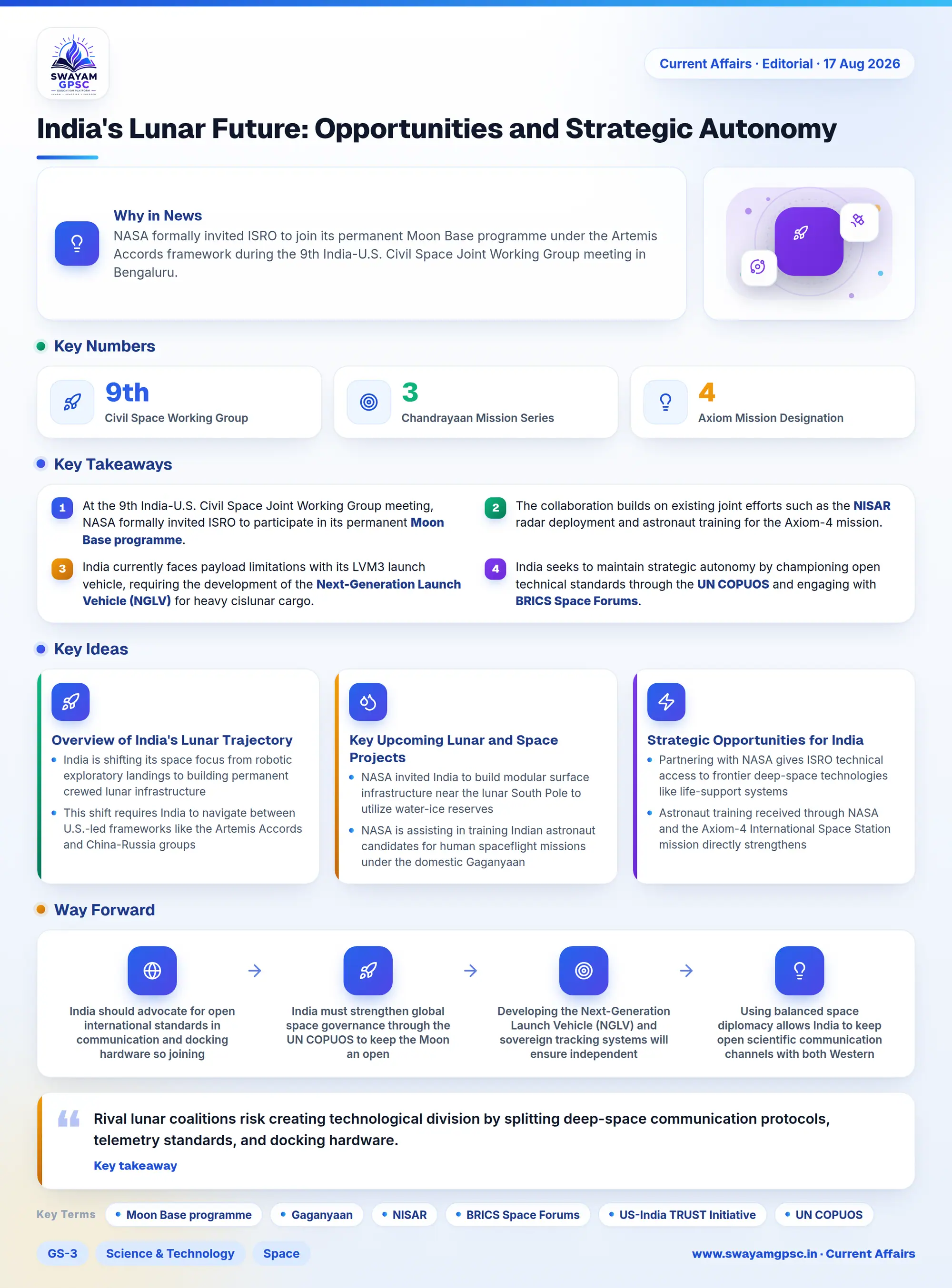
India's Lunar Future: Opportunities and Strategic Autonomy
#GS-3 #Science & Technology #Space #GS-2 #Current Events #International #National #Lunar Exploration #ISRO #Artemis Accords
Key takeaways
- At the 9th India-U.S. Civil Space Joint Working Group meeting, NASA formally invited ISRO to participate in its permanent Moon Base programme.
- The collaboration builds on existing joint efforts such as the NISAR radar deployment and astronaut training for the Axiom-4 mission.
- India currently faces payload limitations with its LVM3 launch vehicle, requiring the development of the Next-Generation Launch Vehicle (NGLV) for heavy cislunar cargo.
- India seeks to maintain strategic autonomy by championing open technical standards through the UN COPUOS and engaging with BRICS Space Forums.
Why in News
- NASA formally invited ISRO to join its permanent Moon Base programme under the Artemis Accords framework during the 9th India-U.S. Civil Space Joint Working Group meeting in Bengaluru.
Overview of India's Lunar Trajectory
- India is shifting its space focus from robotic exploratory landings to building permanent crewed lunar infrastructure and long-term scientific projects.
- This shift requires India to navigate between U.S.-led frameworks like the Artemis Accords and China-Russia groups like the International Lunar Research Station while keeping its strategic independence.
Key Upcoming Lunar and Space Projects
- NASA invited India to build modular surface infrastructure near the lunar South Pole to utilize water-ice reserves and areas with continuous sunlight.
- NASA is assisting in training Indian astronaut candidates for human spaceflight missions under the domestic Gaganyaan program.
- Both space agencies are integrating scientific instruments across future Chandrayaan missions, building on the joint NISAR radar project.
- India hosts meetings with non-Artemis spacefaring nations including China through BRICS Space Forums to maintain diverse international research ties.
Strategic Opportunities for India
- Partnering with NASA gives ISRO technical access to frontier deep-space technologies like life-support systems, lunar robotics, spacesuits, and power distribution.
- Astronaut training received through NASA and the Axiom-4 International Space Station mission directly strengthens India's Gaganyaan human spaceflight efforts.
- This collaboration helps ISRO expand beyond single probes like Chandrayaan-3 toward continuous lunar surface and orbital operations.
- The US-India TRUST Initiative creates new supply-chain and payload opportunities for private Indian space-tech startups.
Challenges
- Rival lunar coalitions risk creating technological division by splitting deep-space communication protocols, telemetry standards, and docking hardware.
- NASA procurement rules restricting foreign entities that work with China create friction with India's broader diplomatic ties.
- Current operational rockets like the LVM3 have payload limits, making new heavy-lift rockets necessary for cislunar transportation.
- India's overall space spending remains significantly smaller than the large commercial budgets deployed by NASA.
Way Forward
- India should advocate for open international standards in communication and docking hardware so joining Artemis does not block future scientific work with other nations.
- India must strengthen global space governance through the UN COPUOS to keep the Moon an open, peaceful space under the Outer Space Treaty.
- Developing the Next-Generation Launch Vehicle (NGLV) and sovereign tracking systems will ensure independent access to deep space.
- Using balanced space diplomacy allows India to keep open scientific communication channels with both Western and non-Western space agencies.
Conclusion
- NASA's invitation offers ISRO a key role in shaping humanity's first permanent lunar base while requiring careful balance between international partnerships and national technical autonomy.