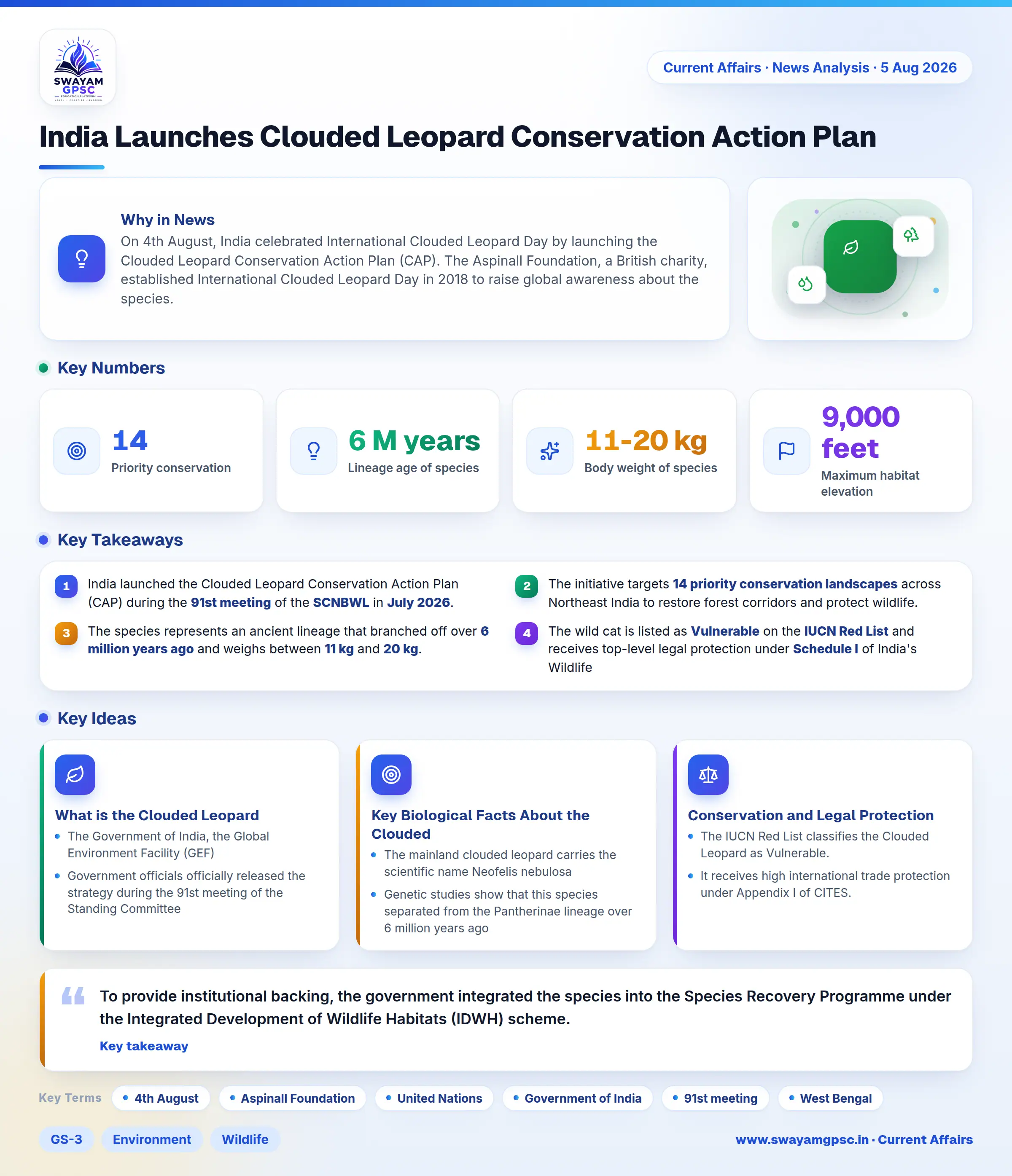
India Launches Clouded Leopard Conservation Action Plan
#GS-3 #Environment #Wildlife #Biodiversity #Conservation #National #Clouded Leopard
Key takeaways
- India launched the Clouded Leopard Conservation Action Plan (CAP) during the 91st meeting of the SCNBWL in July 2026.
- The initiative targets 14 priority conservation landscapes across Northeast India to restore forest corridors and protect wildlife.
- The species represents an ancient lineage that branched off over 6 million years ago and weighs between 11 kg and 20 kg.
- The wild cat is listed as Vulnerable on the IUCN Red List and receives top-level legal protection under Schedule I of India's Wildlife Protection Act, 1972.
- It inhabits diverse forest ecosystems across Asia at elevations reaching up to 9,000 feet (2,743 meters).
Why in News
- On 4th August, India celebrated International Clouded Leopard Day by launching the Clouded Leopard Conservation Action Plan (CAP).
- The Aspinall Foundation, a British charity, established International Clouded Leopard Day in 2018 to raise global awareness about the species.
- This special day highlights major threats facing the cat, including severe habitat loss and illegal wildlife trade.
- It operates as an advocacy observance rather than a formal treaty-based or United Nations event.
What is the Clouded Leopard Conservation Action Plan?
- The Government of India, the Global Environment Facility (GEF), and the United Nations Development Programme (UNDP) jointly created this action plan.
- Government officials officially released the strategy during the 91st meeting of the Standing Committee of the National Board for Wildlife (SCNBWL) held in July 2026 at Coimbatore.
- This strategic framework aims to halt population decline and secure long-term survival for the wild cat across critical landscapes.
- The plan identifies 14 priority conservation landscapes across Northeast India and northern regions of West Bengal and Bihar.
- These priority zones cover states such as Assam, Arunachal Pradesh, Meghalaya, Nagaland, Mizoram, Manipur, and Tripura.
- Researchers will use non-invasive tools like environmental DNA (eDNA), camera traps, occupancy surveys, and genetic sampling to establish a baseline population count.
- Forest guards will use the M-STrIPES mobile application to strengthen anti-poaching patrols and monitor wildlife corridors.
- The plan promotes climate-resilient conservation, sustainable livelihoods for indigenous communities, and transboundary cooperation with Bhutan, Nepal, and Myanmar.
- To provide institutional backing, the government integrated the species into the Species Recovery Programme under the Integrated Development of Wildlife Habitats (IDWH) scheme.
Key Biological Facts About the Clouded Leopard
- The mainland clouded leopard carries the scientific name Neofelis nebulosa, while the Sunda clouded leopard (Neofelis diardi) lives exclusively in Sumatra and Borneo.
- Genetic studies show that this species separated from the Pantherinae lineage over 6 million years ago, making it an ancient feline species.
- Its global habitat extends from the Himalayan foothills across Southeast Asia to southern China.
- In India, the cat inhabits dense subtropical and tropical evergreen forests from lowlands up to 9,000 feet (2,743 meters).
- Weighing between 11 kg and 20 kg, it is the smallest member of the big cat subfamily.
- It features the largest canine teeth relative to skull size among living wild cats, earning it the nickname modern-day saber-tooth.
- It possesses flexible ankle joints that rotate backward, allowing it to climb down trees headfirst with the aid of a long balancing tail.
- Its throat bone structure prevents it from roaring like lions or tigers, but it can purr, hiss, and make chuffing sounds.
- When larger predators like tigers or common leopards share its habitat, it adapts by becoming strictly nocturnal and tree-dwelling.
- Its coat features a pale yellowish-gray or brownish color covered with large dark blotches resembling storm clouds.
Conservation and Legal Protection Status
- The IUCN Red List classifies the Clouded Leopard as Vulnerable.
- It receives high international trade protection under Appendix I of CITES.
- Under India's Wildlife Protection Act, 1972, it holds the highest legal protection in Schedule I.
- The Clouded Leopard is the official state animal of Meghalaya.
- India established its first dedicated protected area for the species at Clouded Leopard National Park within the Sepahijala Wildlife Sanctuary in Tripura.
- Key protective habitats also include the Manas Tiger Reserve in Assam, Dampa Tiger Reserve in Mizoram, and Pakke Tiger Reserve in Arunachal Pradesh.