India's Integrated Strategy to Eliminate Left-Wing Extremism
#GS-2 #GS-3 #Governance & Social Justice #Economy #Current Events #Government Policies & Interventions #Internal Security #Left-Wing Extremism #National
Key takeaways
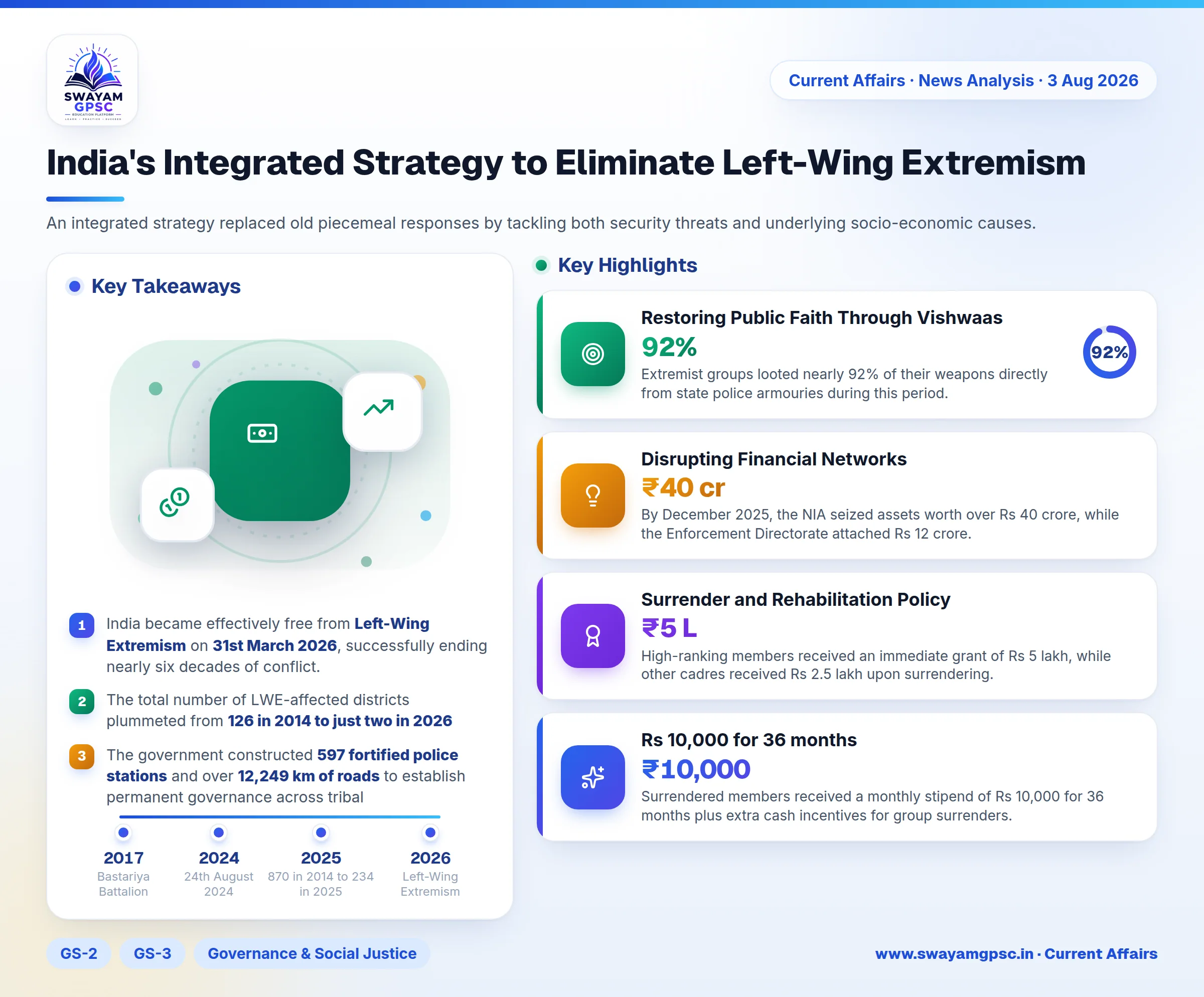
- India became effectively free from Left-Wing Extremism on 31st March 2026, successfully ending nearly six decades of conflict.
- The total number of LWE-affected districts plummeted from 126 in 2014 to just two in 2026, while high-severity districts dropped from 35 to zero.
- The government constructed 597 fortified police stations and over 12,249 km of roads to establish permanent governance across tribal regions.
- Financial crackdowns by the National Investigation Agency resulted in asset seizures exceeding Rs 40 crore by December 2025.
- Under a whole-of-government framework built on Vishwaas, Nirman, and Jan Kalyan, over 3,927 cadres surrendered between 2024 and March 2026.
Why in News
- India became effectively free from Left-Wing Extremism on 31st March 2026 after six decades of violence.
- This historic milestone followed a sustained decline in violent incidents, loss of life, and affected geographic areas.
- The government achieved this success through a unified strategy combining security operations, technology, infrastructure development, welfare schemes, and cadre rehabilitation.
How India Overcame Left-Wing Extremism
- For nearly six decades, Left-Wing Extremism remained India's biggest internal security threat in remote tribal regions.
- An integrated strategy replaced old piecemeal responses by tackling both security threats and underlying socio-economic causes.
- The strategic framework relied on three core pillars: Vishwaas, Nirman, and Jan Kalyan.
- Under Vishwaas, security forces built trust through strong operations, better inter-agency coordination, community outreach, and surrender schemes.
- Under Nirman, the state expanded physical roads, digital networks, governance bodies, and job opportunities across isolated regions.
- Under Jan Kalyan, welfare delivery, social dignity, cultural inclusion, and main-stream integration became top priorities for tribal communities.
- Security created space for development, which built public trust, leading to faster welfare delivery in a continuous positive cycle.
- The number of affected districts dropped dramatically from 126 in 2014 to just two in 2026, while high-severity districts fell from 35 to zero.
- Violent incidents dropped from 870 in 2014 to 234 in 2025, while yearly fatalities declined from 310 down to 100.
- Sustained security operations and improved local governance dismantled extremist networks and restored public peace.
Restoring Public Faith Through Vishwaas
- The Vishwaas pillar focused on establishing a permanent government presence in remote regions and building trust with local communities.
- Left-Wing Extremism originated from the 1967 Naxalbari uprising in West Bengal, following Maoist doctrine on armed revolution.
- Multiple extremist factions joined hands in 2004 to form the CPI (Maoist), creating a major security challenge.
- Between 2004 and 2014, extremism reached its peak, recording 1,936 incidents and 720 civilian deaths in 2010 alone.
- Over that violent decade, 17,542 violent incidents caused the deaths of 1,913 security personnel and 5,019 civilians.
- Extremist groups looted nearly 92% of their weapons directly from state police armouries during this period.
- Before 2014, India lacked a unified national strategy because individual states acted in isolation without central coordination.
- Although the government declared Naxalism as India's biggest internal security threat in 2009, coordinated responses remained limited.
- Security gains from Vishwaas allowed fortified police stations and security camps to bring stability, paving the way for the Nirman pillar.
National Policy and Action Plan
- The government introduced the National Policy and Action Plan in 2015 to replace old reactive tactics with a structured approach.
- The plan deployed Central Armed Police Forces and provided funds through the Security Related Expenditure scheme and Special Infrastructure Scheme.
- India adopted a clear three-pronged framework based on Dialogue, Security, and Coordination under the Ministry of Home Affairs.
- The government set a firm deadline on 24th August 2024 to eliminate Naxalism by 31st March 2026, achieving it ahead of schedule.
Expanded Security Grid
- The government eliminated security gaps in remote areas by building infrastructure, deploying specialized units, and sharing intelligence.
- Authorities constructed 597 fortified police stations compared to only 66 built before 2014.
- Police stations reporting violent incidents dropped from 333 down to 16, while 408 new security camps dominated remote regions.
- Security teams built 68 night-landing helipads for rapid troop deployment, casualty evacuation, and aerial surveillance.
- Forces received 400 bullet-proof and blast-proof vehicles along with five dedicated hospitals for medical care.
- A layered security force united specialized units like CoBRA, CRPF, District Reserve Guard, and state units like Greyhounds.
- Joint training programs among state and central units created an integrated force with clear command structures.
Technology-Led Operations
- Counter-insurgency teams used UAVs, drones, satellite imagery, and AI-based data analysis for real-time tracking after 2014.
- The Ministry of Home Affairs analyzed call logs, mobile location data, and social media activity to monitor movement patterns.
Trace Target Neutralise Doctrine
- Security forces applied the Trace, Target, Neutralise strategy to clear strongholds that remained under extremist control for three decades.
- Targeted intelligence campaigns like Operation Black Forest and Operation Double Bull systematically cleared remote forests.
- Operation Black Forest eliminated over 30 Maoist leaders, while Operation Double Bull rendered three major districts completely Naxal-free.
Disrupting Financial Networks
- The Union Government combined a Whole-of-Government development model with a Whole-of-Agency security approach to dismantle support networks.
- A dedicated vertical inside the National Investigation Agency targeted extremist funding and illegal extortion rings.
- By December 2025, the NIA seized assets worth over Rs 40 crore, while the Enforcement Directorate attached Rs 12 crore.
- By June 2026, the NIA had investigated 112 LWE-related cases and filed formal charge sheets in 100 cases.
Surrender and Rehabilitation Policy
- The state offered generous rehabilitation packages to encourage active cadres to lay down weapons and join mainstream society.
- High-ranking members received an immediate grant of Rs 5 lakh, while other cadres received Rs 2.5 lakh upon surrendering.
- Surrendered members received a monthly stipend of Rs 10,000 for 36 months plus extra cash incentives for group surrenders.
- Clear policies led to 2,337 surrenders in 2025 and 3,927 total surrenders between 2024 and March 2026.
Building the Future Through Nirman
- The Nirman pillar focused on expanding physical roads, telecom networks, schools, and banking facilities across remote tribal areas.
- Ending extremism required giving tribal children access to the same growth opportunities available in major modern cities.
- Authorities built over 12,249 km of roads in affected areas after 2014 out of 17,319 km approved under dedicated schemes.
- Telecom providers installed over 9,600 mobile towers, extending digital connectivity to 44,728 out of 46,592 target villages.
- Financial institutions added 1,804 bank branches, 1,321 ATMs, and 6,025 post offices between 2015 and 2026.
- The government approved 259 Eklavya Model Residential Schools for tribal students, completing 179 of them.
- Authorities established 46 Industrial Training Institutes and 49 Skill Development Centres with an investment of Rs 800 crore.
- Skill programs trained over 90,000 young people and women, boosting employment prospects across local economies.
- Civic action programs allocated Rs 212 crore toward local healthcare camps, free medicine distribution, and community welfare.
- Youth exchange initiatives and Media Plan Scheme projects spent Rs 50.45 crore to improve community outreach.
Promoting Welfare Through Jan Kalyan
- The Jan Kalyan pillar prioritized dignified, inclusive welfare delivery so essential services reached marginalized tribal families.
- Expanding education, healthcare, housing, and job security restored faith in democratic state institutions.
- Surrendered members received housing under PM Awaas Yojana, while their children received free public education up to Class XII.
- The state provided special development grants to villages that eradicated extremist influence and held democratic local elections.
Targeted Development Schemes
- The Special Central Assistance scheme funded critical infrastructure gaps in the most severely affected districts.
- The Aspirational Districts Programme accelerated health, education, and financial inclusion metrics across vulnerable regions.
- The PM-JANMAN scheme provided housing, clean drinking water, and road connectivity specifically to Particularly Vulnerable Tribal Groups.
- The Dharti Aaba Janjatiya Gram Utkarsh Abhiyan coordinated multi-ministerial projects to upgrade overall living standards in tribal villages.
Chhattisgarh Case Study
- Bastar's successful transformation relied on a balanced mix of security operations, infrastructure growth, and tribal community participation.
- Formed in 2017, the Bastariya Battalion recruited 1,143 personnel, including 400 local youth, improving tactical intelligence.
- Engineers constructed over 3,240 km of roads across Bastar, linking isolated villages directly to district hospitals and markets.
- Telecom operators set up 889 mobile towers, enabling digital access and government e-services across remote forest pockets.
- A dedicated state program supported 3,000 surrendered cadres with an initial fund of Rs 20 crore for skill development.
- Launched in May 2026, the Shaheed Veer Gunda Dhur Seva Dera initiative converted 70 security camps into public service hubs.
- Setting up a Common Service Centre in Netanar symbolised the permanent return of state governance to historical extremist hotspots.
- Cultural events like Bastar Pandum and the Bastar Olympics encouraged youth participation, local leadership, and social unity.
Conclusion
- India's victory against Left-Wing Extremism shows a permanent shift from short-term containment to comprehensive transformation.
- The three pillars of Vishwaas, Nirman, and Jan Kalyan proved that long-term security requires development paired with social dignity.