India's Growing Strategic Shift Toward U.S. LPG Imports
#GS-3 #Economy #Infrastructure #Science & Technology #Energy #Current Events #National #Energy Security #India-US Relations
Key takeaways
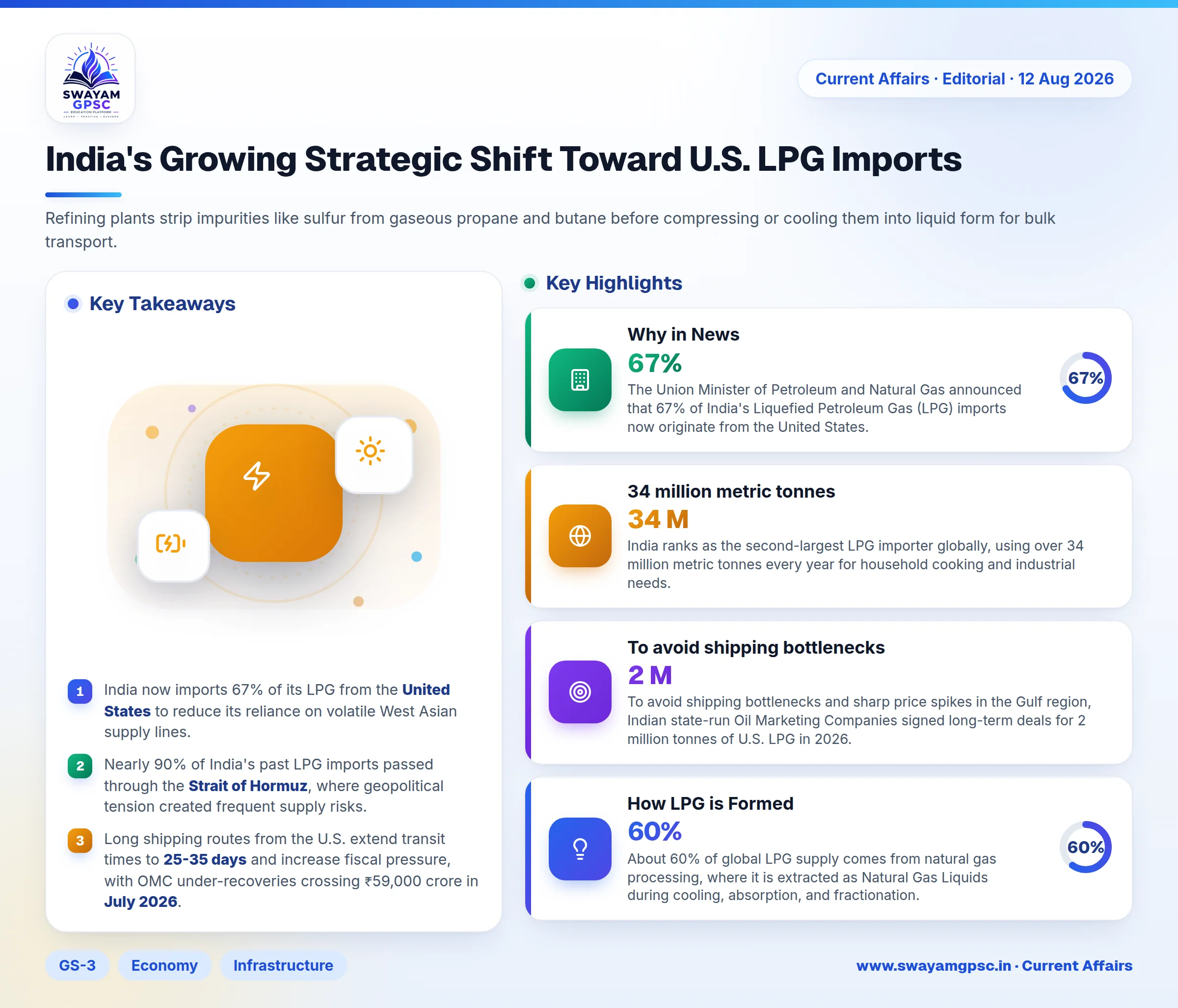
- India now imports 67% of its LPG from the United States to reduce its reliance on volatile West Asian supply lines.
- Nearly 90% of India's past LPG imports passed through the Strait of Hormuz, where geopolitical tension created frequent supply risks.
- Long shipping routes from the U.S. extend transit times to 25-35 days and increase fiscal pressure, with OMC under-recoveries crossing ₹59,000 crore in July 2026.
- Building 30-60 days of underground strategic LPG reserves and increasing domestic refinery output are crucial steps to guard against maritime disruptions.
Why in News
- The Union Minister of Petroleum and Natural Gas announced that 67% of India's Liquefied Petroleum Gas (LPG) imports now originate from the United States.
- India ranks as the second-largest LPG importer globally, using over 34 million metric tonnes every year for household cooking and industrial needs.
- To avoid shipping bottlenecks and sharp price spikes in the Gulf region, Indian state-run Oil Marketing Companies signed long-term deals for 2 million tonnes of U.S. LPG in 2026.
- While this pivot reduces immediate supply risks in West Asia, it creates longer shipping routes, currency exchange volatility, and fresh geopolitical dependencies.
How LPG is Formed
- LPG is a clean-burning and high-energy flammable mixture composed mainly of propane (C₃H₈) and butane (C₄H₁₀).
- About 60% of global LPG supply comes from natural gas processing, where it is extracted as Natural Gas Liquids during cooling, absorption, and fractionation.
- Roughly 40% of global yield comes from crude oil refining as a secondary product during atmospheric distillation, catalytic cracking, and hydroprocessing.
- Refining plants strip impurities like sulfur from gaseous propane and butane before compressing or cooling them into liquid form for bulk transport.
Reasons Driving Dependence on U.S. LPG
- Nearly 90% of India's historical LPG imports passed through the Strait of Hormuz, where conflict disruptions forced India to seek alternative suppliers.
- Gulf LPG prices under the Saudi Aramco CP benchmark jumped from $543/tonne in February 2026 to $790/tonne in June 2026, making U.S. propane competitive despite higher freight costs.
- Domestic LPG demand rose to 6.5 million metric tonnes in Q1 FY27, while domestic refinery production lagged behind at 4.3 million metric tonnes.
- Indian public refiners proactively secured long-term contracts for 2.2 million metric tonnes of U.S. cooking gas in 2026 to protect 33 crore active domestic households.
- The massive shale gas boom in the U.S. produced large export surpluses of propane and butane, turning America into a dependable energy partner.
Challenges and Implications of Overdependence
- Cooking gas is politically sensitive in India, meaning unexpected shortages or price hikes directly hurt household budgets and spark public anger.
- When global LPG prices rise while local retail rates stay frozen, state refiners incur under-recoveries that exceeded ₹59,000 crore by July 2026.
- Because long-distance shipments from the U.S. are billed in U.S. Dollars, a stronger dollar directly raises the rupee cost of every cargo.
- Transporting LPG from the U.S. requires 25-35 days compared to 5-10 days from the Persian Gulf, increasing freight costs and ocean travel times.
- Heavy reliance on a single Western nation exposes India to potential non-tariff trade barriers, secondary sanctions, or political pressure during trade talks.
Way Forward
- The government should direct domestic refineries to redirect higher volumes of internal propane and butane into the LPG pool to expand local supply.
- India must build long-term supply partnerships with non-Hormuz regional producers like Australia to shorten shipping routes outside the Persian Gulf.
- Developing dedicated underground cavern storage for LPG can create a buffer of 30-60 days against global maritime trade disruptions.
- Promoting electric induction cooking and solar-powered cooktops through schemes like e-Vishwakarma will help lower household LPG growth over time.
- Oil companies should use financial hedging tools and local currency trade settlement mechanisms to shield themselves from foreign exchange risks.
Conclusion
- Sourcing two-thirds of LPG needs from the U.S. shows flexible crisis management in response to Persian Gulf supply risks.
- However, swapping geographical proximity for long shipping routes creates new trade, freight, and currency vulnerabilities.
- Building strategic LPG reserves, boosting domestic refining capacity, and securing Indo-Pacific partners are vital steps for India's long-term energy security.