India's Green Hydrogen Roadmap
#GS-2 #Governance & Social Justice #Poverty #GS-3 #Economy #Infrastructure #Agriculture #Environment #Climate Change #Sustainable Development #Government Policies & Interventions #Environmental Pollution & Degradation #Growth & Development #Conservation
Key takeaways
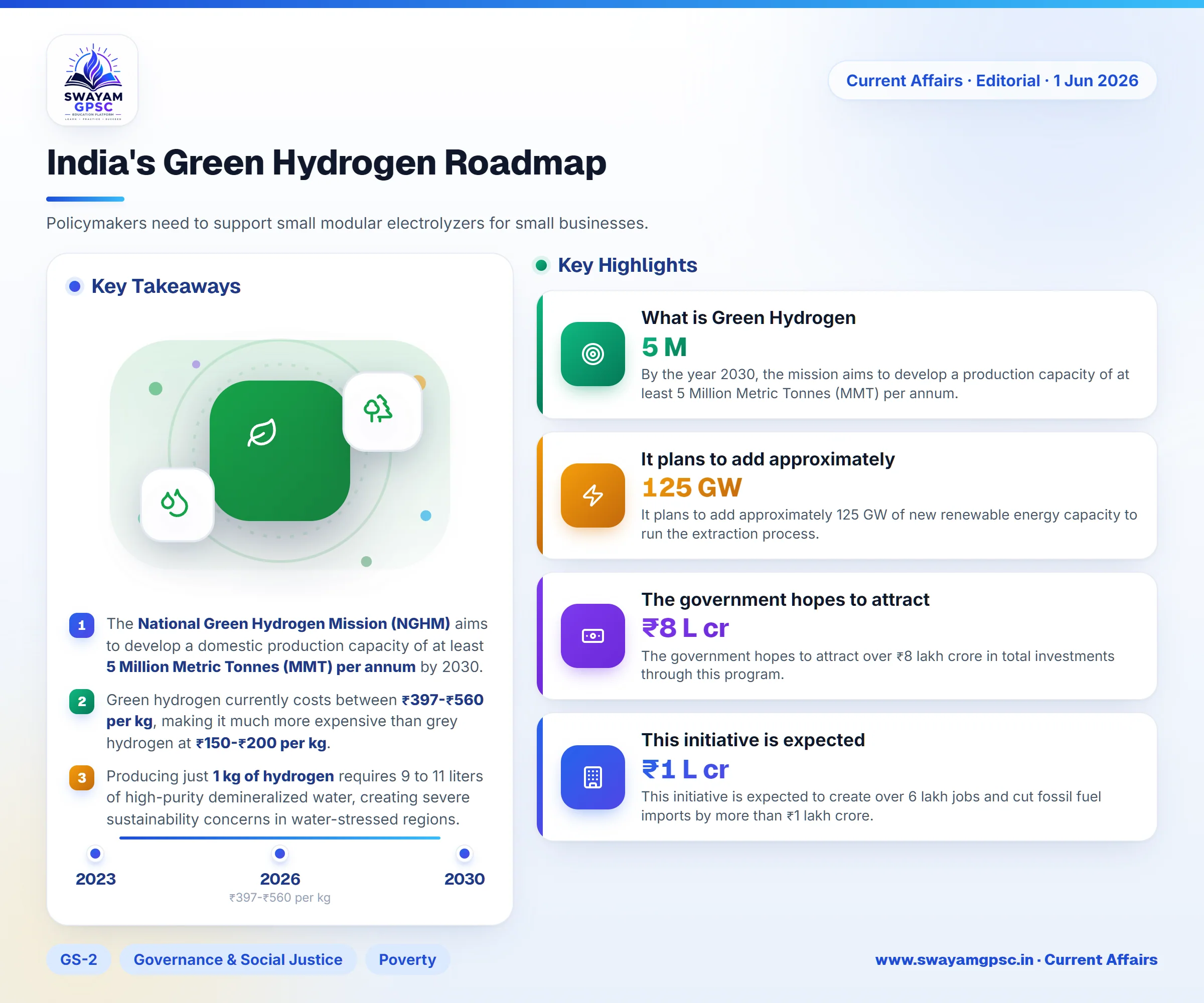
- The National Green Hydrogen Mission (NGHM) aims to develop a domestic production capacity of at least 5 Million Metric Tonnes (MMT) per annum by 2030.
- Green hydrogen currently costs between ₹397-₹560 per kg, making it much more expensive than grey hydrogen at ₹150-₹200 per kg.
- Producing just 1 kg of hydrogen requires 9 to 11 liters of high-purity demineralized water, creating severe sustainability concerns in water-stressed regions.
- The Solar Energy Corporation of India (SECI) has contracted to supply 7,24,000 tonnes of green ammonia every year to 13 fertilizer plants, saving $2.5 billion over a decade.
Why in News
- This editorial analyzes a recent piece from The Hindu BusinessLine about making green hydrogen practical for Indian industries.
- It argues that achieving true energy security through the NGHM requires moving away from just large central projects.
- The analysis stresses that leaders must focus on delivered costs rather than production expenses.
- Policymakers need to support small modular electrolyzers for small businesses.
- Integrating power sector reforms will make green hydrogen a bankable solution for hard-to-abate sectors like fertilizers and refining.
What is Green Hydrogen
- Green hydrogen is a clean fuel created through the electrolysis of water using renewable energy sources like wind, solar, or hydropower.
- An electrolyzer applies an electrical current to separate water (H2O) into oxygen (O2) and hydrogen (H2).
- This fuel is called green because the entire creation cycle produces virtually zero greenhouse gas emissions, unlike fossil fuel methods.
- The National Green Hydrogen Mission (NGHM), 2023 is a major initiative by the Ministry of New and Renewable Energy (MNRE) to make India a global hub.
- By the year 2030, the mission aims to develop a production capacity of at least 5 Million Metric Tonnes (MMT) per annum.
- It plans to add approximately 125 GW of new renewable energy capacity to run the extraction process.
- The government hopes to attract over ₹8 lakh crore in total investments through this program.
- This initiative is expected to create over 6 lakh jobs and cut fossil fuel imports by more than ₹1 lakh crore.
- It will also help abate nearly 50 MMT of annual greenhouse gas emissions.
- Hydrogen is classified into different colors based on its production method and carbon footprint.
- Green hydrogen uses electrolysis with renewable energy and has zero carbon footprint.
- Grey hydrogen relies on Steam Methane Reforming (SMR) using natural gas and leaves a high carbon footprint.
- Blue hydrogen uses SMR + Carbon Capture & Storage with natural gas, resulting in a low carbon footprint because carbon is captured.
- Brown hydrogen uses gasification with coal, creating a very high carbon footprint.
What are the Key Applications of Green Hydrogen
- Steel production is one of India's most carbon-heavy industries, traditionally using coking coal in blast furnaces.
- Green hydrogen replaces coking coal in the Direct Reduced Iron (DRI) process, leaving water vapor as the only emission.
- The Ministry of Steel has received Rs. 455 crore to run pilot projects for green hydrogen in steel making up to FY 2029-30 under the NGHM.
- Private companies like Tata Steel and Jindal Steel Works (JSW) are actively testing Hydrogen-DRI plants.
- Tata Steel successfully injected 6Kg/(ton of hot metal) of hydrogen, cutting 7-10% of CO2 emissions per tonne of crude steel.
- Jindal Steel Works (JSW) built a carbon capture and storage facility with a 100 tonnes per day (TPD) capacity at its DRI plant in Dolvi (Maharashtra).
- India is the 2nd-largest consumer and 3rd-largest producer of fertilizers across the world.
- Producing Ammonia (NH3) drives heavy natural gas imports, but green hydrogen combines with nitrogen to make green ammonia for fertilizers.
- The Solar Energy Corporation of India (SECI) signed 10-year agreements to supply 7,24,000 tonnes of green ammonia every year to 13 fertilizer plants.
- This step will save India roughly $2.5 billion in foreign currency over the next ten years.
- Refineries use massive amounts of hydrogen to remove sulfur from crude oil and upgrade heavy crude through desulfurization.
- Indian Oil Corporation (IOCL) is opening India's first green hydrogen plant at its Panipat Refinery.
- This plant replaces grey hydrogen to significantly lower the refinery's Scope 1 emissions.
- SECI is also launching refinery projects with a capacity of 30,000 tonnes per year.
- The shipping sector needs clean bunker fuels, and green hydrogen derivatives like green methanol offer a great alternative.
- The government designated three major facilities, Deendayal Port (Kandla), V.O. Chidambaranar Port (Tuticorin), and Paradip Port (Odisha), as Green Hydrogen Hubs.
- These hubs will store, distribute, and fuel ships along major global maritime trade routes.
- Battery electric vehicles struggle with heavy trucks, but Hydrogen Fuel Cells offer long ranges and fast refueling times.
- Five pilot projects will deploy 37 hydrogen-fueled buses and trucks across 10 diverse topographic routes.
- These are backed by 9 dedicated hydrogen refueling stations to test Fuel Cell Electric Vehicles (FCEVs).
- Excess solar and wind energy can run electrolyzers during peak hours to balance the power grid.
- The generated hydrogen is stored in tanks or salt caverns and turned back into electricity at night.
- NTPC Limited is building a massive Green Hydrogen Hub at Pudimadaka, Andhra Pradesh for grid-scale energy storage.
- Hydrogen can also be turned into Sustainable Aviation Fuel (SAF) by making synthetic hydrocarbons.
- An English company named OXCCU raised $22.7 million to make sustainable aviation fuel more affordable using a special catalyst.
Challenges
- The biggest obstacle is that green hydrogen is much more expensive than grey hydrogen made from natural gas.
- As of 2026, green hydrogen costs between ₹397-₹560 per kg, while fossil-fuel grey hydrogen costs ₹150-₹200 per kg.
- Without help from the SIGHT (Strategic Interventions for Green Hydrogen Transition) scheme, industries will not switch voluntarily.
- Making electrolyzer stacks requires specialized materials like iridium or platinum and high-precision engineering.
- India depends heavily on imported components, and building a local supply chain is a long-term research challenge.
- Producing 1 kg of hydrogen through electrolysis requires 9 to 11 liters of high-purity demineralized water.
- Many potential production zones in Rajasthan and Gujarat already suffer from severe water shortages.
- Plants must invest in costly water treatment like desalination to avoid taking water from local residents.
- Hydrogen is extremely light, highly flammable, and can embrittle steel pipelines, making transport very difficult.
- Existing natural gas pipelines cannot carry pure hydrogen without expensive retrofits.
- Long-distance transport requires expensive high-pressure tube trailers or cryogenic liquid tankers.
- National safety standards for handling a high-pressure hydrogen economy are still in early development.
- Ports like Kandla and Tuticorin must build special safety protocols before functioning as massive hubs.
- India faces fierce competition from countries like Australia, Chile, and Middle Eastern nations that heavily subsidize hydrogen.
- India spends only 0.6% of its GDP on R&D, lagging behind the US (3.4%), China (2.6%), and South Korea (5.3%).
- This low research spending slows down innovative technology adoption across domestic industries.
Way Forward
- Expanding the SIGHT program to include small modular electrolyzers from 10 kW to 2 MW will help smaller industrial units.
- Increasing production-linked incentives (PLI) will bridge the cost gap until economies of scale arrive.
- Building Hydrogen Valley Innovation Clusters (HVIC) by co-locating production near refineries and steel plants cuts midstream transport costs by 70-85%.
- Using hubs like Kandla (Deendayal Port) and Paradip will link production directly to industrial buyers.
- The government should introduce Green Hydrogen Purchase Obligations (GHPO) for hard-to-abate sectors to create bankable demand.
- Promoting Hybrid Renewable Energy Parks combining solar, wind, and battery storage ensures consistent power for electrolyzers.
- Waiving inter-state transmission charges for 25 years helps lower electricity costs for green projects.
- Intensifying R&D through the ₹100 crore Call for Proposals will help manufacture local electrolyzers.
- The India-US critical minerals pact will help localize supply chains and reduce reliance on imports.
- Initiating pilot projects to blend hydrogen into existing natural gas pipelines solves the last-mile transport problem.
- Fast-tracking the National Hydrogen Safety Protocol will ensure uniform safety standards across all refueling routes.
- The NGHM skilling component and new Centres of Excellence (CoEs) will prepare a skilled workforce.
- The Indian Carbon Market (ICM) will let companies monetize emission reductions, naturally narrowing the cost gap between green and grey hydrogen.