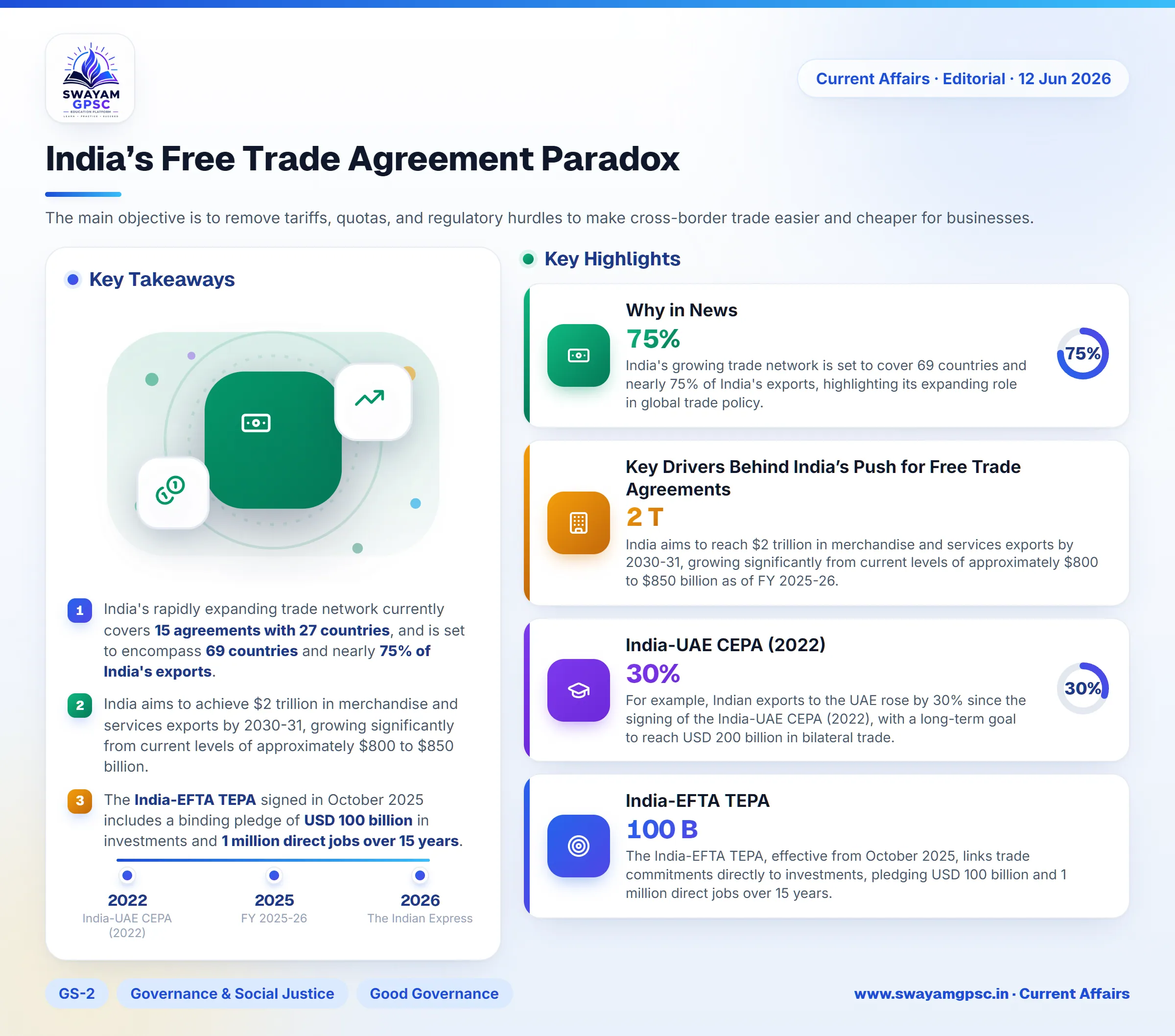
India’s Free Trade Agreement Paradox
#GS-2 #Governance & Social Justice #Good Governance #Regulatory Bodies #GS-3 #Economy #Growth #Infrastructure #Agriculture #Current Events #National #International #Free Trade Agreement (FTA) #Trade Deficit #MSMEs
Key takeaways
- India's rapidly expanding trade network currently covers 15 agreements with 27 countries, and is set to encompass 69 countries and nearly 75% of India's exports.
- India aims to achieve $2 trillion in merchandise and services exports by 2030-31, growing significantly from current levels of approximately $800 to $850 billion.
- The India-EFTA TEPA signed in October 2025 includes a binding pledge of USD 100 billion in investments and 1 million direct jobs over 15 years.
- While developed economies achieve FTA utilization rates of 70 to 80%, Indian utilization typically hovers between 20% and 30% due to complex Rules of Origin.
- India's integration into global value chains remains low at 16.1%, falling behind the OECD average of 19.3% and competitors like Vietnam at 43.6%.
Why in News
- This editorial reviews an article from The Indian Express published on 08/06/2026, focusing on India's rapidly expanding Free Trade Agreement (FTA) network.
- India's growing trade network is set to cover 69 countries and nearly 75% of India's exports, highlighting its expanding role in global trade policy.
What is a Free Trade Agreement?
- A Free Trade Agreement (FTA) is an international treaty between two or more countries that reduces or eliminates trade barriers.
- Comprehensive agreements like Comprehensive Economic Partnership Agreements (CEPAs) often cover services, investments, intellectual property rights, and dispute resolution.
- The main objective is to remove tariffs, quotas, and regulatory hurdles to make cross-border trade easier and cheaper for businesses.
- Recent agreements signed or operationalized by India include the India-EU FTA, India-Oman CEPA, India-New Zealand FTA, India-UK CETA, India-EFTA TEPA, and India-Australia CECA.
- An FTA eliminates tariffs on the vast majority of goods and includes deep commitments in services, whereas a Preferential Trade Agreement (PTA) only reduces tariffs on a narrow, specific list of goods.
Key Drivers Behind India’s Push for Free Trade Agreements
- India aims to reach $2 trillion in merchandise and services exports by 2030-31, growing significantly from current levels of approximately $800 to $850 billion as of FY 2025-26.
- For example, Indian exports to the UAE rose by 30% since the signing of the India-UAE CEPA (2022), with a long-term goal to reach USD 200 billion in bilateral trade.
- Modern agreements integrate India into global supply chains by allowing easier imports of intermediate parts and advanced machinery for value-added assembly.
- The India-EFTA TEPA, effective from October 2025, links trade commitments directly to investments, pledging USD 100 billion and 1 million direct jobs over 15 years.
- India diversifies its export destinations to reduce heavy reliance on its top five markets (USA, UAE, Netherlands, China, and UK), which account for nearly 40 to 45% of total goods exports.
- The US remains India's largest export destination, taking up approximately 22% of total global exports.
- According to the UNCTAD Trade and Development Report 2025, India ranks 3rd among Global South economies in trade partnership diversity.
- High-standard trade agreements act as strong credibility signals that lower operational risks and attract foreign direct investment.
- For instance, FDI from the UAE to India jumped over three-fold to $3.35 billion in FY 2022-23, making the UAE the 4th largest investor in India.
- India prioritizes mass-employment sectors like textiles, footwear, and gems by securing preferential access in wealthy consumer markets.
- The India-EU FTA, concluded in January 2026, provides zero-duty access across all tariff lines to open up the USD 263.5 billion EU import market for millions of MSMEs.
- Services account for nearly 40% of India's total exports, with the India-New Zealand FTA (signed in April 2026) facilitating easier visas for Indian professionals.
- Strategic geo-economic balancing allows India to position itself as a trusted global partner by deepening economic ties with the UK, the EU, Oman, and Australia.
- Oman acts as a vital gateway to the Gulf Cooperation Council (GCC) nations through the India-Oman CEPA, bypassing chokepoints like the Strait of Hormuz via ports like Sohar.
- As global companies adopt de-risking strategies, India is utilizing the China Plus One approach to position itself as an alternative manufacturing hub.
- India currently has 15 FTAs covering 27 countries, with another 9 agreements involving 42 countries nearing completion.
Challenges
- A major concern is that trade agreements have often triggered a massive surge in imports rather than exports, widening the trade deficit.
- Between 2007-09 and 2023-25, India's trade deficit with ASEAN grew by 381%, with Japan by 318%, and with South Korea by 268%.
- In FY2025, India recorded a combined trade deficit of over $50 billion with the UAE, Australia, Mauritius, and EFTA countries.
- Complex Rules of Origin (RoO) make it difficult and costly for Indian exporters to prove eligibility for preferential tariff rates.
- While developed economies see FTA utilization rates of 70 to 80%, Indian utilization typically hovers between 20% and 30%.
- Many FTA partners operate as near free-trade economies with very low Most-Favored-Nation (MFN) tariffs, while India maintains a trade-weighted average MFN tariff of about 12.6%.
- Trade agreements have worsened India's inverted duty structure, where raw materials face higher duties than finished goods.
- Materials like steel and aluminium face MFN duties of 7.5 to 10%, while finished engineering products enter India duty-free from FTA partner nations.
- Stringent non-tariff barriers related to environmental sustainability and carbon footprints prevent many MSMEs from utilizing duty-free market access.
- For example, Japan suspended fresh mango imports from India for the 2026 season due to critical lapses in pest control and fumigation procedures.
- New-generation trade pacts include rules on digital trade and intellectual property that can restrict India's domestic policy space regarding generic medicines and data localization.
- India's integration in global value chains remains low at 16.1%, falling below the OECD average of 19.3%, while countries like Vietnam achieve 43.6%.
Way Forward
- Launch a government-backed Global Compliance-as-a-Service (GCaaS) Digital Hub driven by AI to map products to exact regulatory standards of target FTA markets.
- Establish regional testing cooperatives where MSME clusters share the costs of internationally accredited testing facilities to meet global quality standards.
- Link a portion of Production-Linked Incentive (PLI) subsidies directly to export performance within identified FTA corridors.
- Initiate sectoral private-sector mutual recognition pilots between Indian industry associations and foreign counterparts to build trust before formalizing government agreements.
- Transition to dynamic, data-led monitoring of Rules of Origin to trigger micro-negotiations and simplify documentation rules for struggling product sectors.
- Introduce specialized, government-backed FTA-Market Access Insurance to financially protect risk-averse MSMEs facing unforeseen non-tariff barriers.
- Negotiate digital trade corridors for the electronic exchange of customs paperwork and certificates of origin via blockchain registries to remove bureaucratic friction.
- Transform the commercial wings of embassies and Export Promotion Councils (EPCs) into active scouting units that broadcast real-time market opportunities to domestic industrial clusters.