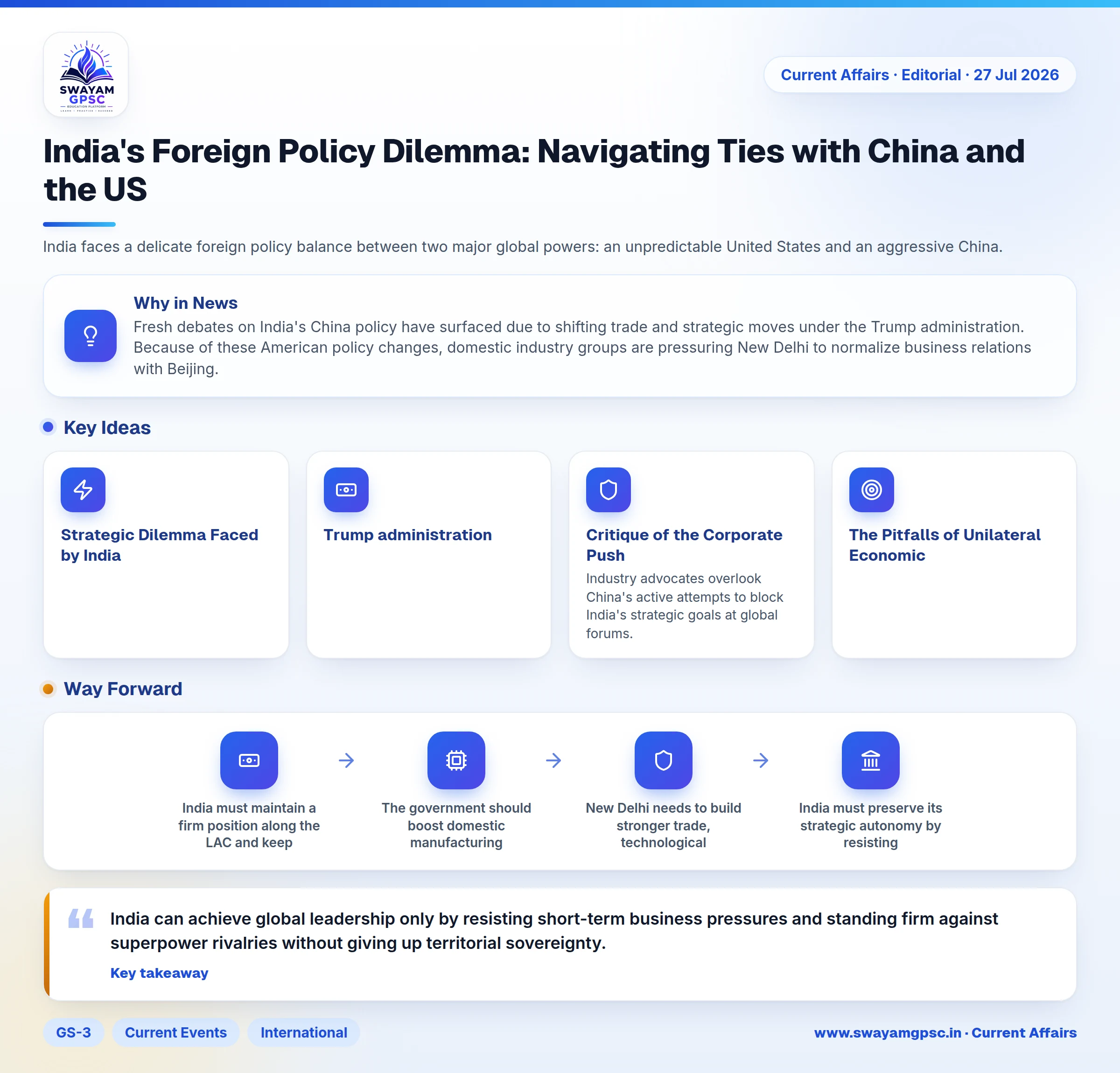
India's Foreign Policy Dilemma: Navigating Ties with China and the US
#GS-3 #Current Events #International #International Relations #Foreign Policy #India-China Relations #India-US Relations
Why in News
- Fresh debates on India's China policy have surfaced due to shifting trade and strategic moves under the **Trump administration**.
- Because of these American policy changes, domestic industry groups are pressuring New Delhi to normalize business relations with Beijing.
Strategic Dilemma Faced by India
- India faces a delicate foreign policy balance between two major global powers: an unpredictable United States and an aggressive China.
- Indian business lobbies are pushing for an economic reset with Beijing because domestic industries rely heavily on Chinese supply chains.
- At the same time, India must handle transactional decisions from Washington, including unexpected trade tariffs and tougher **H-1B visa** restrictions.
Background
- The **Trump administration** created trade friction by levying tariffs on Indian steel and aluminum, ending preferential trade status, restricting **H-1B visas**, and reconnecting with Pakistan.
- China has repeatedly threatened Indian sovereignty through border intrusions along the **Line of Actual Control (LAC)**, including standoffs in **Depsang (2013)**, **Chumar (2014)**, **Doklam (2017)**, and **Galwan (2020)**.
- India depends significantly on Chinese **Active Pharmaceutical Ingredients (APIs)**, heavy machinery, raw industrial materials, and rare earth elements, causing an annual trade deficit above **$100 billion**.
- During **Operation Sindoor** in **May 2025**, Beijing supplied real-time satellite data and tactical intelligence to Islamabad, demonstrating deep military support for Pakistan against India.
Critique of the Corporate Push for a China Reset
- Corporate lobbies focus heavily on short-term company profits by seeking cheap foreign capital, machinery, and pharmaceutical ingredients, while ignoring long-term national security risks.
- Business leaders advocate for economic normalization while ignoring twelve years of direct hostility from the **Chinese Communist Party (CCP)**.
- For instance, corporate voices disregard **People's Liberation Army (PLA)** land-grabbing tactics along the **LAC** and Beijing's official renaming of places in **Arunachal Pradesh**.
- A quick economic reset overlooks Beijing's record of suddenly stopping exports of essential materials during political disputes.
- For example, Beijing previously weaponized its global monopoly over rare earth minerals and specialized tunnel-boring machines.
- Industry advocates overlook China's active attempts to block India's strategic goals at global forums.
- For example, China used its **United Nations Security Council (UNSC)** veto to block sanctions against Pakistan-backed terrorists and stalled India's membership in the **Nuclear Suppliers Group (NSG)**.
The Pitfalls of Unilateral Economic Relaxation
- Allowing Chinese investment into India without settling border disputes increases Beijing's trade surplus, which directly funds its military presence along Indian borders.
- Creating deep industrial dependence gives Beijing an economic kill-switch to disrupt Indian factories during future military or political standoffs.
- Removing restrictions on Chinese smartphone apps, telecommunications gear, and foreign direct investment without gaining border concessions surrenders diplomatic leverage.
- Easing economic safeguards signals weakness to Beijing, allowing China to dictate terms on border discussions from an advantageous position.
The Illusion of Relying on the United States
- American foreign policy remains purely transactional because strategic priorities change quickly according to domestic political motives.
- For instance, Washington slapped tariffs on Indian metals and cut **H-1B visa** quotas despite ongoing diplomatic talks.
- Sudden strategic shifts in Washington create risks that America might reach side deals with adversary nations, leaving strategic partners exposed.
- For example, Washington renewed high-level diplomatic links with Islamabad despite clear security warnings from New Delhi.
- Even with diplomatic dialogues involving figures such as special envoy **Sergio Gor**, Washington will never deploy forces to defend India's land borders.
- For example, India continues to manage high-altitude border standoffs in **Eastern Ladakh** completely on its own.
- Recognizing America's transactional nature should not force India into China's economic sphere, as New Delhi must maintain a balanced and self-reliant foreign policy.
Way Forward
- India must maintain a firm position along the **LAC** and keep economic rules tight until China shows clear, verifiable diplomatic respect.
- The government should boost domestic manufacturing for essential components, **APIs**, and advanced technologies, accepting short-term cost increases to guarantee long-term national safety.
- New Delhi needs to build stronger trade, technological, and defense partnerships with trusted nations across Europe, East Asia, and the **Global South**.
- India must preserve its strategic autonomy by resisting pressure to join any single military alliance, ensuring complete freedom in foreign policy decisions.
Conclusion
- India can achieve global leadership only by resisting short-term business pressures and standing firm against superpower rivalries without giving up territorial sovereignty.
- By expanding domestic production and keeping diplomatic leverage, New Delhi will protect its national dignity and secure a strong place in a multipolar world.