India's First Telecom Manufacturing Zone Established in Gwalior
#GS-3 #Economy #Infrastructure #Science & Technology #ICT #Current Events #National #Telecom Sector
Key takeaways
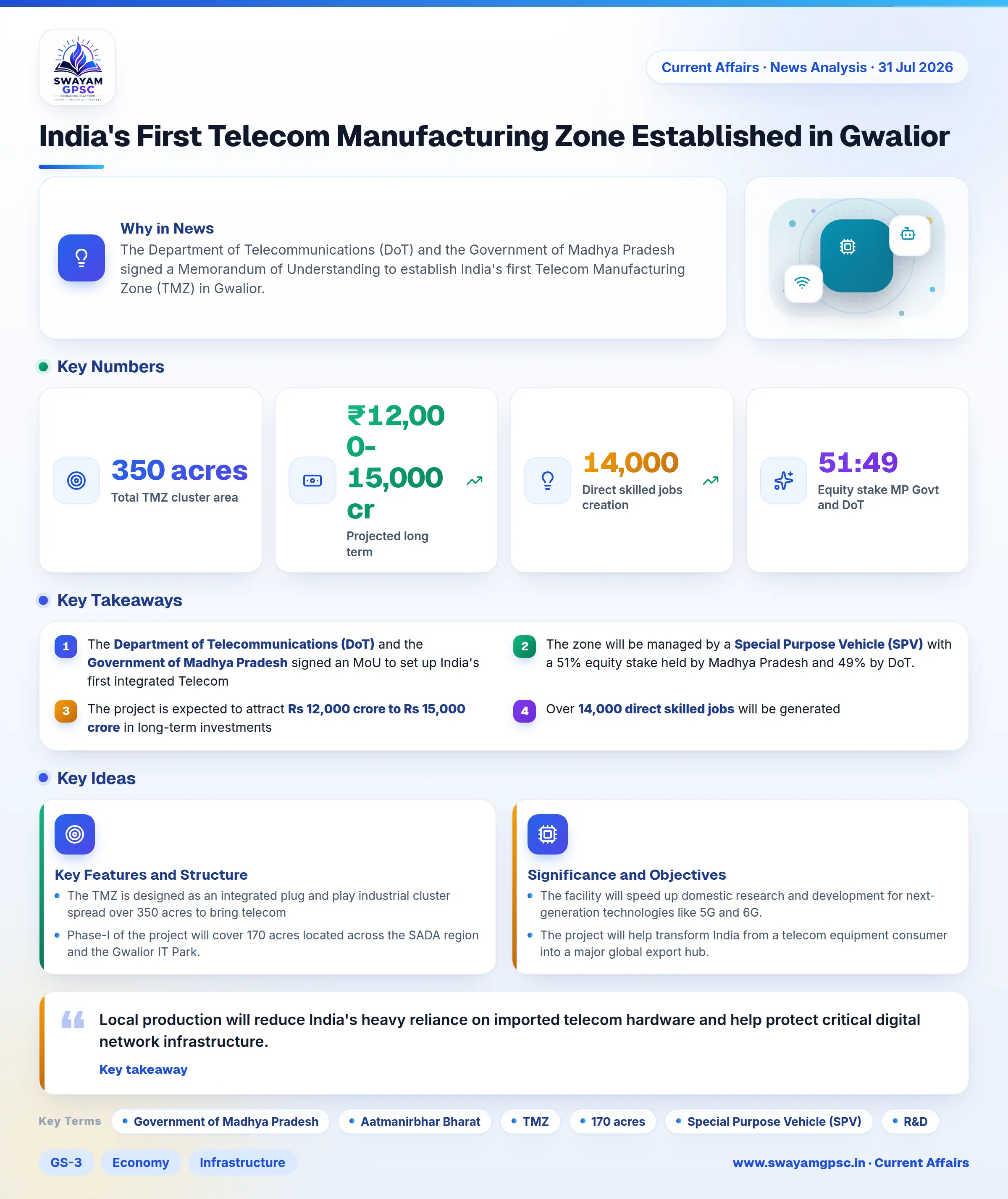
- The Department of Telecommunications (DoT) and the Government of Madhya Pradesh signed an MoU to set up India's first integrated Telecom Manufacturing Zone (TMZ) across 350 acres in Gwalior.
- The zone will be managed by a Special Purpose Vehicle (SPV) with a 51% equity stake held by Madhya Pradesh and 49% by DoT.
- The project is expected to attract Rs 12,000 crore to Rs 15,000 crore in long-term investments, with initial commitments of over Rs 3,500 crore from companies like Dixon Technologies, HFCL, and VVDN.
- Over 14,000 direct skilled jobs will be generated, boosting domestic manufacturing and reducing import dependence for 5G and 6G infrastructure.
Why in News
- The Department of Telecommunications (DoT) and the Government of Madhya Pradesh signed a Memorandum of Understanding to establish India's first Telecom Manufacturing Zone (TMZ) in Gwalior.
- This project aims to build a strong domestic production ecosystem for telecom hardware to support the national vision of Aatmanirbhar Bharat.
Key Features and Structure
- The TMZ is designed as an integrated plug and play industrial cluster spread over 350 acres to bring telecom manufacturing, electronics, research, testing, and intellectual property creation under one roof.
- Phase-I of the project will cover 170 acres located across the SADA region and the Gwalior IT Park.
- A dedicated Special Purpose Vehicle (SPV) will govern the project, where the Government of Madhya Pradesh holds a 51% equity stake and DoT holds 49%.
- The zone will feature shared 4G and 5G testing facilities, product certification laboratories, and specialized R&D design centers.
- Production will cover the entire telecom value chain, including mobile handsets, optical fiber cables, antennas, routers, satellite gear, and semiconductor chips.
- The project expects total long-term investments between Rs 12,000 crore and Rs 15,000 crore, with Rs 3,500 crore already committed by anchor firms like Dixon Technologies, HFCL, and VVDN.
- The industrial zone will create 14,000 direct skilled jobs, including over 3,500 jobs during the first phase alone.
- The zone will offer structured support to equipment manufacturers, technology companies, MSMEs, and start-ups.
Significance and Objectives
- Local production will reduce India's heavy reliance on imported telecom hardware and help protect critical digital network infrastructure.
- The facility will speed up domestic research and development for next-generation technologies like 5G and 6G.
- The project will help transform India from a telecom equipment consumer into a major global export hub.
- Setting up this cluster will strengthen regional industrial growth in Madhya Pradesh and make national supply chains more resilient.