India's Evolving Space Architecture and Global Rise
#GS-3 #Economy #Infrastructure #Science & Technology #Space #Current Events #National
Key takeaways
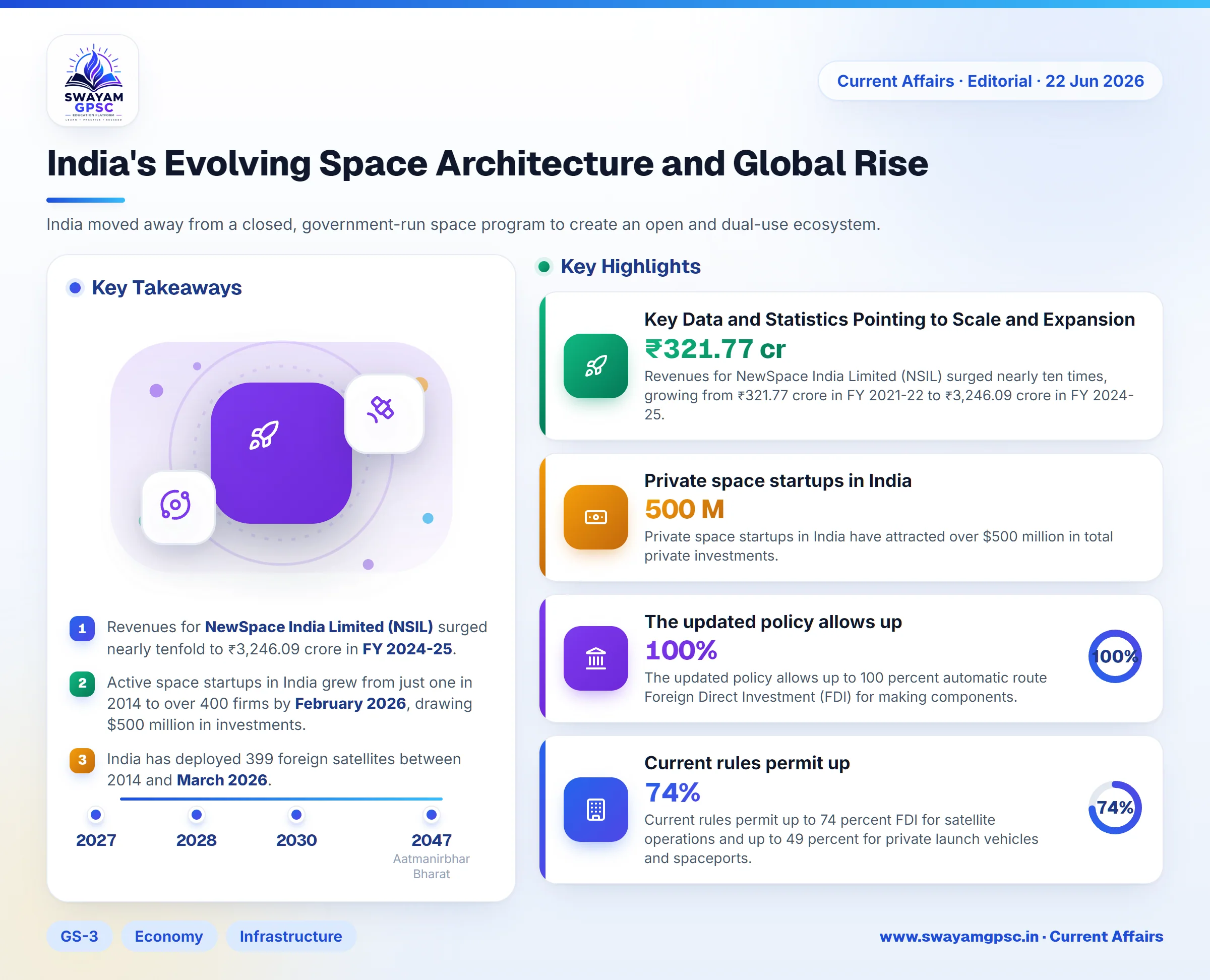
- Revenues for NewSpace India Limited (NSIL) surged nearly tenfold to ₹3,246.09 crore in FY 2024-25.
- Active space startups in India grew from just one in 2014 to over 400 firms by February 2026, drawing $500 million in investments.
- India has deployed 399 foreign satellites between 2014 and March 2026.
- The Bharatiya Antariksh Station (BAS) modular space station will launch its foundational module, BAS-01, by 2028.
Why in News
- The Press Information Bureau released a report highlighting India's transformation into a major global space power over the last twelve years.
- This progress is guided by Aatmanirbhar Bharat and the long-term vision of Viksit Bharat 2047.
- India now successfully balances deep-space exploration with private business growth and public welfare services.
About India's Evolving Space Architecture
- India moved away from a closed, government-run space program to create an open and dual-use ecosystem.
- The new approach uses space maps and satellite data to improve local governance, farming, disaster management, and telecommunications.
Key Data and Statistics Pointing to Scale and Expansion
- Revenues for NewSpace India Limited (NSIL) surged nearly ten times, growing from ₹321.77 crore in FY 2021-22 to ₹3,246.09 crore in FY 2024-25.
- The number of registered private space startups grew from just one in 2014 to more than 400 active firms by February 2026.
- Private space startups in India have attracted over $500 million in total private investments.
- India launched 399 foreign satellites between 2014 and March 2026, compared to only 35 foreign satellite launches before 2014.
- The updated policy allows up to 100 percent automatic route Foreign Direct Investment (FDI) for making components.
- Current rules permit up to 74 percent FDI for satellite operations and up to 49 percent for private launch vehicles and spaceports.
- India's solar observation mission, Aditya-L1, has processed and shared over 27 Terabytes (TB) of continuous solar data with the world.
Current Space Governance and Institutional Architecture
- The Indian National Space Promotion and Authorization Centre (IN-SPACe) acts as a single-window system to regulate private space activities and has transferred 71 technologies from ISRO to local industries.
- The Indian Space Policy 2023 ended the state monopoly and legally opened satellite manufacturing and launches to private companies.
- NewSpace India Limited (NSIL) functions as the commercial arm that builds rockets through public-private partnerships and sells satellite services.
- India uses its own regional navigation system, NavIC, backed by first and second-generation NVS satellites, to cover domestic regions and 1,500 kilometers beyond borders.
- The Norms, Guidelines, and Procedures (NGP 2024) framework sets clear rules for private players to boost investor confidence.
Upcoming and Future Space Programs
- The Gaganyaan mission will send up to three astronauts into a 400-kilometer orbit for up to three days using an Indian-made life-support system.
- The Union Cabinet approved the first module of the Bharatiya Antariksh Station (BAS), named BAS-01, for deployment by 2028.
- The Chandrayaan-4 mission is planned for 2027 to land on the moon, collect core samples, and launch back to Earth automatically.
- The Venus Orbiter Mission received government approval and targets a launch in March 2028 to study the atmosphere and geology of Venus.
- The LUPEX joint mission with Japan's JAXA is scheduled for 2027-28 to send a lander and rover near the lunar south pole.
- India is developing the Next Generation Launch Vehicle (NGLV) to carry up to 30 tons to Low Earth Orbit.
- The TRISHNA thermal imaging satellite is a joint 2026 climate mission with the French space agency CNES to track water stress in crops.
Challenges
- India's space economy is valued at $8 billion, representing only 2 to 3 percent of the global space market.
- Turning complex laboratory designs into large-scale commercial manufacturing lines requires stronger private industrial capabilities.
- Building zero-failure life support systems for human space travel and capsule re-entry remains a major technical test.
- Protecting robotic instruments from the extreme heat and atmospheric pressure of Venus requires advanced materials science.
- Funding multiple deep-space missions, human spaceflight, and new launchpads at the same time creates heavy pressure on the state budget.
Way Forward
- India must expand private manufacturing to capture an 8 percent share of the global space economy by 2030.
- The government needs to finish building the second spaceport at Kulasekarapattinam and the newly approved ₹3,984.86 crore third launch pad at Sriharikota.
- Partnering with Qualcomm will help embed NavIC chips into global smartphones to expand regional navigation use.
- Testing the winged Reusable Launch Vehicle (RLV-TD) will help lower the cost of sending payloads into orbit.
- Expanding regional programs like the South Asia Satellite (GSAT-9) will help share telemedicine and disaster alerts with neighboring countries.