India’s Evolving Low-Fertility Architecture
#GS-2 #Governance & Social Justice #Health #Poverty #Demographics #Economy
Key takeaways
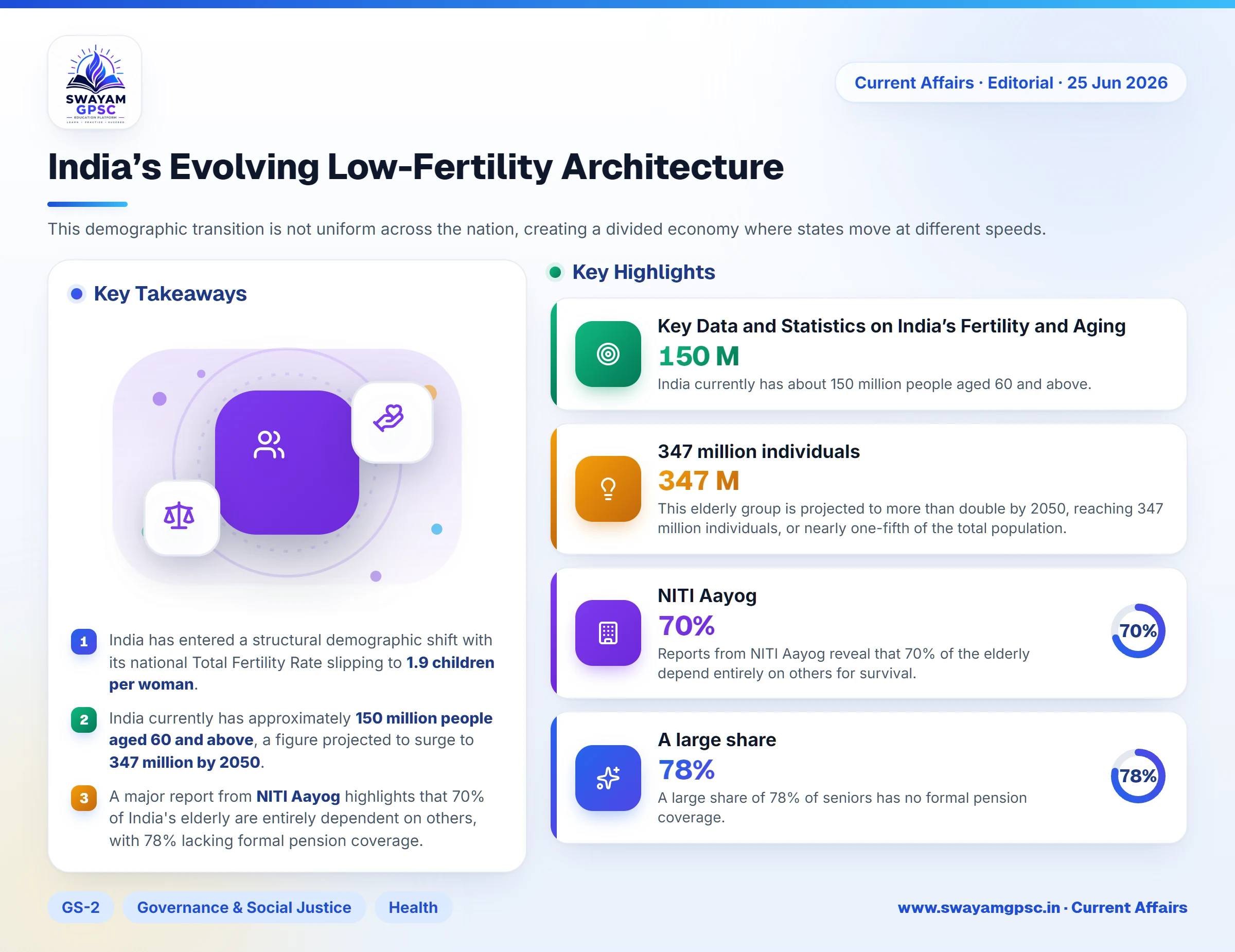
- India has entered a structural demographic shift with its national Total Fertility Rate slipping to 1.9 children per woman.
- India currently has approximately 150 million people aged 60 and above, a figure projected to surge to 347 million by 2050.
- A major report from NITI Aayog highlights that 70% of India's elderly are entirely dependent on others, with 78% lacking formal pension coverage.
- Urban fertility has dropped sharply to 1.5 children per woman, while states like Delhi have reached an ultra-low fertility rate of 1.2.
Why in News
- Recent data from the Sample Registration System (SRS) shows that India has entered a structural demographic shift.
- The national Total Fertility Rate has dropped to 1.9 children per woman.
About India’s Evolving Low-Fertility Architecture
- The drop in fertility marks a major shift for a country that previously focused on controlling population growth.
- This demographic transition is not uniform across the nation, creating a divided economy where states move at different speeds.
- Southern and eastern states are quickly becoming aging societies.
- Poorer northern regions continue to produce large youth groups that will enter the workforce over the next two decades.
Key Data and Statistics on India’s Fertility and Aging Trends
- Rural fertility stays close to the replacement level, but urban fertility has dropped sharply to 1.5 children per woman.
- Delhi has reached an ultra-low fertility rate of 1.2.
- Kerala, Tamil Nadu, and West Bengal sit at 1.3, which is lower than the United States at 1.6 and matches Japan at 1.3.
- Northern states keep high fertility rates, led by Bihar at 2.9.
- Uttar Pradesh follows at 2.6, Madhya Pradesh at 2.4, and Rajasthan at 2.3.
- India currently has about 150 million people aged 60 and above.
- This elderly group is projected to more than double by 2050, reaching 347 million individuals, or nearly one-fifth of the total population.
- Reports from NITI Aayog reveal that 70% of the elderly depend entirely on others for survival.
- A large share of 78% of seniors has no formal pension coverage.
Key Institutional and Fiscal Challenges
- Advanced economies aged only after they fully industrialized and built strong social safety nets.
- India is entering mass aging with a low per-capita income of around $2,800.
- The government struggles to fund senior welfare because net direct taxpayers make up only 6% of the total population.
- Most workers stay in informal jobs, leaving old-age income security outside formal employment contracts.
- Contribution-based programs fail informal workers because their incomes are highly unpredictable.
- The old-age pension under the National Social Assistance Programme (NSAP) offers a meager ₹200 a month for people aged 60 to 79.
- The pension rises to ₹500 for those above 80, which fails to protect seniors from poverty.
- Traditional joint families and unpaid female labor used to absorb eldercare costs inside the home.
- Urbanization and nuclear households are breaking down this family safety net, leaving parents vulnerable to loneliness and health crises.
- Aging populations will shift medical demand toward long-term management of chronic illnesses like hypertension, diabetes, dementia, physical disability, and palliative dependence.
Way Forward
- The government should introduce a basic, inflation-indexed minimum pension floor for the informal workforce.
- Creating a national labor market allows migrant workers to carry health and nutrition benefits across state borders.
- Targeted public healthcare programs must embed specialized geriatric care into district health planning and primary health networks.
- Younger states like Bihar and Uttar Pradesh must invest heavily in education and skills so migrating youth avoid low-wage informal jobs.
- The state must expand formal public assistance programs to handle responsibilities that households can no longer manage alone.