India's Emerging Space Technologies: Capabilities, Missions, and Strategic Growth
#GS-3 #Science & Technology #Space #Indigenization of Technology #Infrastructure #Achievements of Indians in Science & Technology
Key takeaways
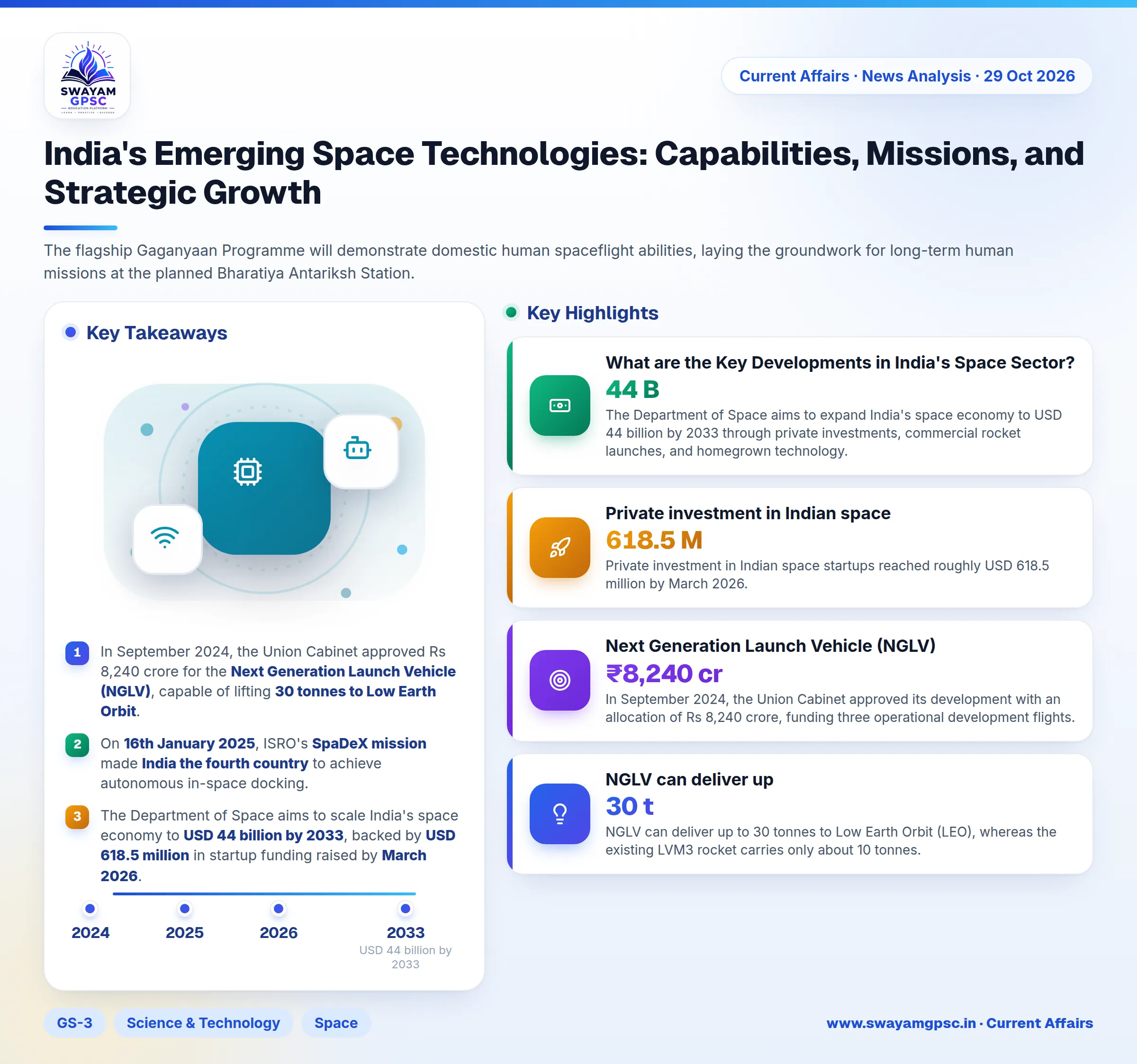
- In September 2024, the Union Cabinet approved Rs 8,240 crore for the Next Generation Launch Vehicle (NGLV), capable of lifting 30 tonnes to Low Earth Orbit.
- On 16th January 2025, ISRO's SpaDeX mission made India the fourth country to achieve autonomous in-space docking.
- The Department of Space aims to scale India's space economy to USD 44 billion by 2033, backed by USD 618.5 million in startup funding raised by March 2026.
- ISRO successfully tested a 300-millinewton stationary plasma thruster for 1,000 hours in March 2025 to advance electric propulsion capabilities.
- The joint NISAR mission, launched on 30 July 2025 using L-band and S-band radars, provides all-weather Earth imaging on a 12-day cycle.
Why in News
- The Indian Space Research Organisation (ISRO) is rapidly developing next-generation launch vehicles, reusable rockets, indigenous propulsion systems, and in-space docking technologies to expand India's overall space capabilities.
- These technical advancements aim to directly support upcoming landmark missions like Gaganyaan and the construction of the Bharatiya Antariksh Station (BAS).
What are the Key Developments in India's Space Sector?
- India's organized space journey started when INCOSPAR was established in 1962, followed by its first sounding rocket launch from Thumba, Kerala, in 1963, and the founding of ISRO in 1969.
- To minimize dependence on foreign tech, India is building indigenous solutions in reusable launch vehicles, advanced propulsion, space docking, satellite navigation, and Earth observation.
- The flagship Gaganyaan Programme will demonstrate domestic human spaceflight abilities, laying the groundwork for long-term human missions at the planned Bharatiya Antariksh Station.
- Active participation from private companies and space startups is boosting local manufacturing, tech development, and commercial space applications.
- The Department of Space aims to expand India's space economy to USD 44 billion by 2033 through private investments, commercial rocket launches, and homegrown technology.
- Commercial arm NewSpace India Limited (NSIL) has signed 118 Technology Transfer Agreements across 83 ISRO technologies to build industrial expertise.
- Private investment in Indian space startups reached roughly USD 618.5 million by March 2026.
- Government frameworks like the Indian Space Policy, 2023 and regulatory body IN-SPACe now allow private entities to build satellites, offer launch services, and run commercial space businesses.
Next Generation Launch Vehicle (NGLV)
- The Next Generation Launch Vehicle (NGLV) is a heavy-lift, partially reusable rocket being developed by ISRO for affordable and heavy space transportation.
- In September 2024, the Union Cabinet approved its development with an allocation of Rs 8,240 crore, funding three operational development flights.
- NGLV can deliver up to 30 tonnes to Low Earth Orbit (LEO), whereas the existing LVM3 rocket carries only about 10 tonnes.
- A partially reusable version of NGLV will carry a 14-tonne LEO payload capacity to lower launch costs.
- NGLV will carry missions for the Bharatiya Antariksh Station, human spaceflights, lunar initiatives, interplanetary trips, and mega satellite constellations.
India's Traditional Launch Vehicles
- The Polar Satellite Launch Vehicle (PSLV) serves as ISRO's reliable workhorse, placing up to 1,750 kg into a 600-km Sun-Synchronous Polar Orbit (SSPO) and 1,425 kg into Sub-Geosynchronous Transfer Orbit (Sub-GTO).
- The Geosynchronous Satellite Launch Vehicle (GSLV) uses an indigenous Cryogenic Upper Stage to launch 2-tonne class communication satellites into higher orbits.
- The Launch Vehicle Mark-3 (LVM3) is India's premier heavy-lifter, capable of sending 4-tonne class satellites to GTO and 10-tonne class payloads to LEO.
- The Small Satellite Launch Vehicle (SSLV) is a three-stage, 120-tonne rocket designed to put small satellites weighing up to 500 kg into a 500-km planar orbit quickly.
Key Space Terms Defined
- A Sun-Synchronous Orbit (SSO) is a polar orbit where a satellite flies over a specific ground point at the same local solar time, ensuring uniform sunlight for imaging.
- A Geostationary Transfer Orbit (GTO) is an elliptical route used to reach final geostationary orbit; its high point reaches nearly 35,786 km, where onboard motors circularize the satellite's path.
- A Cryogenic Upper Stage uses liquid hydrogen (LH2) as fuel and liquid oxygen (LOX) as oxidizer to achieve ultra-high thrust efficiency for lifting heavy payloads.
- ISRO successfully developed its own cryogenic stage to replace Russian imports, strengthening national self-reliance in rocketry.
Reusable Launch Vehicle (RLV) Technology
- Reusable launch vehicles bring back major rocket components to Earth safely, drastically reducing launch expenses and turnaround times.
- ISRO successfully executed three Reusable Launch Vehicle Landing Experiments (RLV-LEX) during 2023 and 2024 using its Pushpak RLV Demonstrator.
- The LEX-03 test in June 2024 proved autonomous landing on an airfield despite severe wind crosswinds and off-center flight paths.
- These trials build internal expertise in autonomous flight guidance, atmospheric re-entry control, and precise runway landings.
Scramjet and Air-Breathing Propulsion
- A Supersonic Combustion Ramjet (Scramjet) scoops oxygen directly from atmospheric air during flight, saving vehicle weight by eliminating onboard liquid oxidizers.
- Scramjet engines function at hypersonic speeds above Mach 5, maintaining stable fuel combustion inside supersonic airflows.
- ISRO conducted a successful flight test of a scramjet engine in August 2016 at Mach 6, demonstrating stable hypersonic combustion.
- In July 2024, ISRO launched an RH-560 sounding rocket to test advanced air-breathing propulsion systems under real flight conditions.
- Air-breathing systems significantly lighten rocket mass and make future long-distance space transports far more economical.
Electric and Green Propulsion Technologies
- Electric propulsion accelerates propellants using electric power, consuming far less fuel for long-term satellite positioning and orbit shifts.
- In March 2025, ISRO finished a 1,000-hour life test of an indigenous 300-millinewton stationary plasma thruster.
- This plasma technology delivers six times higher efficiency than chemical engines and will undergo flight trials on satellite TDS-01.
- Green propulsion focuses on non-toxic, eco-friendly chemical fuels to replace hazardous classic propellants like hydrazine.
- ISRO is developing ISROSENE, an indigenous rocket-grade kerosene designed to run next-generation LOX-kerosene semicryogenic rocket engines.
- Private firm Bellatrix Aerospace built a 1-newton class green monopropellant thruster under DRDO's Technology Development Fund, proving in-orbit operation in January 2024.
Radioisotope Heating and Power Technologies
- Radioisotope Heater Units (RHUs) harness decay heat from radioactive elements to keep delicate spacecraft parts warm in deep space cold.
- Radioisotope Thermoelectric Generators (RTGs) convert decay heat into steady electricity, powering probes on long missions where sunlight is weak.
- ISRO and the Department of Atomic Energy (DAE) are jointly building indigenous RHUs and RTGs for future missions to the Moon and Mars.
Space Docking and In-Orbit Servicing
- ISRO's Space Docking Experiment (SpaDeX) successfully demonstrated spacecraft rendezvous, docking, and separation mechanisms in orbit.
- The first successful docking occurred on 16th January 2025, making India the fourth nation to achieve space docking after the US, Russia, and China.
- ISRO executed an undocking in March 2025, followed by a second autonomous docking and power transfer in April 2025.
- In-orbit servicing abilities allow operators to refuel, repair, upgrade, and maintain satellites, significantly extending their operational lives.
- Autonomous docking is vital for returning lunar samples, combining multi-rocket payloads, and assembling the Bharatiya Antariksh Station.
Indigenous Satellite Navigation and Communication
- The Navigation with Indian Constellation (NavIC) offers precise positioning and timing coverage across India and up to 1,500 km beyond its borders.
- NavIC delivers an open Standard Positioning Service (SPS) for everyday citizens and an encrypted Restricted Service (RS) for defense forces.
- ISRO launched GSAT-24 in 2022 to expand Direct-to-Home (DTH) satellite TV operations across India.
- Launched in 2024, GSAT-N2 (GSAT-20) provides 48 Gbps capacity to boost broadband internet access and in-flight Wi-Fi services.
- The dedicated satellite CMS-03 (GSAT-7R), scheduled for 2025, will strengthen secure naval communications and national maritime security.
Advanced Earth Observation Technologies
- The NISAR mission (NASA-ISRO Synthetic Aperture Radar), launched on 30 July 2025, combines NASA's L-band and ISRO's S-band radar frequencies.
- NISAR captures high-resolution Earth images day and night in all weather, tracking glacier movements, ground sinking, crop health, and natural disasters.
- The satellite maps Earth's global land mass and ice surfaces completely every 12 days.
- Launched in November 2018, the Hyperspectral Imaging Satellite (HysIS) analyzes light reflection across many narrow spectral bands.
- HysIS monitors crop health, forest cover, mineral deposits, soil characteristics, and water resources by detecting unique material light signatures.
Conclusion
- India's space strategy is rapidly transforming into a self-reliant, commercial, and high-technology enterprise.
- Continued R&D funding, private sector growth, and deep industry-academic partnerships will help convert space breakthroughs into massive economic growth.
- These technical advancements secure India's strategic autonomy, elevate its scientific standing, and solidify its role in the international space economy.