India's Emergence as a Leading Global Tourism Hub
#GS-1 #Culture #Art & Architecture #Heritage #GS-2 #Government Policies & Interventions #GS-3 #Economy #Infrastructure #Current Events #National
Key takeaways
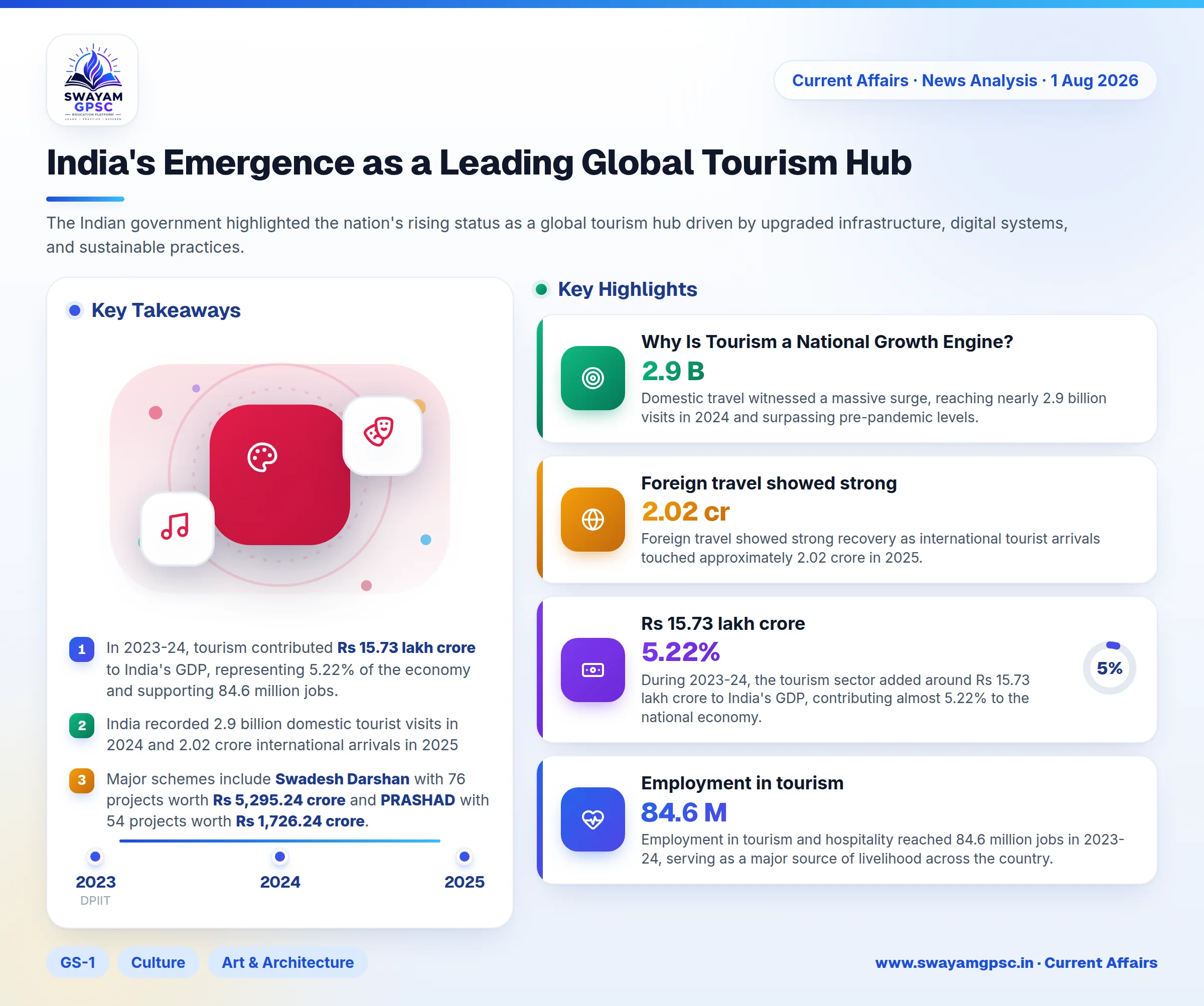
- In 2023-24, tourism contributed Rs 15.73 lakh crore to India's GDP, representing 5.22% of the economy and supporting 84.6 million jobs.
- India recorded 2.9 billion domestic tourist visits in 2024 and 2.02 crore international arrivals in 2025, generating USD 31.7 billion in foreign earnings.
- Major schemes include Swadesh Darshan with 76 projects worth Rs 5,295.24 crore and PRASHAD with 54 projects worth Rs 1,726.24 crore.
- The e-Tourist Visa facility now covers citizens of 175 countries across 33 airports, 19 seaports, and 4 land ports.
Why in News
- The Indian government highlighted the nation's rising status as a global tourism hub driven by upgraded infrastructure, digital systems, and sustainable practices.
Why Is Tourism a National Growth Engine?
- Tourism drives India's overall economic expansion by empowering local businesses across hospitality, transport, food services, and traditional handicrafts.
- Domestic travel witnessed a massive surge, reaching nearly 2.9 billion visits in 2024 and surpassing pre-pandemic levels.
- Foreign travel showed strong recovery as international tourist arrivals touched approximately 2.02 crore in 2025.
- During 2023-24, the tourism sector added around Rs 15.73 lakh crore to India's GDP, contributing almost 5.22% to the national economy.
- Employment in tourism and hospitality reached 84.6 million jobs in 2023-24, serving as a major source of livelihood across the country.
- Foreign exchange earnings from international tourism reached nearly USD 31.7 billion in 2025.
- Tourism fosters balanced regional growth by creating sustainable income opportunities for local communities in remote and less-developed regions.
- Rich cultural traditions, diverse landscapes, and spiritual heritage give India a strong foundation to become a global leader in travel.
What Factors Give India a Tourism Advantage?
- India offers diverse experiences within one nation, ranging from ancient historical sites and mountain ranges to vibrant festivals and local cuisines.
- The country boasts 45 UNESCO World Heritage Sites, highlighting its exceptional natural and historical assets to international travelers.
- Environmental travel flourishes across 106 National Parks, 18 Biosphere Reserves, protected forests, and scenic coastlines.
- Cultural attractions include famous monuments, historic museums, traditional performing arts, and time-honored wellness systems like Yoga and Ayurveda.
Major Tourism Segments
- As the birthplace of Hinduism, Buddhism, Jainism, and Sikhism, India attracts pilgrims to holy destinations like Kashi, Ayodhya, Bodh Gaya, Amritsar, Tirupati, and Puri.
- Upgraded transport links and better visitor amenities are helping transform sacred pilgrimage sites into modern spiritual hubs.
- Key Buddhist sites such as Bodhgaya, Sarnath, and Kushinagara strengthen historical and cultural ties with Asian nations.
- Historical tourism thrives around ancient forts, royal palaces, and historic cities, complemented by classical art forms and local food.
- Global visitors seek holistic health services through traditional medicine systems including Yoga, Ayurveda, and naturopathy.
- Top-quality medical facilities offering affordable treatments have made India a preferred international destination for medical travel.
- Wildlife reserves, tiger sanctuaries, and coastal ecosystems support outdoor activities like safaris and trekking while encouraging nature conservation.
- Rural tourism connects travelers with authentic village life through local homestays, traditional crafts, and organic farming experiences.
- Modern convention centers enable India to host international business events, expanding tourism under the MICE segment.
- Expanding business tourism generates steady income throughout the year rather than relying only on holiday seasons.
- A long coastline exceeding 7,500 km supports diverse activities including cruise travel, river rafting, water sports, and desert safaris.
- Offering varied travel choices encourages international visitors to extend their stay across multiple destinations.
How Is Infrastructure-Led Development Transforming Tourism Destinations?
- Under the Swadesh Darshan scheme, the government approved 76 projects costing over Rs 5,295.24 crore across 14 thematic circuits, completing 75 of them.
- The upgraded Swadesh Darshan 2.0 initiative focuses on sustainable destination planning with 53 projects worth Rs 2,207.08 crore.
- The PRASHAD scheme approved 54 projects worth over Rs 1,726.24 crore to enhance infrastructure at major pilgrimage centers.
- Through special capital support, 40 projects across 23 states worth Rs 3,295.76 crore were approved to build world-class tourist spots.
- The Challenge-Based Destination Development program sanctioned 37 projects worth Rs 687.99 crore to boost high-potential spiritual and eco-tourism sites.
- Expanded highways, modernized railway stations, Vande Bharat trains, and regional airports under UDAN significantly reduce travel time.
- The Viksit UDAN program with a budget over Rs 28,840 crore aims to build more than 100 new aerodromes and 200 helipads in smaller towns.
How Is India Improving Ease of Travel and Digital Tourism?
- International travel has become much simpler following the rollout of the convenient e-Tourist Visa system.
- Citizens from 175 countries can now access the e-Tourist Visa, entering through 33 airports, 19 seaports, and 4 land ports.
- Expanding digital entry permits simplifies border entry procedures for travelers coming from key international markets.
- The NIDHI+ portal offers a unified digital registration system for hospitality businesses and tourism service providers.
- Online applications and transparent processing on NIDHI+ improve administrative efficiency and ease of doing business.
- As of April 2023, India had 1,497 DPIIT-recognized tourism startups across 262 districts, creating nearly 13,919 jobs.
- About 58% of these startups operate in Tier-II and Tier-III cities, spreading technological innovation beyond major metro areas.
- Startups create modern solutions for online booking, smart mobility, rural homestays, and AI-driven travel planning.
- Key platforms include Highway Delite for highway amenities, VilloTale for rural homestays, and udChalo for defense personnel travel.
How Can Sustainable and Inclusive Tourism Support Long-Term Growth?
- India is advancing a sustainable tourism model that balances environmental care with community benefits and high-quality experiences.
- The Travel for LiFE campaign encourages tourists and business operators to practice resource conservation and responsible travel habits.
- Promoting outdoor activities like birdwatching and nature trails helps divert crowd pressure from overvisited destinations.
- Responsible travel generates steady income for local guides, artisans, and small homestay owners in rural communities.
- Sustainable destination management protects local cultural heritage, wildlife habitats, and natural ecosystems.
- Tourism contributes to global goals including SDG 8.9 for local jobs, SDG 12.B for impact monitoring, and SDG 14.7 for coastal preservation.
Way Forward
- India's tourism industry is shifting toward a globally competitive, inclusive, and environmentally sustainable model.
- Combining rich heritage, natural diversity, and modern infrastructure prepares India to become a leading global destination.
- Future growth depends on balancing higher tourist arrivals with community participation, heritage protection, and environmental care.