India Electric Mobility Index 2025
#GS-3 #Economy #Infrastructure #Environment #Climate Change #Sustainable Development #GS-2 #Current Events #National #Government Policies
Key takeaways
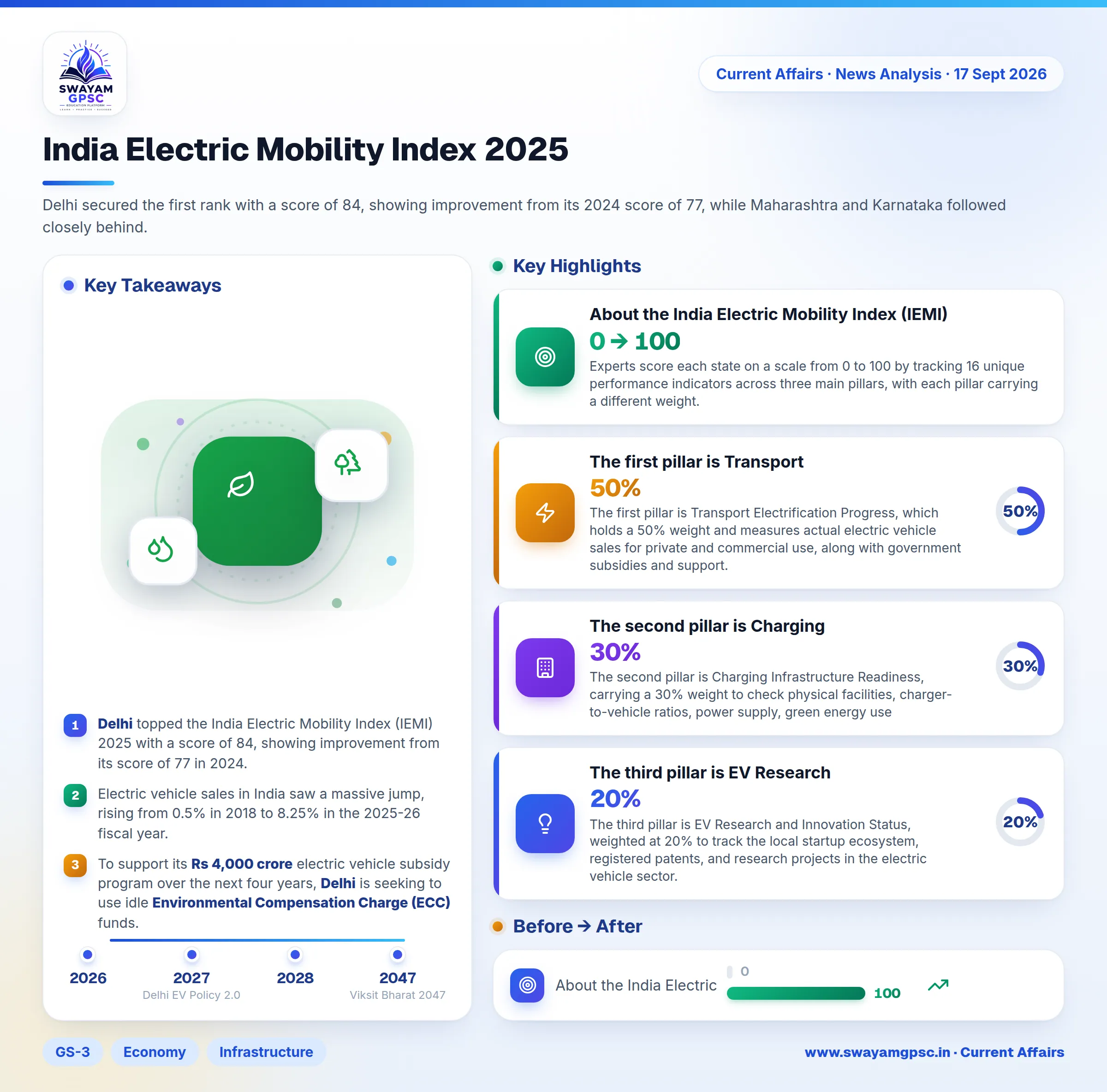
- Delhi topped the India Electric Mobility Index (IEMI) 2025 with a score of 84, showing improvement from its score of 77 in 2024.
- Electric vehicle sales in India saw a massive jump, rising from 0.5% in 2018 to 8.25% in the 2025-26 fiscal year.
- To support its Rs 4,000 crore electric vehicle subsidy program over the next four years, Delhi is seeking to use idle Environmental Compensation Charge (ECC) funds.
- Road transport accounts for 12% of India's energy-related carbon dioxide emissions, while the automotive sector contributes 7.1% to the national GDP.
Why in News
- NITI Aayog recently launched the second edition of the India Electric Mobility Index (IEMI) 2025.
- This report names Delhi as the leading State or Union Territory in adopting electric vehicles across the country.
About the India Electric Mobility Index (IEMI)
- NITI Aayog created the IEMI alongside the World Resources Institute India to measure how well different states plan policies, build infrastructure, and put electric vehicle plans into action.
- The index offers a clear ranking system to help promote both cooperative and competitive federalism as states work together and compete to improve clean transport.
- Experts score each state on a scale from 0 to 100 by tracking 16 unique performance indicators across three main pillars, with each pillar carrying a different weight.
- The first pillar is Transport Electrification Progress, which holds a 50% weight and measures actual electric vehicle sales for private and commercial use, along with government subsidies and support.
- The second pillar is Charging Infrastructure Readiness, carrying a 30% weight to check physical facilities, charger-to-vehicle ratios, power supply, green energy use, and funding for charging networks.
- The third pillar is EV Research and Innovation Status, weighted at 20% to track the local startup ecosystem, registered patents, and research projects in the electric vehicle sector.
- The index groups states into four categories based on scores: Top Performers scoring 65 or more, Frontrunners scoring 50 to 64, Emerging Performers scoring 35 to 49, and Aspirants scoring under 35.
- Delhi secured the first rank with a score of 84, showing improvement from its 2024 score of 77, while Maharashtra and Karnataka followed closely behind.
- Among hilly and northeastern states, Manipur took the lead with a score of 46, followed by Tripura and Assam.
- Delhi led in both electrification progress and research, while Karnataka scored highest in charging readiness, followed by Maharashtra and Haryana.
- Madhya Pradesh improved the most in this edition, jumping 16 spots from 23rd place to 7th place overall.
- Electric vehicle sales rose sharply from just 0.5% in 2018 to 8.25% in 2025-26, driven by central programs like the FAME scheme, PM E-DRIVE, and the PLI scheme.
- The report shows strong policy support across the country, as 29 out of 36 States and Union Territories have released their own dedicated electric vehicle policies.
- This index helps local governments move from making policies to executing them successfully, which is crucial to achieving the Viksit Bharat 2047 goal and cutting India's 89% dependence on imported crude oil.
- Road transport causes 12% of India's energy-related carbon dioxide emissions, making clean energy vehicles vital, while the automotive industry supports the economy by contributing 7.1% to the national GDP and employing 19 million people.
Delhi’s EV Ecosystem
- Under the Delhi EV Policy 2.0, Delhi has set bold targets and is the first region to mandate complete electrification of auto-rickshaws and light commercial vehicles by January 2027, and two-wheelers by January 2028.
- By early 2026, Delhi ran the largest fleet of electric buses in India and offered direct subsidies for electric bicycles.
- To fund its Rs 4,000 crore subsidy scheme over four years, Delhi is asking the Supreme Court to let it use idle Environmental Compensation Charge (ECC) funds.
Challenges
- Transitioning to electric vehicles in India faces several hurdles, including a lack of charging stations, high initial costs for buyers, dependence on imported battery materials, weak power grids, and unequal progress across different states.
Way Forward
- States must move from merely writing policies to actively building infrastructure and using innovative funding sources, like Delhi's approach to environmental funds, to support long-term subsidy schemes.
- India needs to boost local research and development to lower its dependence on imported battery minerals, and strengthening regional innovation ecosystems will help build cheaper, homegrown electric vehicle technologies.