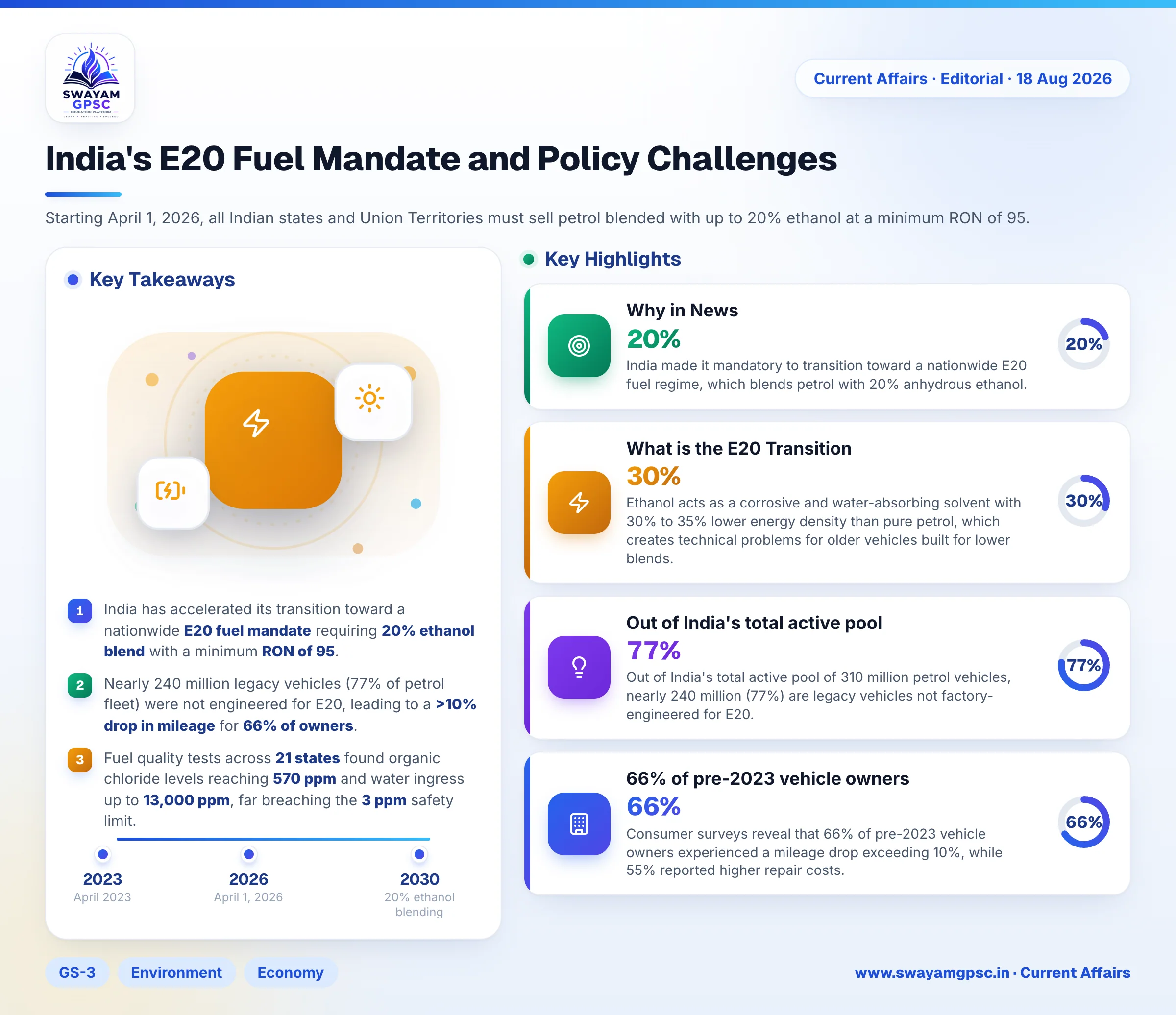
India's E20 Fuel Mandate and Policy Challenges
#GS-3 #Environment #Economy #Science & Technology #Energy #Biofuels #E20 Fuel Mandate
Key takeaways
- India has accelerated its transition toward a nationwide E20 fuel mandate requiring 20% ethanol blend with a minimum RON of 95.
- Nearly 240 million legacy vehicles (77% of petrol fleet) were not engineered for E20, leading to a >10% drop in mileage for 66% of owners.
- Fuel quality tests across 21 states found organic chloride levels reaching 570 ppm and water ingress up to 13,000 ppm, far breaching the 3 ppm safety limit.
- Key policy recommendations include reintroducing E0 or E10 fuel pumps, introducing certified aftermarket retrofit kits, and enforcing strict quality audits.
Why in News
- India made it mandatory to transition toward a nationwide E20 fuel regime, which blends petrol with 20% anhydrous ethanol.
- The new mandatory fuel policy requires a minimum Research Octane Number (RON) of 95, sparking public and auto industry debate.
What is the E20 Transition
- The E20 transition is a flagship green energy initiative under the Ethanol Blended Petrol (EBP) Programme designed to replace 20% of fossil petrol with domestically produced ethanol.
- Ethanol acts as a corrosive and water-absorbing solvent with 30% to 35% lower energy density than pure petrol, which creates technical problems for older vehicles built for lower blends.
Key Statistics
- Out of India's total active pool of 310 million petrol vehicles, nearly 240 million (77%) are legacy vehicles not factory-engineered for E20.
- Consumer surveys reveal that 66% of pre-2023 vehicle owners experienced a mileage drop exceeding 10%, while 55% reported higher repair costs.
- Fuel tests across 21 states showed organic chloride levels between 6 to 570 ppm in Rajasthan and up to 420 ppm in Delhi, breaching the safe ceiling of 3 ppm.
- Water seepage in fuel station tanks reached 12,500 ppm in Uttar Pradesh and 13,000 ppm in Andhra Pradesh, causing fuel separation and engine corrosion.
Current Status of E20 Implementation
- Starting April 1, 2026, all Indian states and Union Territories must sell petrol blended with up to 20% ethanol at a minimum RON of 95.
- Oil marketing companies have completely phased out pure unblended petrol (E0), leaving drivers without lower-blend alternatives.
- Only vehicles made after April 2023 follow BS 6 Phase 2 Real Driving Emissions (RDE) standards with fluorinated rubber (FKM/Viton) parts and ethanol-calibrated engines.
- The Ministry of Petroleum and Natural Gas informed Parliament that no formal government assessment has quantified how many Indian vehicles are E20-compatible.
- Laboratory studies from IIT Kanpur report minimal efficiency losses below 5%, whereas independent real-world logs and car makers report accelerated parts wear.
Initiatives Taken So Far
- The government established a minimum fuel quality floor of Research Octane Number (RON) 95 for E20 fuel to reduce engine knocking.
- India reached its nationwide 20% ethanol blending timeline ahead of its original 2030 target by expanding grain and sugarcane distillery capacity.
- The Society of Indian Automobile Manufacturers (SIAM) launched an official study to evaluate long-term material safety across legacy vehicles.
Challenges
- Ethanol readily absorbs atmospheric moisture, and once water content passes 0.5%, the ethanol-water mixture separates at the bottom of fuel tanks and causes engine stalling.
- Standard Nitrile Rubber (NBR) hoses and pump diaphragms in older vehicles experience chemical swelling and fuel leaks when exposed to 20% ethanol.
- Ethanol strips away old rust scale from aging fuel tanks, creating floating sludge that clogs fuel filters and damages high-pressure fuel injectors.
- Rainwater leaking into dealer underground storage tanks (UST) ruins entire batches of fuel, pumping corrosive water-alcohol mixtures directly into customer vehicles.
- Forcing 240 million legacy vehicle owners to pay higher maintenance costs without offering cheaper unblended fuel violates consumer protection principles.
Way Forward
- Oil marketing companies should bring back separate fuel pumps dispensing lower blends like E0 or E10 to protect legacy vehicles from damage.
- Authorities must enforce clear, visible labels on all fuel dispensers showing the exact ethanol blend percentage and RON rating.
- The government should encourage component makers to produce certified aftermarket retrofit kits like ethanol-resistant FKM hoses and inline water filters.
- Strict quality control must monitor moisture and chloride levels in real time, keeping organic chlorides strictly below 3 ppm across all refineries and fuel pumps.
- India should run long-term field trials across different weather conditions to track real vehicle wear and refine policy, learning from Brazil's biofuel model.
Conclusion
- India's rapid move to E20 fuel is a major milestone for energy security, lower crude imports, and lower carbon emissions.
- However, rolling out a single fuel blend without options puts an unfair repair burden on over 240 million legacy vehicle owners.
- Balancing national biofuel goals with consumer safety through clear labeling, dual-fuel options, and strict quality checks is essential to maintain public trust.