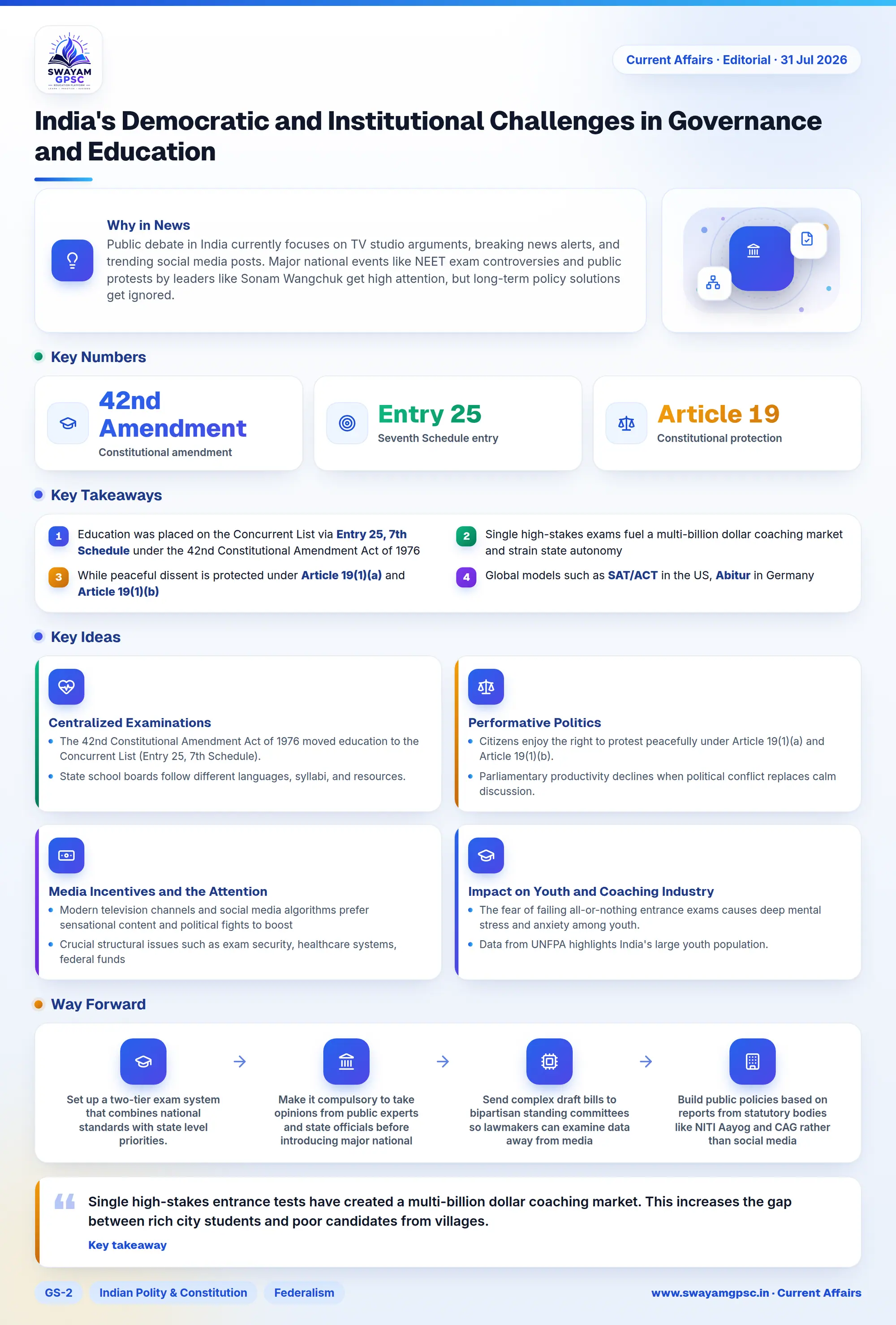
India's Democratic and Institutional Challenges in Governance and Education
#GS-2 #Indian Polity & Constitution #Federalism #Governance & Social Justice #Good Governance #Education #Current Events #National
Key takeaways
- Education was placed on the Concurrent List via Entry 25, 7th Schedule under the 42nd Constitutional Amendment Act of 1976, making central tests like NEET a matter of federal discussion.
- Single high-stakes exams fuel a multi-billion dollar coaching market and strain state autonomy, going against recommendations of the Sarkaria Commission and Punchhi Commission.
- While peaceful dissent is protected under Article 19(1)(a) and Article 19(1)(b), PRS Legislative Research highlights a drop in parliamentary scrutiny through Departmentally Related Standing Committees (DRSCs).
- Global models such as SAT/ACT in the US, Abitur in Germany, and UCAS in the UK offer lessons on balancing national standardization with regional fairness.
- Policy formulation must rely on data from bodies like NITI Aayog and CAG to channel youth potential recorded in UNFPA reports into national growth.
Why in News
- Public debate in India currently focuses on TV studio arguments, breaking news alerts, and trending social media posts.
- Major national events like NEET exam controversies and public protests by leaders like Sonam Wangchuk get high attention, but long-term policy solutions get ignored.
Centralized Examinations and Educational Federalism
- The 42nd Constitutional Amendment Act of 1976 moved education to the Concurrent List (Entry 25, 7th Schedule). Because of this, holding a single central exam limits the power of states to run their own colleges and health systems.
- State school boards follow different languages, syllabi, and resources. Conducting nationwide exams based on one syllabus disadvantages rural students from state boards.
- The Sarkaria Commission and Punchhi Commission recommended cooperative federalism. A hybrid exam framework allows central universities to use national tests while letting states control admissions for state-funded colleges.
- Conducting a single national examination creates a massive operational vulnerability. Any leak of question papers ruins the credibility of the whole exam system and reduces public trust.
Performative Politics and Institutional Scrutiny
- Citizens enjoy the right to protest peacefully under Article 19(1)(a) and Article 19(1)(b). However, recent protests focus more on capturing headlines than suggesting real law changes.
- Parliamentary productivity declines when political conflict replaces calm discussion. Data from PRS Legislative Research shows that lawmakers rely less on Departmentally Related Standing Committees (DRSCs) to study government proposals.
- Opposition parties can build public trust by presenting well-researched policy proposals and detailed amendments instead of relying only on news optics.
Media Incentives and the Attention Economy
- Modern television channels and social media algorithms prefer sensational content and political fights to boost ratings and user engagement.
- Crucial structural issues such as exam security, healthcare systems, federal funds, and climate resilience get little media space during political rivalries.
- News organizations must follow news ethics by sharing expert analysis, verifiable facts, and realistic policy choices with citizens.
Impact on Youth and Coaching Industry
- Single high-stakes entrance tests have created a multi-billion dollar coaching market. This increases the gap between rich city students and poor candidates from villages.
- The fear of failing all-or-nothing entrance exams causes deep mental stress and anxiety among youth. India needs diverse career paths to reduce this pressure.
- Data from UNFPA highlights India's large youth population. If national exam systems lose transparency, youth enthusiasm will turn into social frustration.
International Best Practices
- Federal systems in the US use tests like SAT/ACT along with local university criteria, while Germany leaves the Abitur exam to individual federal states.
- Universities in the UK use UCAS to review overall school records and student interviews, avoiding total dependence on one test.
- Using encrypted digital question papers, biometric checks, and blockchain records prevents paper leaks and removes security risks.
- Nations like Finland and Singapore rely on independent testing agencies to maintain high standards, clear procedures, and public confidence.
Way Forward
- Set up a two-tier exam system that combines national standards with state level priorities.
- Make it compulsory to take opinions from public experts and state officials before introducing major national schemes.
- Send complex draft bills to bipartisan standing committees so lawmakers can examine data away from media pressure.
- Build public policies based on reports from statutory bodies like NITI Aayog and CAG rather than social media chatter.
Conclusion
- Democracy functions best when disagreements lead to constructive reform rather than political shows. Lasting growth requires focusing on data-driven policies and protecting institutional integrity.