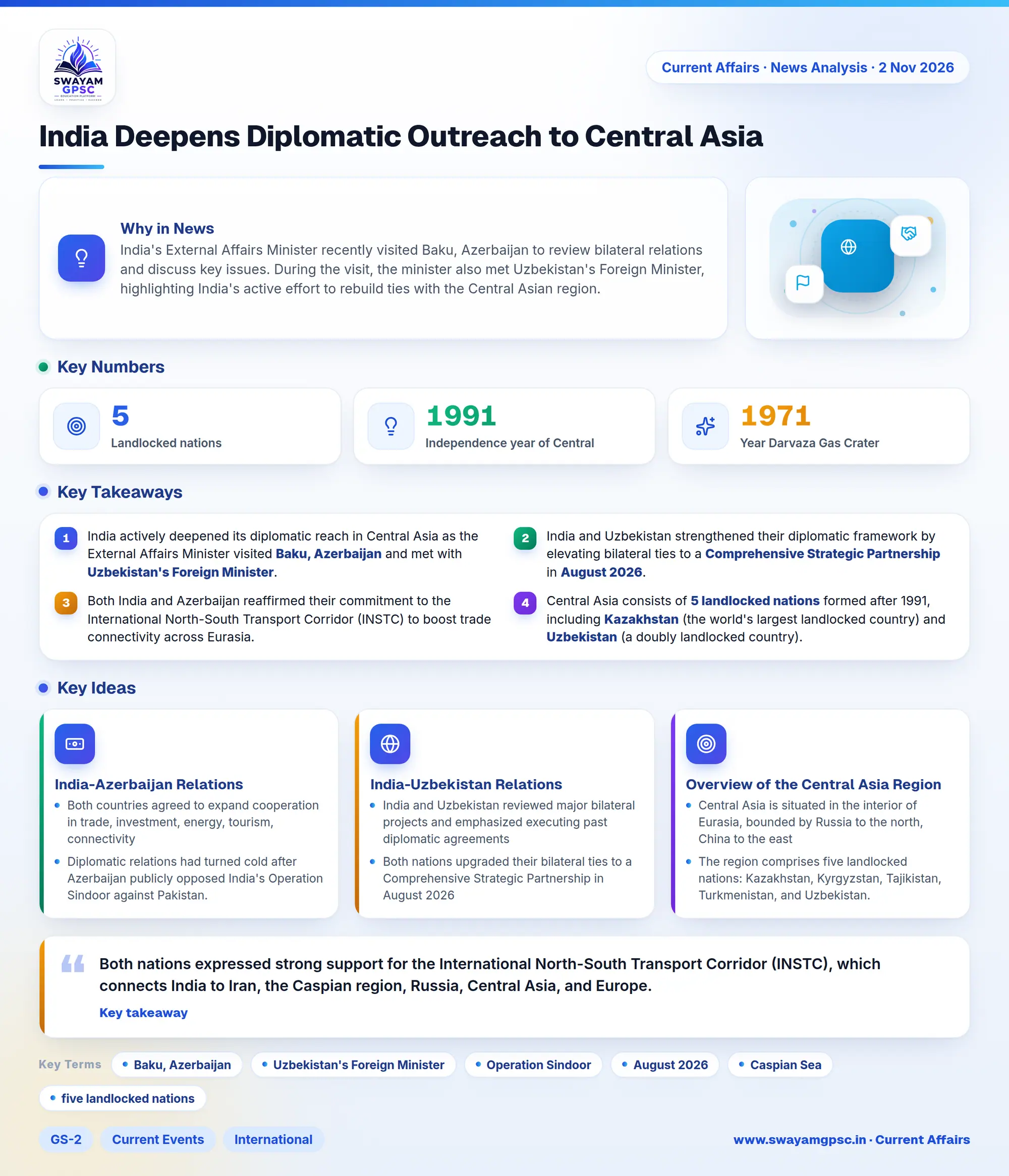
India Deepens Diplomatic Outreach to Central Asia
#GS-2 #Current Events #International #Groupings & Agreements Involving India and/or Affecting India's Interests #India and its Neighbourhood #Effect of Policies & Politics of Countries on India's Interests #Central Asia #International Relations
Key takeaways
- India actively deepened its diplomatic reach in Central Asia as the External Affairs Minister visited Baku, Azerbaijan and met with Uzbekistan's Foreign Minister.
- India and Uzbekistan strengthened their diplomatic framework by elevating bilateral ties to a Comprehensive Strategic Partnership in August 2026.
- Both India and Azerbaijan reaffirmed their commitment to the International North-South Transport Corridor (INSTC) to boost trade connectivity across Eurasia.
- Central Asia consists of 5 landlocked nations formed after 1991, including Kazakhstan (the world's largest landlocked country) and Uzbekistan (a doubly landlocked country).
Why in News
- India's External Affairs Minister recently visited Baku, Azerbaijan to review bilateral relations and discuss key issues.
- During the visit, the minister also met Uzbekistan's Foreign Minister, highlighting India's active effort to rebuild ties with the Central Asian region.
India-Azerbaijan Relations
- Both countries agreed to expand cooperation in trade, investment, energy, tourism, connectivity, and people-to-people ties.
- Diplomatic relations had turned cold after Azerbaijan publicly opposed India's Operation Sindoor against Pakistan. This visit marks an active effort to repair bilateral ties.
- Both nations expressed strong support for the International North-South Transport Corridor (INSTC), which connects India to Iran, the Caspian region, Russia, Central Asia, and Europe.
India-Uzbekistan Relations
- India and Uzbekistan reviewed major bilateral projects and emphasized executing past diplomatic agreements without delays.
- Both nations upgraded their bilateral ties to a Comprehensive Strategic Partnership in August 2026, expanding cooperation in trade, mining, energy, and uranium supply.
Overview of the Central Asia Region
- Central Asia is situated in the interior of Eurasia, bounded by Russia to the north, China to the east, Iran and Afghanistan to the south, and the Caspian Sea to the west.
- The region comprises five landlocked nations: Kazakhstan, Kyrgyzstan, Tajikistan, Turkmenistan, and Uzbekistan.
- All five countries emerged as independent sovereign nations after the collapse of the Soviet Union in 1991.
- Key geographical features include the Tian Shan and Pamir mountain ranges, the Karakum and Kyzylkum deserts, and the Amu Darya and Syr Darya rivers that historically fed the Aral Sea.
- The region holds immense strategic value due to its ancient position on the Silk Road and vast untapped reserves of oil, natural gas, and uranium.
- Kazakhstan is the world's largest landlocked country by total land area.
- Uzbekistan is one of only two doubly landlocked countries in the world, surrounded entirely by other landlocked nations.
- The Aral Sea, lying between Kazakhstan and Uzbekistan, has shrunk drastically due to decades of river water diversion for agricultural irrigation.
- Lake Issyk-Kul in Kyrgyzstan ranks as the world's second-largest alpine lake, surpassed only by Lake Titicaca.
- Turkmenistan contains the famous Darvaza Gas Crater, a natural gas cavern that collapsed in 1971 and has been burning continuously since.