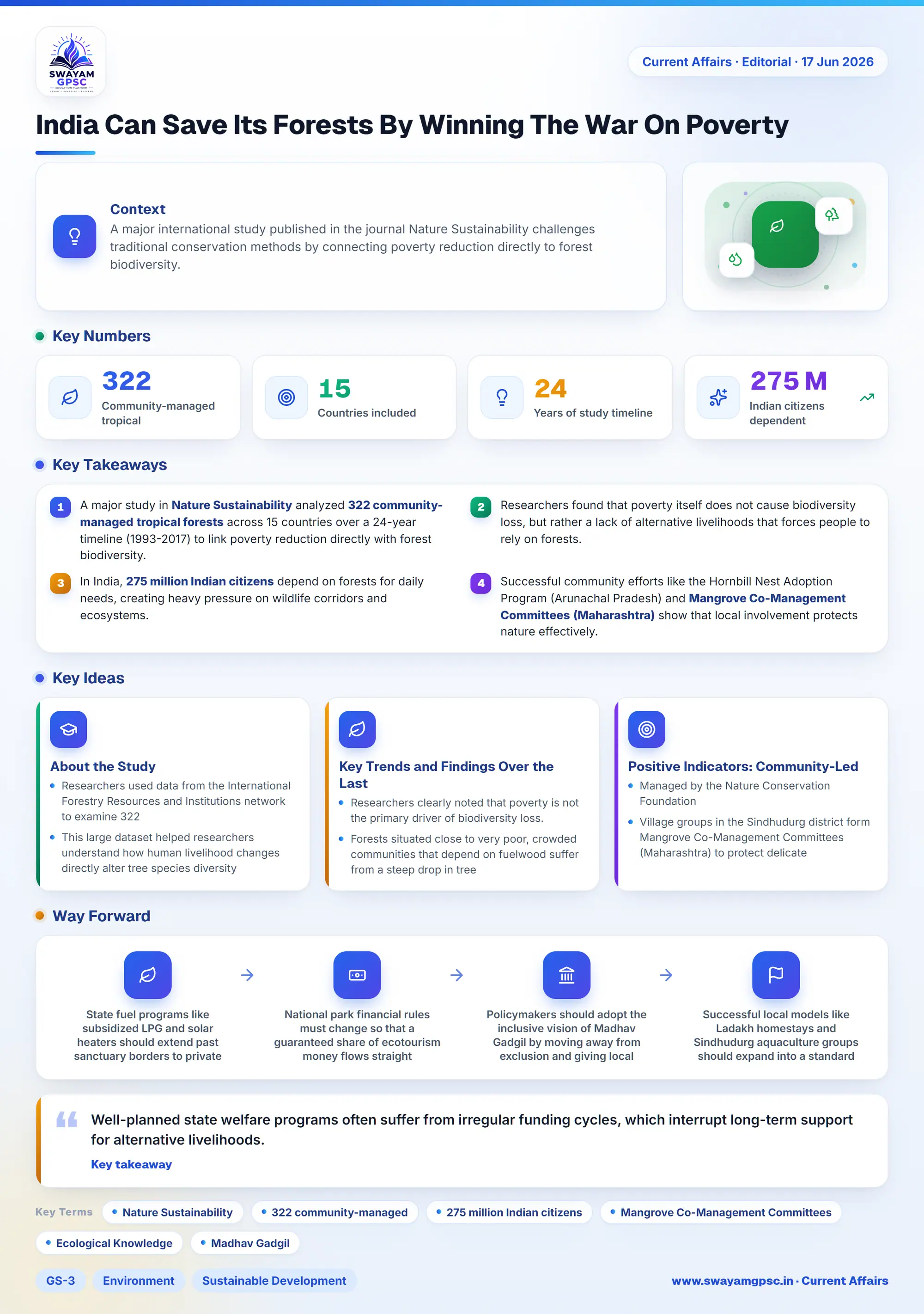
India Can Save Its Forests By Winning The War On Poverty
#GS-3 #Environment #Sustainable Development #Biodiversity #Economy #Agriculture #Current Events #National
Key takeaways
- A major study in Nature Sustainability analyzed 322 community-managed tropical forests across 15 countries over a 24-year timeline (1993-2017) to link poverty reduction directly with forest biodiversity.
- Researchers found that poverty itself does not cause biodiversity loss, but rather a lack of alternative livelihoods that forces people to rely on forests.
- In India, 275 million Indian citizens depend on forests for daily needs, creating heavy pressure on wildlife corridors and ecosystems.
- Successful community efforts like the Hornbill Nest Adoption Program (Arunachal Pradesh) and Mangrove Co-Management Committees (Maharashtra) show that local involvement protects nature effectively.
Context
- A major international study published in the journal Nature Sustainability challenges traditional conservation methods by connecting poverty reduction directly to forest biodiversity.
About the Study
- Researchers used data from the International Forestry Resources and Institutions network to examine 322 community-managed tropical forests across 15 countries over a 24-year timeline (1993-2017).
- This large dataset helped researchers understand how human livelihood changes directly alter tree species diversity, which acts as a key sign of ecological health and forest strength.
Key Trends and Findings Over the Last Decade
- Researchers clearly noted that poverty is not the primary driver of biodiversity loss. Instead, when local residents lack other ways to earn a living, they must rely heavily on nearby forests for basic survival.
- Forests situated close to very poor, crowded communities that depend on fuelwood suffer from a steep drop in tree species diversity. This low species variety weakens the ecosystem and makes it extremely vulnerable to environmental shocks.
- On the other hand, tropical forests where residents have steady access to other jobs like farming and non-forest trades display much higher tree species diversity.
- For decades, Indian forest management has depended on the fortress model, which limits human presence and restricts resource access. While this helped save a few famous species, it turned many wildlife reserves into isolated ecological islands trapped by heavy human settlement.
- Because human-dominated landscapes shrink available forests, they face heavy pressure from the 275 million Indian citizens who depend on them every day. This damage directly harms wildlife corridors that large animals use to move between protected areas.
Positive Indicators: Community-Led Conservation Successes
- Managed by the Nature Conservation Foundation, the Hornbill Nest Adoption Program (Arunachal Pradesh) turned former Nyishi hunters into paid nest guards and forest patrollers to protect vital bird habitats.
- Village groups in the Sindhudurg district form Mangrove Co-Management Committees (Maharashtra) to protect delicate mangrove zones while running sustainable aquaculture, ecotourism, and local fishing.
- The Snow Leopard Conservancy Initiatives (Ladakh) reduced human-wildlife conflicts by setting up community-run homestays and local livestock insurance schemes.
- State Forest Departments across India have systematically distributed subsidized LPG connections, efficient cooking stoves, and clean heaters around tiger reserves to lower local dependence on forest fuelwood.
Challenges
- Well-planned state welfare programs often suffer from irregular funding cycles, which interrupt long-term support for alternative livelihoods.
- The willingness of frontline forest communities to switch to alternative livelihoods changes significantly based on local social and economic conditions.
- Wildlife tourism has become a huge industry in India, but only a tiny fraction of this money actually reaches the communities living right next to protected areas.
- Modern conservation policies frequently ignore the valuable Ecological Knowledge of indigenous groups who have lived beside forests for generations, losing chances to support scientific methods.
Way Forward
- State fuel programs like subsidized LPG and solar heaters should extend past sanctuary borders to private lands and community forests near critical wildlife corridors.
- National park financial rules must change so that a guaranteed share of ecotourism money flows straight into village development funds.
- Policymakers should adopt the inclusive vision of Madhav Gadgil by moving away from exclusion and giving local groups formal harvesting rights, economic benefits, and a true role in resource management.
- Successful local models like Ladakh homestays and Sindhudurg aquaculture groups should expand into a standard national framework for all forest-edge villages.
Conclusion
- The Nature Sustainability study proves that fighting poverty and protecting biodiversity are two sides of the same coin. Relying on strict exclusion models is no longer practical when 275 million people depend on forest resources in human-dominated landscapes.