Immersive Technologies and India's AVGC-XR Ecosystem Expansion
#GS-3 #Science & Technology #ICT #Economy #Infrastructure #Immersive Technologies #Extended Reality #AVGC-XR Ecosystem
Key takeaways
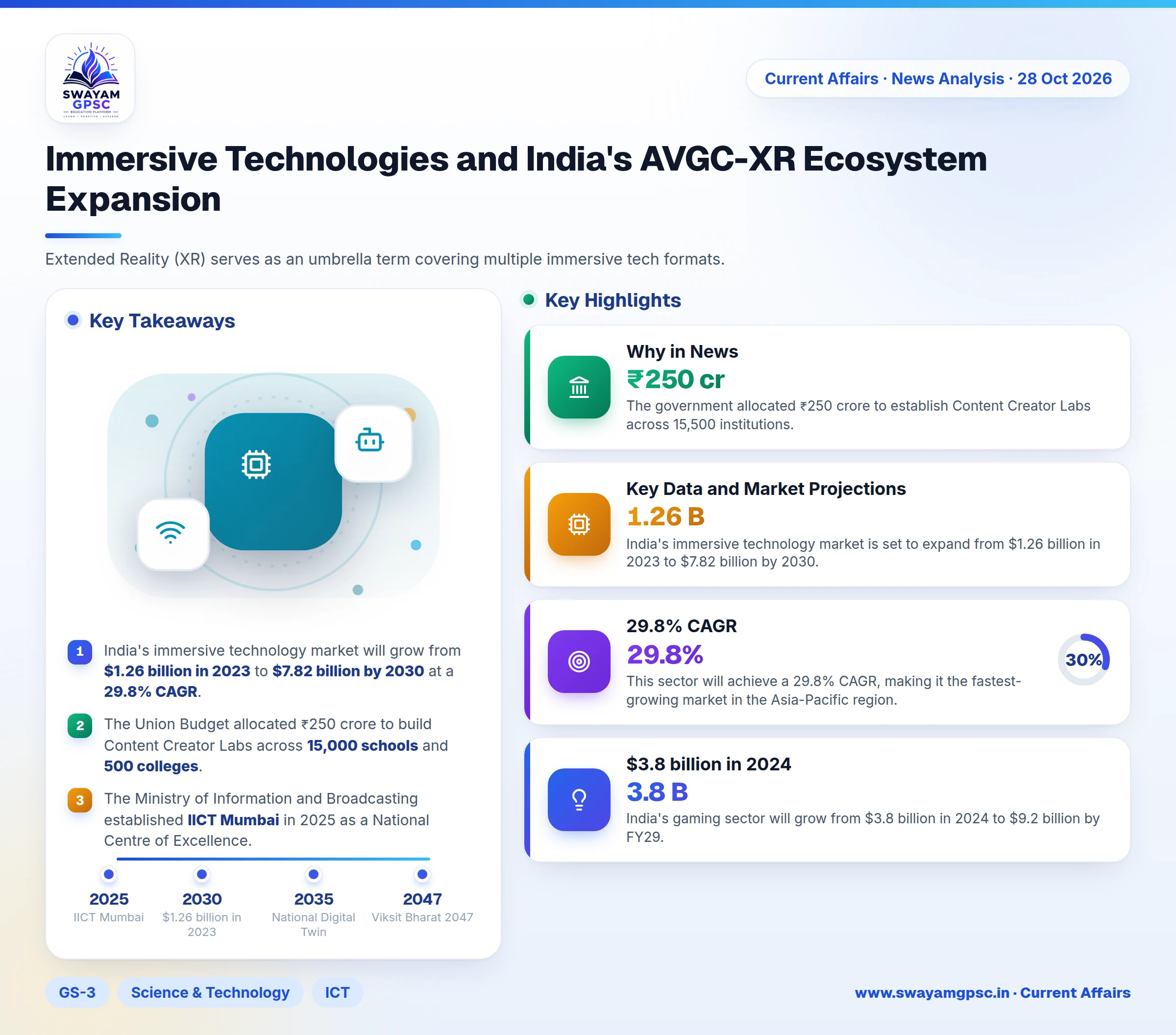
- India's immersive technology market will grow from $1.26 billion in 2023 to $7.82 billion by 2030 at a 29.8% CAGR.
- The Union Budget allocated ₹250 crore to build Content Creator Labs across 15,000 schools and 500 colleges.
- The Ministry of Information and Broadcasting established IICT Mumbai in 2025 as a National Centre of Excellence.
- MeitY's GENESIS Scheme is supporting 84 AR/VR startups and 106 technology incubators in Tier-II and Tier-III cities.
- The Department of Telecommunications aims to develop a National Digital Twin covering major urban centers by 2035.
Why in News
- The Ministry of Information and Broadcasting is expanding India's AVGC-XR ecosystem.
- The government allocated ₹250 crore to establish Content Creator Labs across 15,500 institutions.
- The government established IICT Mumbai to promote immersive technologies across the nation.
What are Immersive Technologies
- These interactive technologies blend physical and virtual worlds while engaging sight, sound, and touch.
- Extended Reality (XR) serves as an umbrella term covering multiple immersive tech formats.
- Virtual Reality (VR) completely replaces the real world with a interactive 3D computer simulation using headsets.
- Augmented Reality (AR) overlays real-time digital info and models onto the actual physical environment.
- Mixed Reality (MR) combines physical and digital spaces so real and virtual objects interact live.
- Haptic Technology simulates touch using physical resistance, vibrations, and tactile textures.
- 360-degree video offers omnidirectional spatial recordings that let users view scenes from any angle.
Key Data and Market Projections
- India's immersive technology market is set to expand from $1.26 billion in 2023 to $7.82 billion by 2030.
- This sector will achieve a 29.8% CAGR, making it the fastest-growing market in the Asia-Pacific region.
- India's gaming sector will grow from $3.8 billion in 2024 to $9.2 billion by FY29.
- The Union Budget 2026-27 allocated ₹250 crore for AVGC labs in 15,000 schools and 500 colleges.
- IICT Mumbai will coordinate the national rollout of these AVGC Content Creator Labs.
- The Department of Telecommunications plans to build a National Digital Twin for major cities by 2035.
Cross-Sectoral Applications in India
- These technologies convert abstract theoretical models into interactive 3D spatial simulations for classrooms.
- IIT Madras researchers deploy AR/VR modules in rural schools to teach history, anatomy, and astronomy.
- Digital Twins combine 5G, IoT, and mobility data to model urban growth before starting construction.
- The DoT launched the Sangam: Digital Twin initiative and Varanasi's 3D Spatial Planning project for traffic and logistics.
- Cultural institutions convert artifacts into high-resolution virtual spaces for remote digital access.
- The Ministry of Culture uses JATAN software alongside mobile AR tours at sites like Hampi and Nalanda.
- Real-time virtual studios and motion capture tools power modern media production and indigenous gaming products.
- Uttar Pradesh is building an integrated AVGC-XR Park near Noida International Airport in Jewar.
Major Policy and Institutional Initiatives
- IICT Mumbai was set up in 2025 as a National Centre of Excellence offering 18 specialized courses.
- MeitY launched the GENESIS Scheme to support 84 AR/VR startups and 106 incubators in smaller cities.
- The WaveX Media-Tech Incubator under MIB accelerates early-stage spatial computing startups.
- States developed local policies like Karnataka's Policy 3.0, Maharashtra's ₹3,268 crore roadmap, and Tamil Nadu's ELCOT Viyan CoE.
- CSIR organized the ESTIC-2026 Conclave at Bharat Mandapam featuring sessions on Generative XR.
Challenges
- Imported headsets and GPU servers carry high costs and create foreign supply chain dependencies.
- High import duties on XR headsets limit their deployment in resource-constrained public schools.
- Interactive VR and digital twins require uninterrupted 5G coverage that remains sparse in rural regions.
- Rural classroom learning modules suffer from rendering lag on slower mobile networks.
- Schools and universities lack trained instructors skilled in 3D engines like Unreal Engine and Unity.
- Domestic tech studios struggle to recruit creators for shader programming and haptic interface design.
- Long usage of immersive headsets causes cybersickness, eye strain, and physical disorientation.
- Students using headsets for long classes experience motion sickness without strict usage rules.
Way Forward
- Introduce a targeted Production-Linked Incentive (PLI) scheme for near-eye displays and spatial sensors.
- Include 3D engine programming into National Skills Qualification Framework (NSQF) courses and engineering degrees.
- Build a sovereign open-source repository containing digital copies of Indian heritage sites and cultural assets.
- Establish regulatory rules under the Digital Personal Data Protection (DPDP) Act to safeguard biometric data.
Conclusion
- Immersive tools mark India's transition from traditional screen interactions to spatial computing.
- India must shift from a market of tech consumers into a global exporter of XR hardware and software.
- Connecting grassroots education with startup incentives will fulfill the vision of Viksit Bharat 2047.