IAEA Refers Iran to UNSC Over Nuclear Non-Compliance
#GS-2 #Current Events #International #IAEA #UNSC #Nuclear Non-Proliferation
Key takeaways
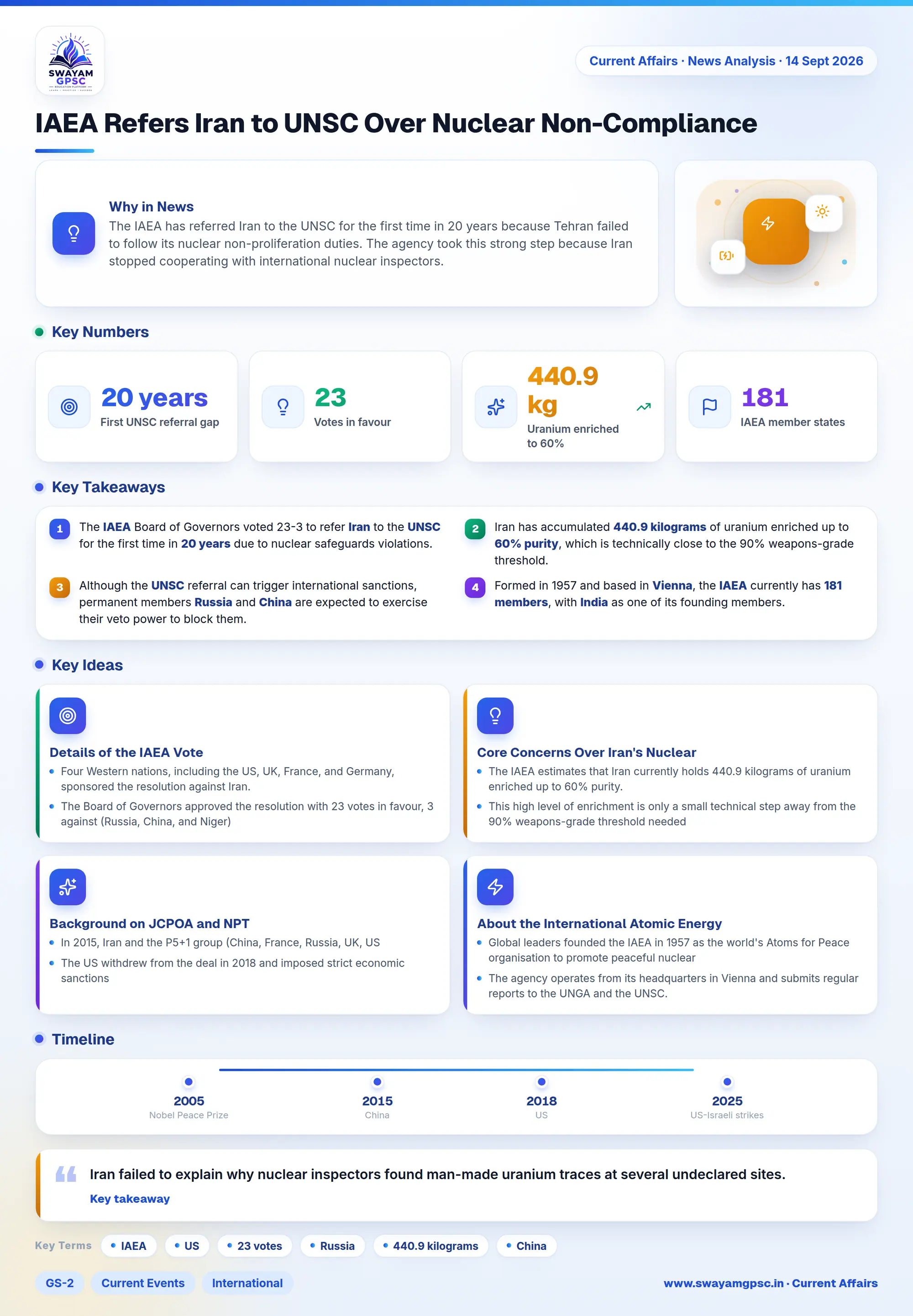
- The IAEA Board of Governors voted 23-3 to refer Iran to the UNSC for the first time in 20 years due to nuclear safeguards violations.
- Iran has accumulated 440.9 kilograms of uranium enriched up to 60% purity, which is technically close to the 90% weapons-grade threshold.
- Although the UNSC referral can trigger international sanctions, permanent members Russia and China are expected to exercise their veto power to block them.
- Formed in 1957 and based in Vienna, the IAEA currently has 181 members, with India as one of its founding members.
Why in News
- The IAEA has referred Iran to the UNSC for the first time in 20 years because Tehran failed to follow its nuclear non-proliferation duties.
- The agency took this strong step because Iran stopped cooperating with international nuclear inspectors.
Details of the IAEA Vote
- Four Western nations, including the US, UK, France, and Germany, sponsored the resolution against Iran.
- The Board of Governors approved the resolution with 23 votes in favour, 3 against (Russia, China, and Niger), and 8 abstentions.
- A Security Council referral can lead to global sanctions, but permanent members Russia and China hold veto power and will likely block punitive actions.
Core Concerns Over Iran's Nuclear Activities
- Iran failed to explain why nuclear inspectors found man-made uranium traces at several undeclared sites.
- The IAEA estimates that Iran currently holds 440.9 kilograms of uranium enriched up to 60% purity.
- This high level of enrichment is only a small technical step away from the 90% weapons-grade threshold needed for nuclear bombs.
Background on JCPOA and NPT Obligations
- In 2015, Iran and the P5+1 group (China, France, Russia, UK, US, plus Germany) signed the JCPOA to limit Iranian nuclear work in exchange for sanctions relief.
- The US withdrew from the deal in 2018 and imposed strict economic sanctions, prompting Iran to breach enrichment limits step by step.
- Independent of the JCPOA, Iran is a signatory to the NPT and must obey its Comprehensive Safeguards Agreement (CSA) with the IAEA.
- This safeguards framework forces Iran to declare all nuclear material so the IAEA can verify that it is not used for weapons.
- Following US-Israeli strikes in June 2025, Iran blocked IAEA inspectors from entering several nuclear locations.
- These restrictions prevented the agency from fulfilling its international inspection duties properly.
About the International Atomic Energy Agency (IAEA)
- Global leaders founded the IAEA in 1957 as the world's Atoms for Peace organisation to promote peaceful nuclear energy.
- The agency operates from its headquarters in Vienna and submits regular reports to the UNGA and the UNSC.
- It counts 181 members as of December 2025, with India participating as a founding member.
- The organisation won the Nobel Peace Prize in 2005 for its work toward a safer and nuclear-free world.