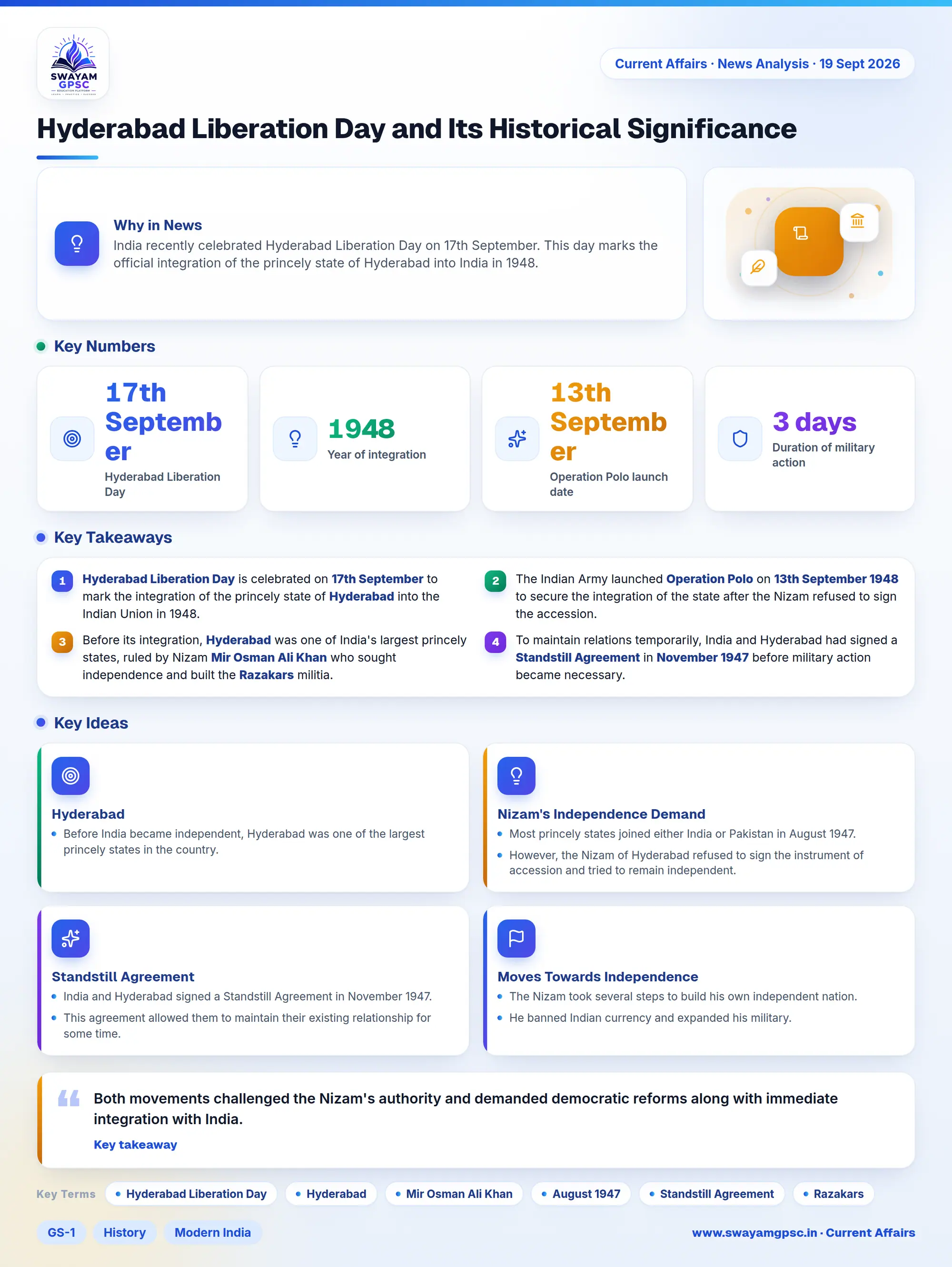
Hyderabad Liberation Day and Its Historical Significance
#GS-1 #History #Modern India #Post-independence Consolidation of India #GS-2 #Current Events #National
Key takeaways
- Hyderabad Liberation Day is celebrated on 17th September to mark the integration of the princely state of Hyderabad into the Indian Union in 1948.
- The Indian Army launched Operation Polo on 13th September 1948 to secure the integration of the state after the Nizam refused to sign the accession.
- Before its integration, Hyderabad was one of India's largest princely states, ruled by Nizam Mir Osman Ali Khan who sought independence and built the Razakars militia.
- To maintain relations temporarily, India and Hyderabad had signed a Standstill Agreement in November 1947 before military action became necessary.
Why in News
- India recently celebrated Hyderabad Liberation Day on 17th September.
- This day marks the official integration of the princely state of Hyderabad into India in 1948.
Background
- Before India became independent, Hyderabad was one of the largest princely states in the country.
- It covered modern Telangana along with parts of Karnataka and Maharashtra.
- The state was ruled by the Nizam, Mir Osman Ali Khan or Asaf Jah VII.
- He wanted to keep his state independent after the British left India.
Nizam's Independence Demand
- Most princely states joined either India or Pakistan in August 1947.
- However, the Nizam of Hyderabad refused to sign the instrument of accession and tried to remain independent.
Standstill Agreement
- India and Hyderabad signed a Standstill Agreement in November 1947.
- This agreement allowed them to maintain their existing relationship for some time.
Moves Towards Independence
- The Nizam took several steps to build his own independent nation.
- He banned Indian currency and expanded his military.
- He also imported weapons from Pakistan.
- At the same time, he built up a private army called the Razakars with help from the organization Ittehad-ul-Muslimeen.
Role of Razakars
- Qasim Razvi led the Razakars militia.
- This group strongly opposed joining India.
- They used violence to suppress any political rivals or groups who wanted to join the Indian Union.
Internal Agitations
- The Nizam faced major challenges from within his own state.
- These included the Communist uprising in Telangana and the Hyderabad State Congress movement.
- Both movements challenged the Nizam's authority and demanded democratic reforms along with immediate integration with India.
International Appeals
- The Nizam tried to get global support to stay independent.
- He reached out to Britain, the USA, and the United Nations.
- In 1948, he even appealed to the UN Security Council and the International Court of Justice.
- However, all his diplomatic efforts failed.
India's Diplomatic Efforts
- Sardar Vallabhbhai Patel initially tried to negotiate with the Nizam.
- He wanted a peaceful solution that would protect India's unity and national interests.
Operation Polo
- On 13th September 1948, the Indian Army launched Operation Polo.
- This was a decisive military action to merge Hyderabad with India.
- Within three days, Hyderabad's forces surrendered.
- The Nizam then agreed to disband the violent Razakars militia.