Human Stampedes in India: Causes, Challenges, and NDMA Guidelines
#GS-3 #Disaster Management #Disaster Preparedness #Disaster Response #GS-2 #Current Events #National #Crowd Management
Key takeaways
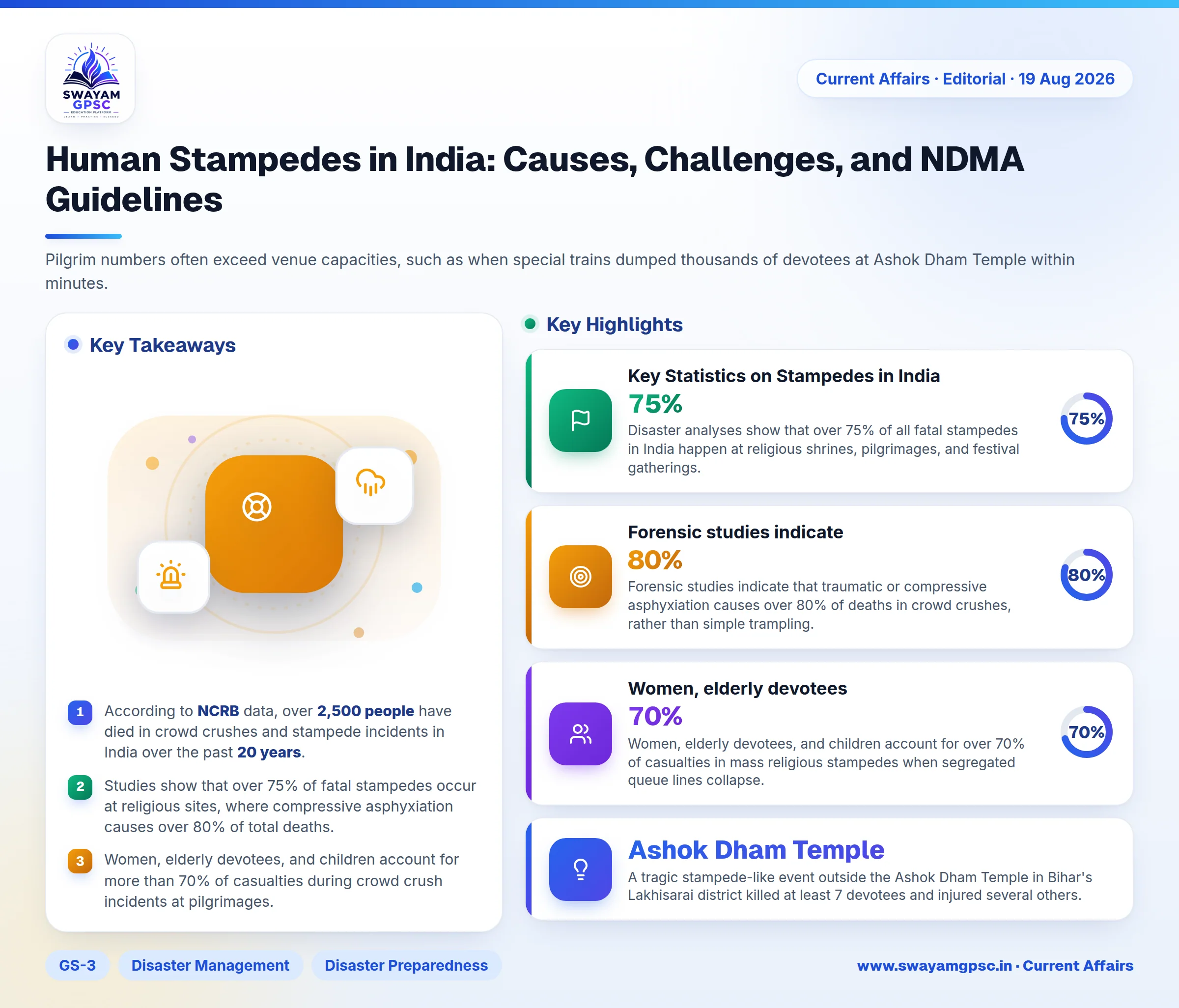
- According to NCRB data, over 2,500 people have died in crowd crushes and stampede incidents in India over the past 20 years.
- Studies show that over 75% of fatal stampedes occur at religious sites, where compressive asphyxiation causes over 80% of total deaths.
- Women, elderly devotees, and children account for more than 70% of casualties during crowd crush incidents at pilgrimages.
- Critical crowd collapse occurs when density exceeds 4 to 5 persons per square meter, requiring strict implementation of NDMA crowd management guidelines.
Why in News
- A tragic stampede-like event outside the Ashok Dham Temple in Bihar's Lakhisarai district killed at least 7 devotees and injured several others.
Understanding Human Stampedes
- A human stampede involves a sudden, rapid, and uncoordinated movement of a large crowd caused by panic, excitement, perceived danger, or crowd control failure.
- When crowd density goes beyond 4 to 5 persons per square meter, crowd turbulence or progressive collapse happens, causing crushing, trampling, and compressive asphyxiation.
Key Statistics on Stampedes in India
- Disaster analyses show that over 75% of all fatal stampedes in India happen at religious shrines, pilgrimages, and festival gatherings.
- According to NCRB data, over 2,500 people died in crowd crushes and stampede incidents across India in the last 20 years.
- Forensic studies indicate that traumatic or compressive asphyxiation causes over 80% of deaths in crowd crushes, rather than simple trampling.
- Women, elderly devotees, and children account for over 70% of casualties in mass religious stampedes when segregated queue lines collapse.
Causes of Stampedes
- Pilgrim numbers often exceed venue capacities, such as when special trains dumped thousands of devotees at Ashok Dham Temple within minutes.
- Unverified rumors create rapid panic among crowds, such as false reports of a live falling wire after an electric pole collapsed in Lakhisarai.
- Weak physical infrastructure causes failures, such as bamboo barricades collapsing under crowd pressure and causing devotees to fall over each other.
- Mixing incoming and outgoing crowd movement creates dangerous head-on collisions in narrow corridors during peak holy hours.
- Poor coordination between civil administration, transport authorities, and temple management leaves police unprepared for sudden crowd surges.
Challenges in Crowd Management
- Authorities lack real-time crowd analytics like AI-enabled density cameras and automated headcount sensors, forcing police to rely on inaccurate visual checks.
- Devotees often resist police discipline and break queues to reach inner sanctums during auspicious astrological timings (Muhurats).
- Shrines lack proper holding pens and zigzag waiting corridors outside main structures, allowing continuous crowd surges directly toward inner sanctums.
- Narrow approach roads blocked by shops, stalls, and pilgrims prevent ambulances and first responders from reaching injured victims quickly.
- Many historical shrines operate under informal governance without trained security personnel, disaster plans, or professional event managers.
NDMA Guidelines for Stampede Prevention
- Shrines must enforce strict one-way entry and exit routes without crossovers to ensure continuous crowd movement away from the inner sanctum.
- Authorities must set up multi-stage holding areas and zigzag snake queues outside main shrines to slow down incoming crowd momentum.
- Management must build central command rooms connected to CCTV surveillance and high-decibel PA systems to dispel rumors quickly.
- Authorities should fix maximum venue capacities and regulate entry using time-slotted online passes, wristbands, or physical tokens during major festivals.
- Every major shrine must maintain an approved Event Disaster Management Plan, dedicated green corridors for ambulances, and on-site emergency first-aid stations.
Way Forward
- The tragedy at Ashok Dham Temple shows that authorities must treat crowd management as an essential part of disaster risk reduction.
- Implementing NDMA guidelines on capacity limits, unidirectional movement, holding pens, and fast rumor response is vital for pilgrim safety.
- Combining advanced surveillance technology with proactive administrative planning will ensure that religious devotion remains safe and dignified.