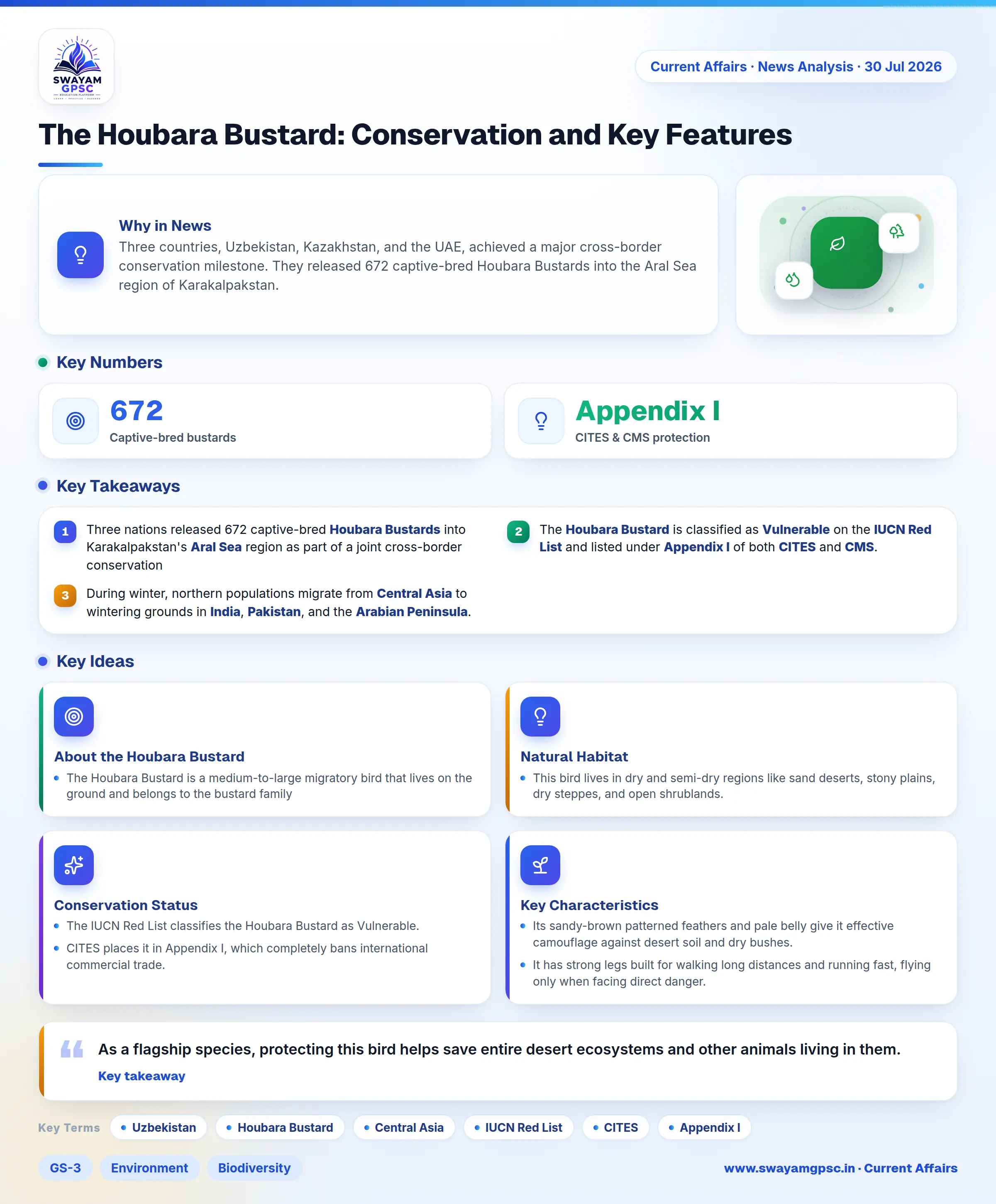
The Houbara Bustard: Conservation and Key Features
#GS-3 #Environment #Biodiversity #Wildlife #Current Events #International #Houbara Bustard #Conservation
Key takeaways
- Three nations released 672 captive-bred Houbara Bustards into Karakalpakstan's Aral Sea region as part of a joint cross-border conservation project.
- The Houbara Bustard is classified as Vulnerable on the IUCN Red List and listed under Appendix I of both CITES and CMS.
- During winter, northern populations migrate from Central Asia to wintering grounds in India, Pakistan, and the Arabian Peninsula.
Why in News
- Three countries, Uzbekistan, Kazakhstan, and the UAE, achieved a major cross-border conservation milestone. They released 672 captive-bred Houbara Bustards into the Aral Sea region of Karakalpakstan.
About the Houbara Bustard
- The Houbara Bustard is a medium-to-large migratory bird that lives on the ground and belongs to the bustard family (Otididae). It is famous for being hard to spot and highly adapted to extremely dry desert conditions.
Natural Habitat
- This bird lives in dry and semi-dry regions like sand deserts, stony plains, dry steppes, and open shrublands. Its habitat stretches across Central Asia, the Middle East, North Africa, and parts of South Asia, including the Thar Desert and Rann of Kutch.
Conservation Status
- The IUCN Red List classifies the Houbara Bustard as Vulnerable.
- CITES places it in Appendix I, which completely bans international commercial trade.
- The Convention on Migratory Species (CMS) includes it in Appendix I, demanding strict protection along all its migration paths.
Key Characteristics
- Its sandy-brown patterned feathers and pale belly give it effective camouflage against desert soil and dry bushes.
- It has strong legs built for walking long distances and running fast, flying only when facing direct danger.
- Male birds perform striking mating rituals by raising black-and-white neck feathers, inflating throat sacs, and running in circles.
- It survives in dry regions by eating a mixed diet of seeds, plant shoots, beetles, locusts, small lizards, and other invertebrates.
- Birds from northern areas like Kazakhstan and Uzbekistan fly long distances south to spend winters in Pakistan, India, and the Arabian Peninsula.
Significance
- As a flagship species, protecting this bird helps save entire desert ecosystems and other animals living in them.
- It serves as a successful model showing how global teamwork, funding, and captive breeding can rebuild damaged habitats.