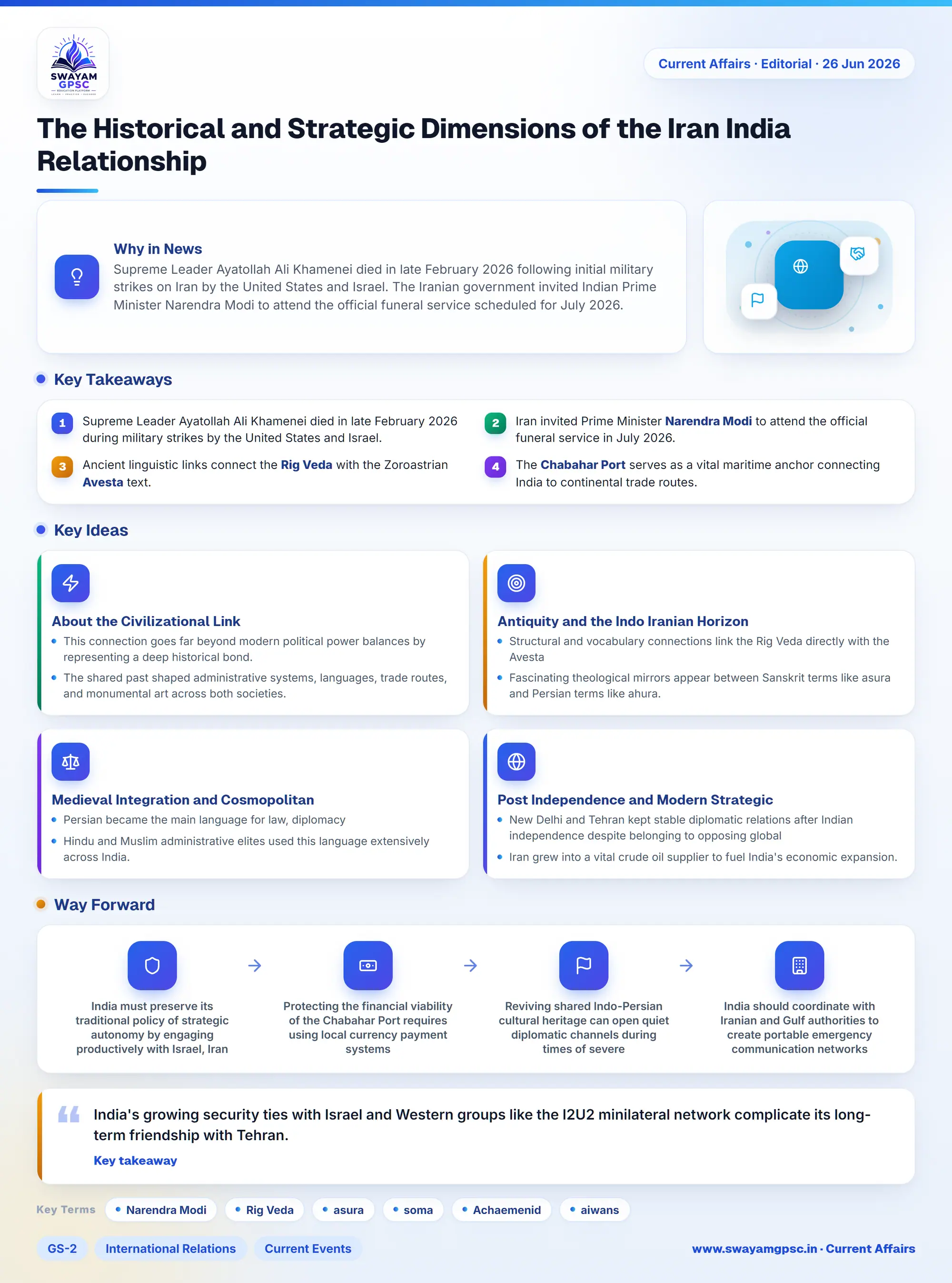
The Historical and Strategic Dimensions of the Iran India Relationship
#GS-2 #International Relations #Current Events #Bilateral Relations #Economy #Infrastructure
Key takeaways
- Supreme Leader Ayatollah Ali Khamenei died in late February 2026 during military strikes by the United States and Israel.
- Iran invited Prime Minister Narendra Modi to attend the official funeral service in July 2026.
- Ancient linguistic links connect the *Rig Veda* with the Zoroastrian *Avesta* text.
- The Chabahar Port serves as a vital maritime anchor connecting India to continental trade routes.
Why in News
- Supreme Leader Ayatollah Ali Khamenei died in late February 2026 following initial military strikes on Iran by the United States and Israel.
- The Iranian government invited Indian Prime Minister Narendra Modi to attend the official funeral service scheduled for July 2026.
About the Civilizational Link
- This connection goes far beyond modern political power balances by representing a deep historical bond.
- The shared past shaped administrative systems, languages, trade routes, and monumental art across both societies.
Antiquity and the Indo Iranian Horizon
- Structural and vocabulary connections link the *Rig Veda* directly with the *Avesta* , which is the sacred text of Zoroastrianism.
- Fascinating theological mirrors appear between Sanskrit terms like *asura* and Persian terms like *ahura*.
- Similar word pairs include *soma* and *haoma* along with *yajna* and *yasna*.
- Emperor Darius incorporated Gandhara and Sind into the Persian Empire during the Achaemenid era between 550 and 330 BCE.
- Indian soldiers served inside the Persian military while overland trade paths linked the subcontinent into continental Eurasia.
- Elite Mauryan imperial architecture absorbed structural ideas from Persian traditions, especially polished stone edict pillars.
Medieval Integration and Cosmopolitan Fusions
- Persian became the main language for law, diplomacy, and intellectual life during the Delhi Sultanate and Mughal periods.
- Hindu and Muslim administrative elites used this language extensively across India.
- Indian builders blended native styles with Persian elements like arches, domes, and vaulted halls known as *aiwans*.
- Other adopted Persian features include formal entryways called *pishtaqs* and quadrilateral garden layouts known as *charbaghs*.
- Thousands of Iranian scholars, poets, and physicians moved to India starting in the 16th century for royal patronage.
- This migration enriched early modern Indian learning and helped establish the famous Mughal painting ateliers.
Post Independence and Modern Strategic Ties
- New Delhi and Tehran kept stable diplomatic relations after Indian independence despite belonging to opposing global blocs during the Cold War.
- Iran grew into a vital crude oil supplier to fuel India's economic expansion.
- India viewed Iran as a geographic gateway to bypass land barriers and reach Afghanistan and Central Asia.
- The Chabahar Port project stands out as the pinnacle of modern bilateral infrastructure integration and secures a reliable trade corridor.
Challenges
- India's growing security ties with Israel and Western groups like the I2U2 minilateral network complicate its long-term friendship with Tehran.
- Unilateral Western sanctions on Iranian banking, shipping, and oil sectors restrict India from making smooth trade payments and importing energy regularly.
- Active military fighting involving the United States, Israel, and Iran threatens key maritime choke points in West Asia.
- Regional conflicts drive up trade insurance costs and endanger millions of Indian workers living in the Gulf.
- China's expanding economic footprint and long-term infrastructure investments in Iran challenge India's regional leadership goals.
Way Forward
- India must preserve its traditional policy of strategic autonomy by engaging productively with Israel, Iran, and Gulf nations without joining regional security blocks.
- Protecting the financial viability of the Chabahar Port requires using local currency payment systems or humanitarian trade exemptions to bypass global sanctions.
- Reviving shared Indo-Persian cultural heritage can open quiet diplomatic channels during times of severe regional conflict.
- India should coordinate with Iranian and Gulf authorities to create portable emergency communication networks for protecting the diaspora.