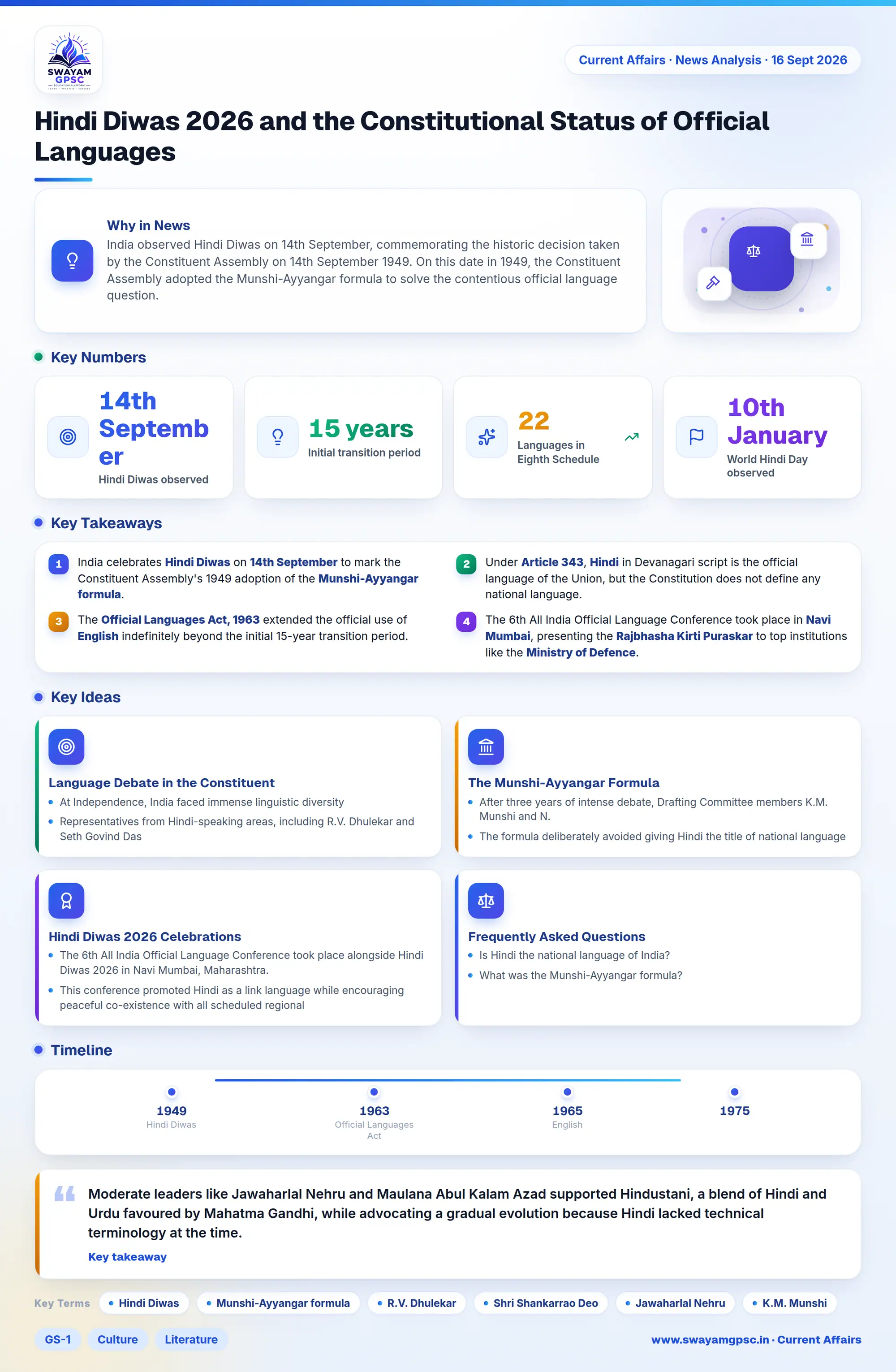
Hindi Diwas 2026 and the Constitutional Status of Official Languages
#GS-1 #Culture #Literature #GS-2 #Indian Polity & Constitution #Constitution #Current Events #National #Hindi Diwas #Official Languages Act 1963 #Eighth Schedule
Key takeaways
- India celebrates Hindi Diwas on 14th September to mark the Constituent Assembly's 1949 adoption of the Munshi-Ayyangar formula.
- Under Article 343, Hindi in Devanagari script is the official language of the Union, but the Constitution does not define any national language.
- The Official Languages Act, 1963 extended the official use of English indefinitely beyond the initial 15-year transition period.
- The 6th All India Official Language Conference took place in Navi Mumbai, presenting the Rajbhasha Kirti Puraskar to top institutions like the Ministry of Defence.
- The Constitution currently protects 22 languages under the Eighth Schedule, which excludes English despite its use as an associate official language.
Why in News
- India observed Hindi Diwas on 14th September, commemorating the historic decision taken by the Constituent Assembly on 14th September 1949.
- On this date in 1949, the Constituent Assembly adopted the Munshi-Ayyangar formula to solve the contentious official language question.
- This annual occasion brings renewed focus on the language debates in the Constituent Assembly and how India balanced Hindi promotion with linguistic diversity.
Language Debate in the Constituent Assembly
- At Independence, India faced immense linguistic diversity, creating an intense debate on whether English should be replaced by a native Indian language for central administration.
- Representatives from Hindi-speaking areas, including R.V. Dhulekar and Seth Govind Das, demanded that Hindi be declared the sole national language immediately.
- These Hindi advocates argued that accommodating multiple languages would harm national unity and insisted on stopping the use of English right away.
- Members from non-Hindi-speaking states, particularly from South India, strongly opposed forcing linguistic uniformity across the country.
- Leaders like Shri Shankarrao Deo championed the idea of unity in diversity, warning that imposing Hindi would erase the distinct cultures of linguistic minorities.
- Moderate leaders like Jawaharlal Nehru and Maulana Abul Kalam Azad supported Hindustani, a blend of Hindi and Urdu favoured by Mahatma Gandhi, while advocating a gradual evolution because Hindi lacked technical terminology at the time.
The Munshi-Ayyangar Formula
- After three years of intense debate, Drafting Committee members K.M. Munshi and N. Gopalaswami Ayyangar designed a balanced compromise framework.
- The formula deliberately avoided giving Hindi the title of national language, choosing instead to declare Hindi in Devanagari script as the official language of the Union government.
- To reassure non-Hindi states, the plan allowed English to continue as an associate official language for a transition period of 15 years until 1965.
- When this 15-year period ended in 1965, major anti-Hindi protests broke out in Tamil Nadu, prompting Parliament to pass the Official Languages Act, 1963 to keep English indefinitely.
- The Assembly adopted the international form of Hindu-Arabic numerals for central official use, settling disagreements over Devanagari numerals.
- Individual states received the freedom to select their own regional languages or English for state-level government work.
- Lawmakers placed the Munshi-Ayyangar compromise into Part XVII of the Constitution, spanning Articles 343 to 351.
- Under Article 343, Hindi in Devanagari script serves as the official language of the Union government.
- According to Article 348, Supreme Court and High Court proceedings, along with legislative texts, must be in English, though a Governor can allow Hindi or state languages in High Courts with presidential consent.
- Under Article 350A, states must provide primary education facilities in the student's mother tongue.
- Under Article 351, the central government receives a direct duty to promote the spread and growth of Hindi.
- The Constitution originally listed 14 major languages under the Eighth Schedule, which has now grown to 22 languages including Hindi.
- English is not listed in the Eighth Schedule, but it remains an associate official language through the Official Languages Act, 1963.
Hindi Diwas 2026 Celebrations and Awards
- The 6th All India Official Language Conference took place alongside Hindi Diwas 2026 in Navi Mumbai, Maharashtra.
- This conference promoted Hindi as a link language while encouraging peaceful co-existence with all scheduled regional languages.
- The Department of Official Language under the Ministry of Home Affairs presented the Rajbhasha Kirti Puraskar to recognize top-performing government bodies in Hindi usage.
- The Ministry of Defence won the First Prize among large organizations with more than 300 staff members.
- The Department of Financial Services secured the First Prize among smaller organizations with under 300 staff members for innovative Hindi promotion.
- Under official guidelines, any ministry that wins the first prize for two consecutive years becomes ineligible for the regular award in the third year.
- The Department of Administrative Reforms and Public Grievances received the special Rajbhasha Utkrishtata Sammaan for winning first prize in 2023-24 and 2024-25.
- The government also presented the Rajbhasha Gaurav Puraskar to honor individual authors and civil servants for original Hindi writings.
- National Hindi Diwas on 14th September differs from World Hindi Day on 10th January, which commemorates the 1975 World Hindi Conference in Nagpur.
Frequently Asked Questions
- Is Hindi the national language of India? No, the Constitution does not declare any national language; Article 343 designates Hindi as the official language of the Union.
- What was the Munshi-Ayyangar formula? It was a constitutional compromise that named Hindi the official language while keeping English during a transition phase.
- Why did English continue after 1965? Parliament passed the Official Languages Act, 1963 to allow English alongside Hindi to protect non-Hindi states.
- What does Article 351 mandate? It directs the central government to promote and develop Hindi while drawing vocabulary from Hindustani and other Indian languages.
- How does the Constitution protect regional languages? It offers protection through regional autonomy, primary schooling in mother tongues, and listing 22 languages in the Eighth Schedule.