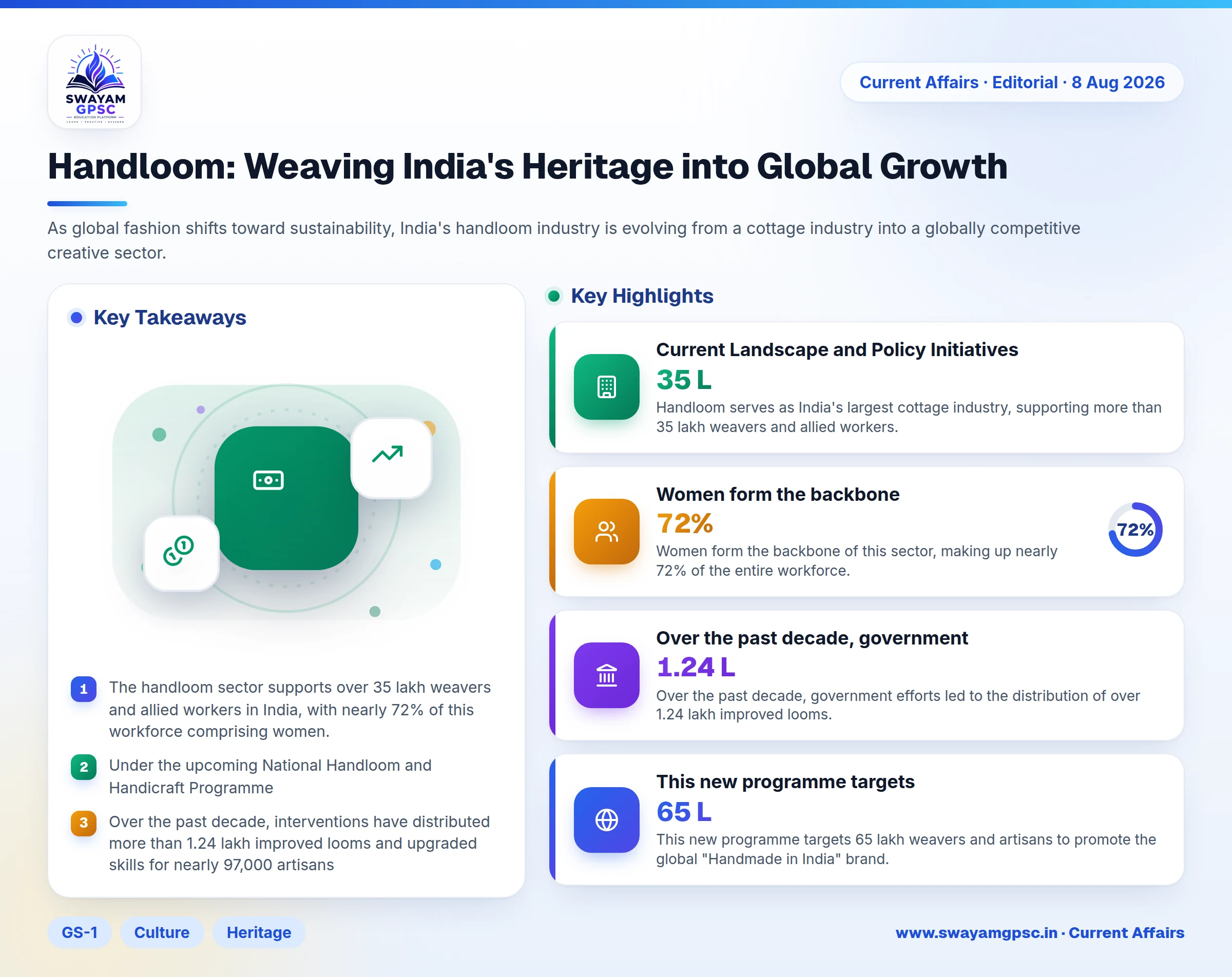
Handloom: Weaving India's Heritage into Global Growth
#GS-1 #Culture #Heritage #GS-3 #Economy #Employment #Handloom Industry
Key takeaways
- The handloom sector supports over 35 lakh weavers and allied workers in India, with nearly 72% of this workforce comprising women.
- Under the upcoming National Handloom and Handicraft Programme, the government aims to strengthen 1,800 clusters across more than 500 districts to reach 65 lakh artisans.
- Over the past decade, interventions have distributed more than 1.24 lakh improved looms and upgraded skills for nearly 97,000 artisans across 797 handloom clusters.
- Future policy targets aim to elevate handloom into premium luxury markets, helping artisans reach aspirational monthly incomes of ₹50,000.
Why in News
- On August 7, 2026, Union Minister of Textiles Giriraj Singh authored a commentary marking the 12th National Handloom Day.
- The commentary highlighted handloom as a vital strategic sector for achieving the national vision of Viksit Bharat 2047.
Overview of the Handloom Sector
- India's handloom sector represents a strong civilisational heritage that combines culture with eco-friendly handcrafted production.
- As global fashion shifts toward sustainability, India's handloom industry is evolving from a cottage industry into a globally competitive creative sector.
Historical and Civilisational Heritage
- The roots of Indian handloom trace back to the Indus Valley Civilisation, where cotton was first grown and woven.
- Indian textiles led global trade during the 18th century, gaining world renown for unmatched skill and quality.
- Legendary regional products include Bengal's Muslin, where a 25-metre long fabric could pass through a single ring.
- Other iconic weaving traditions include Banarasi Silk, Kanchipuram weaves, and Pochampally Ikat.
Current Landscape and Policy Initiatives
- Handloom serves as India's largest cottage industry, supporting more than 35 lakh weavers and allied workers.
- Women form the backbone of this sector, making up nearly 72% of the entire workforce.
- Over the past decade, government efforts led to the distribution of over 1.24 lakh improved looms.
- Training initiatives upgraded skills for around 97,000 artisans spread across 797 handloom clusters.
- The government improved quality standards using GI tags, Handloom Mark, India Handmade certification, Urban Haats, and Design Resource Centres.
- The upcoming National Handloom and Handicraft Programme will strengthen 1,800 clusters in over 500 districts.
- This new programme targets 65 lakh weavers and artisans to promote the global "Handmade in India" brand.
Technology, Innovation, and Handloom 4.0
- Historical innovations like Mahatma Gandhi's Ambar Charkha set an early example of adapting tools for social impact.
- Modern regional loom designs include Assam's Maina Loom and Sivasagar's Chitranjan Handloom.
- The Centre of Excellence for Handloom Technology, set up with IITs, creates lighter and stronger looms for weavers, including persons with disabilities.
- Digital tools under Handloom 4.0 use AI to track product quality, loom maintenance, and weaver productivity across a pilot of 100 looms.
- The VisioNXT platform provides market intelligence by forecasting design trends, detecting counterfeit products, and connecting artisans directly to global buyers.
Handloom as a Driver of Growth
- The sector drives rural economy and women-led growth by giving financial independence to over 35 lakh workers.
- Low carbon emissions make handloom a global benchmark for sustainable luxury fashion.
- Weaving traditions transform historical culture into active economic value across domestic and international markets.
- Technological updates like lighter looms and AI monitoring improve artisan output without replacing human skill.
Challenges
- Unstable raw material prices for silk, cotton, and wool reduce profit margins for small weavers.
- Cheap mass-produced goods from powerlooms create unfair competition and fake genuine GI-tagged handloom designs.
- Long supply chains and dependence on middlemen keep weaver incomes low.
- Heavy traditional looms cause physical strain and occupational health issues, turning younger generations away from weaving.
Way Forward
- Implement the National Handloom and Handicraft Programme across 1,800 clusters to assist 65 lakh artisans.
- Expand digital platforms like VisioNXT and Handloom 4.0 to spot trends, block fakes, and sell directly online.
- Distribute lighter, ergonomic loom models designed by IITs to boost productivity and inclusion.
- Provide dedicated support through Weavers' Service Centres and IIHTs to raise weaver earnings toward ₹50,000 per month.
Conclusion
- Handloom forms a key foundation for India's sustainable economic and cultural growth strategy.
- Combining age-old craft with AI technology and direct global trade turns local weavers into thriving global entrepreneurs.