Green Hydrogen and India's Clean Energy Transition
#GS-3 #Science & Technology #Energy #Environment #Climate Change #Sustainable Development #Infrastructure #Current Events #National #Gujarat
Key takeaways
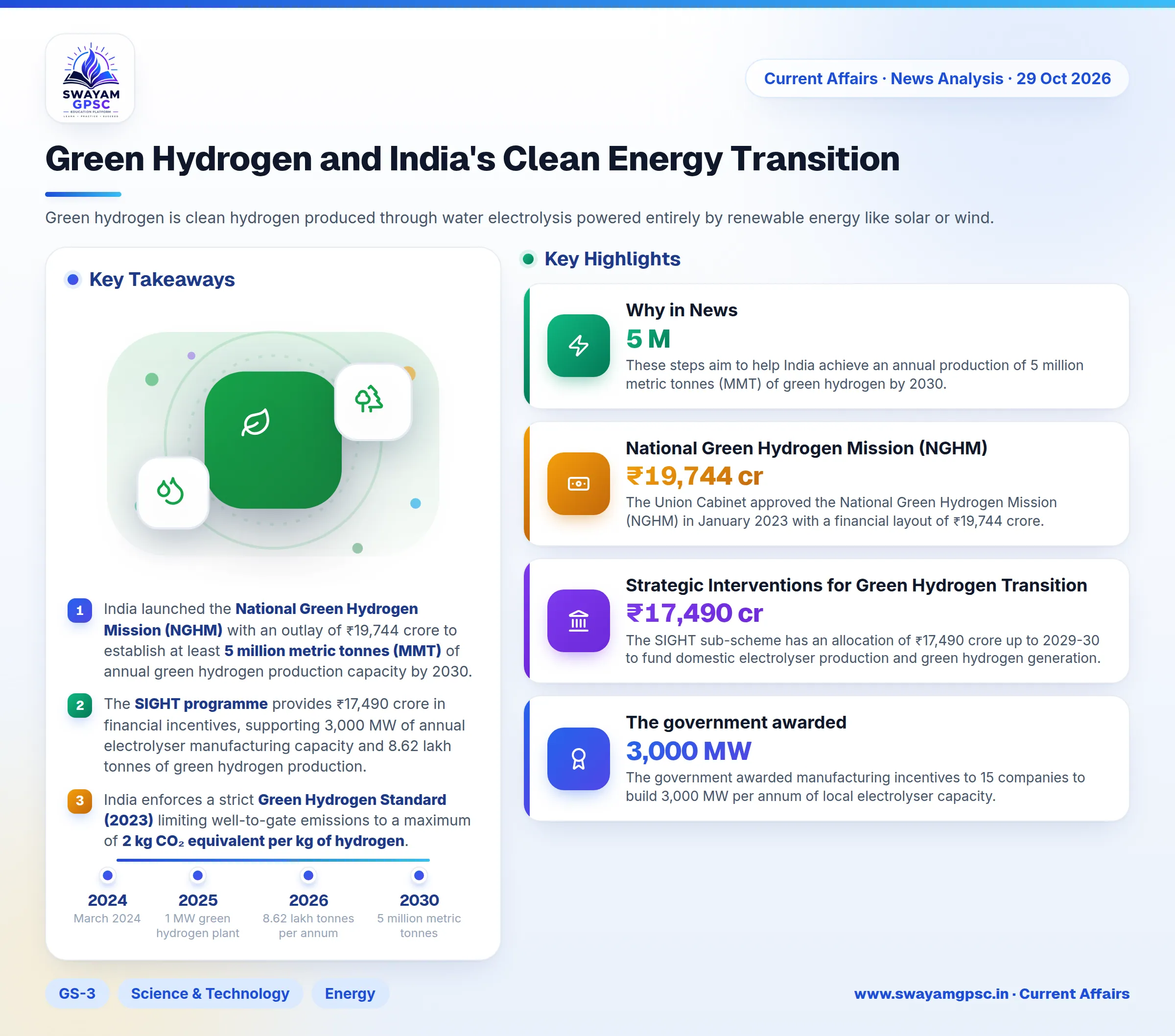
- India launched the National Green Hydrogen Mission (NGHM) with an outlay of ₹19,744 crore to establish at least 5 million metric tonnes (MMT) of annual green hydrogen production capacity by 2030.
- The SIGHT programme provides ₹17,490 crore in financial incentives, supporting 3,000 MW of annual electrolyser manufacturing capacity and 8.62 lakh tonnes of green hydrogen production.
- India enforces a strict Green Hydrogen Standard (2023) limiting well-to-gate emissions to a maximum of 2 kg CO₂ equivalent per kg of hydrogen.
- Key infrastructure support includes a 25-year waiver on ISTS transmission charges for plants commissioned by 31 December 2030 and port hubs at Deendayal Port, V.O. Chidambaranar Port, and Paradip Port.
- India inaugurated its first indigenous hydrogen train on 17th July 2026 on the Jind-Sonipat section in Haryana, while Gujarat leads as one of six states with a dedicated policy.
Why in News
- India is accelerating its National Green Hydrogen Mission (NGHM) to transform into a global leader in clean energy.
- The country actively supports domestic electrolyser manufacturing, green hydrogen production, industrial pilot projects, and clear certification systems.
- These steps aim to help India achieve an annual production of 5 million metric tonnes (MMT) of green hydrogen by 2030.
- This strategic effort aligns directly with India's broader target of reaching Net Zero emissions by 2070.
Key Facts About Green Hydrogen
- Green hydrogen is clean hydrogen produced through water electrolysis powered entirely by renewable energy like solar or wind.
- Because it uses clean electricity, its production creates significantly lower carbon emissions compared to traditional fossil-fuel-based methods.
- Hydrogen functions as a versatile energy carrier that can store and transport energy for many uses.
- In a fuel cell, hydrogen combines with oxygen to generate electricity, releasing only water and heat as by-products without any harmful gases.
- Although hydrogen can come from water or natural gas, its environmental footprint depends entirely on how it is extracted.
- Green hydrogen provides a practical path to decarbonize hard-to-abate industries like fertilizers, petroleum refining, steel, and heavy transport.
- Using India's vast solar and wind power to produce green hydrogen locally reduces reliance on imported fossil fuels and stabilizes domestic energy prices.
Production Process of Green Hydrogen
- Water electrolysis serves as the main method for producing green hydrogen.
- Renewable electricity splits water (H₂O) into hydrogen gas (H₂) and oxygen gas (O₂) with minimal carbon emissions, following the reaction 2H₂O → 2H₂ + O₂.
- An electrolyser contains two key charged electrodes, a negative cathode and a positive anode, immersed in an electrolyte solution.
- A specialized diaphragm or membrane separates the rising hydrogen and oxygen gases while letting specific ions flow between the electrodes.
- When electric current flows through the setup, hydrogen forms at the cathode and oxygen collects at the anode.
- Water must undergo deep purification before electrolysis to protect sensitive equipment, requiring theoretically 9 litres of pure water to make 1 kg of hydrogen.
- The newly produced hydrogen goes through drying, purification, and compression stages so workers can store, transport, or use it safely.
- India's official Green Hydrogen Standard counts all carbon emissions from these purification and compression steps when assessing clean credentials.
India's Green Hydrogen Policy Architecture
- India's policy structure centers on the National Green Hydrogen Mission (NGHM), backed by financial support, pilot programs, and infrastructure.
- The Mission uses a whole-of-government approach to unite key Central Ministries and State Governments.
- The Ministry of Petroleum and Natural Gas encourages green hydrogen adoption in petroleum refineries and city gas networks.
- The Ministry of Chemicals and Fertilisers promotes using green ammonia to manufacture farm fertilizers.
- The Ministry of Road Transport and Highways drafts safety regulations and standards for hydrogen-fueled vehicles.
- The Ministry of Steel guides the adoption of green hydrogen in low-carbon steel manufacturing.
- The Ministry of External Affairs builds international partnerships and secures technology collaborations abroad.
National Green Hydrogen Mission (NGHM)
- The Union Cabinet approved the National Green Hydrogen Mission (NGHM) in January 2023 with a financial layout of ₹19,744 crore.
- The Ministry of New and Renewable Energy (MNRE) manages the mission to build India into a global hub for producing and exporting green hydrogen.
- By 2030, the mission plans to set up at least 5 million metric tonnes (MMT) of annual domestic production capacity, which could expand to 10 MMT if global demand rises.
Strategic Interventions for Green Hydrogen Transition (SIGHT)
- The SIGHT sub-scheme has an allocation of ₹17,490 crore up to 2029-30 to fund domestic electrolyser production and green hydrogen generation.
- The government awarded manufacturing incentives to 15 companies to build 3,000 MW per annum of local electrolyser capacity.
- Production incentives cover 8.62 lakh tonnes per annum of green hydrogen capacity, with 8,000 tonnes per annum already commissioned by February 2026.
Sector-Specific Pilot Projects
- The Mission funds real-world demonstration projects in key sectors to verify commercial viability and identify technical gaps.
- For steelmaking, the government allocated ₹455 crore up to 2029-30 and approved five projects, including an ₹84 crore test for 100% hydrogen injection.
- For mobility, 12 projects support 70 hydrogen vehicles (27 buses and 43 trucks) along with 16 refueling stations across 21 routes.
- For shipping, the V.O. Chidambaranar Port Authority awarded a ₹38.12 crore green methanol bunkering project supported by an MNRE grant of ₹35 crore.
Green Hydrogen Hubs and Innovation Clusters
- Developing hydrogen hubs concentrates production, supply chains, and shared infrastructure in key coastal locations to cut operational costs.
- The government recognized Deendayal Port (Gujarat), V.O. Chidambaranar Port (Tamil Nadu), and Paradip Port (Odisha) as major green hydrogen hubs.
- Engineers commissioned an indigenous 1 MW green hydrogen plant at Kandla Port in July 2025.
- The government also set up four Hydrogen Valley Innovation Clusters (HVICs) located in Jodhpur, Odisha, Pune, and Kerala.
Enabling Policy Framework
- Eligible green hydrogen and ammonia plants commissioned before 31 December 2030 receive a 25-year waiver of Inter-State Transmission System (ISTS) charges.
- Policy rules guarantee Open Access approvals within 15 days and allow companies to bank surplus renewable power for up to 30 days.
- The Green Energy Corridor Scheme upgrades power grids to carry clean electricity, while existing Solar Parks and SEZs provide land and infrastructure.
- Standalone green hydrogen and ammonia plants enjoy an exemption from prior Environmental Clearances under the EIA Notification, 2006.
Regulations and Standards
- The Green Hydrogen Standard (2023) sets a maximum emissions threshold of 2 kg CO₂ equivalent per kg of hydrogen measured over 12 months.
- The Green Hydrogen Certification Scheme (2025) tasks the Bureau of Energy Efficiency (BEE) with accrediting independent verification agencies.
- A dedicated digital certification portal went live in June 2026 to track and certify production batches online.
- Official standards for green ammonia and green methanol establish clear carbon emission limits to encourage clean fuel trading.
World Hydrogen and Fuel Cell Day 2026
- MNRE held a national stakeholder consultation in New Delhi on 8th October 2026 to mark World Hydrogen and Fuel Cell Day.
- The meeting focused on strengthening safety protocols, testing frameworks, and inter-agency coordination for hydrogen handling.
- MNRE released a report titled India's Hydrogen Standards: Gap Assessment and Preliminary Action Framework created alongside Boston Consulting Group (BCG).
Research and Development
- The Strategic Hydrogen Innovation Partnership (SHIP) creates a public-private structure to make green hydrogen production cheaper and safer.
- The government released R&D guidelines in March 2024 backed by a ₹400 crore budget.
- By June 2026, an initial ₹113-crore R&D roadmap started funding advanced research in hydrogen production, storage, and safety technologies.
Skilling and Start-ups
- The National Green Hydrogen Mission aims to create over 6 lakh jobs by 2030 across the clean energy sector.
- Training programs have already skilled 8,149 candidates and certified 7,248 individuals across 14 States and UTs in key hydrogen technologies.
- The government set aside ₹100 crore to fund green hydrogen start-ups, approving an initial ₹22 crore for the first nine start-ups.
International Cooperation
- India signed bilateral partnerships and joint agreements with Australia, Finland, France, Germany, Saudi Arabia, the UAE, and Uzbekistan.
- India established a dedicated renewable energy agreement with the Netherlands.
- The India-US Hydrogen Task Force operates under the bilateral Strategic Clean Energy Partnership.
- Green hydrogen development forms a core focus of the India-US New and Emerging Renewable Energy Technology Action Platform (RETAP).
State-Level Initiatives
- Six states have notified dedicated green hydrogen policies: Gujarat, Andhra Pradesh, Maharashtra, Uttar Pradesh, Rajasthan, and West Bengal.
- Four states are currently finalizing their drafts: Haryana, Punjab, Bihar, and Keralam.
- Five states integrated green hydrogen into existing industrial policies: Himachal Pradesh, Madhya Pradesh, Odisha, Telangana, and Chhattisgarh.
Major Applications of Green Hydrogen
- In fertilizers, green hydrogen replaces fossil fuel inputs to create green ammonia, dramatically cutting carbon emissions from urea production.
- In petroleum refining, green hydrogen cleans fuels during desulphurisation and hydrocracking operations.
- In steelmaking, green hydrogen replaces coal in Direct Reduced Iron (DRI) production, releasing harmless water vapour instead of CO₂.
- In gas networks, city distribution systems can blend limited amounts of green hydrogen into natural gas pipelines safely.
- In transport, Fuel Cell Electric Vehicles (FCEVs) use hydrogen to power long-haul trucks, buses, and heavy trains cleanly.
- India launched its first indigenous hydrogen train on 17th July 2026 along the Jind-Sonipat section in Haryana.
- In maritime shipping, converting green hydrogen into green methanol or green ammonia provides sustainable fuel options for large vessels.
- For grid storage, power producers can convert excess solar or wind energy into hydrogen to store power over long periods.
Conclusion
- The National Green Hydrogen Mission builds a solid base for a self-reliant, low-carbon hydrogen economy in India.
- Overcoming production costs, storage challenges, and demand growth will determine India's success in hitting its 2030 green hydrogen target and 2070 Net Zero goal.