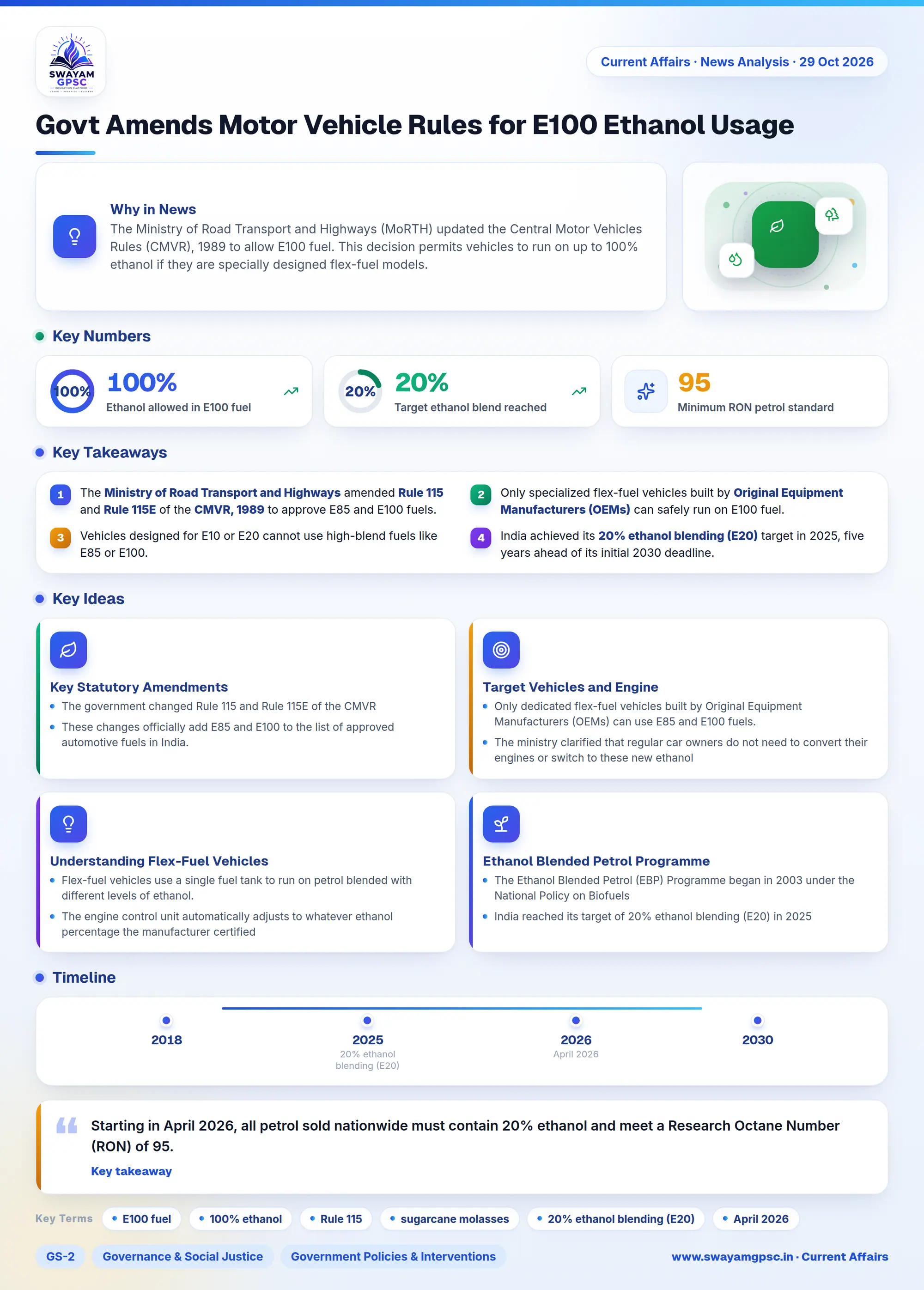
Govt Amends Motor Vehicle Rules for E100 Ethanol Usage
#GS-2 #Governance & Social Justice #Government Policies & Interventions #GS-3 #Environment #Sustainable Development #Economy #Infrastructure #Current Events #National #Rapid Fire CA #Quick Facts For Prelims
Key takeaways
- The Ministry of Road Transport and Highways amended Rule 115 and Rule 115E of the CMVR, 1989 to approve E85 and E100 fuels.
- Only specialized flex-fuel vehicles built by Original Equipment Manufacturers (OEMs) can safely run on E100 fuel.
- Vehicles designed for E10 or E20 cannot use high-blend fuels like E85 or E100.
- India achieved its 20% ethanol blending (E20) target in 2025, five years ahead of its initial 2030 deadline.
- From April 2026, all petrol sold across India must have 20% ethanol and a Research Octane Number (RON) of 95.
Why in News
- The Ministry of Road Transport and Highways (MoRTH) updated the Central Motor Vehicles Rules (CMVR), 1989 to allow E100 fuel.
- This decision permits vehicles to run on up to 100% ethanol if they are specially designed flex-fuel models.
Key Statutory Amendments
- The government changed Rule 115 and Rule 115E of the CMVR, 1989 to regulate official fuel standards and emission testing.
- These changes officially add E85 and E100 to the list of approved automotive fuels in India.
Target Vehicles and Engine Compatibility
- Only dedicated flex-fuel vehicles built by Original Equipment Manufacturers (OEMs) can use E85 and E100 fuels.
- The ministry clarified that regular car owners do not need to convert their engines or switch to these new ethanol blends.
- Cars designed for E10 or E20 blends cannot run on higher blends like E85 or E100 without causing damage.
- Drivers should check the fuel compatibility sticker on their vehicle before filling up with high-ethanol blends.
Understanding Flex-Fuel Vehicles and Ethanol
- Flex-fuel vehicles use a single fuel tank to run on petrol blended with different levels of ethanol.
- The engine control unit automatically adjusts to whatever ethanol percentage the manufacturer certified for the vehicle.
- Ethanol is a renewable biofuel made through sugar fermentation or basic chemical processes.
- In India, producers make ethanol mainly from sugarcane molasses, maize, and surplus food grains.
Ethanol Blended Petrol Programme Progress
- The Ethanol Blended Petrol (EBP) Programme began in 2003 under the National Policy on Biofuels, 2018 to lower oil imports and boost farmer incomes.
- India reached its target of 20% ethanol blending (E20) in 2025, achieving the goal five years ahead of the original 2030 schedule.
- Starting in April 2026, all petrol sold nationwide must contain 20% ethanol and meet a Research Octane Number (RON) of 95.