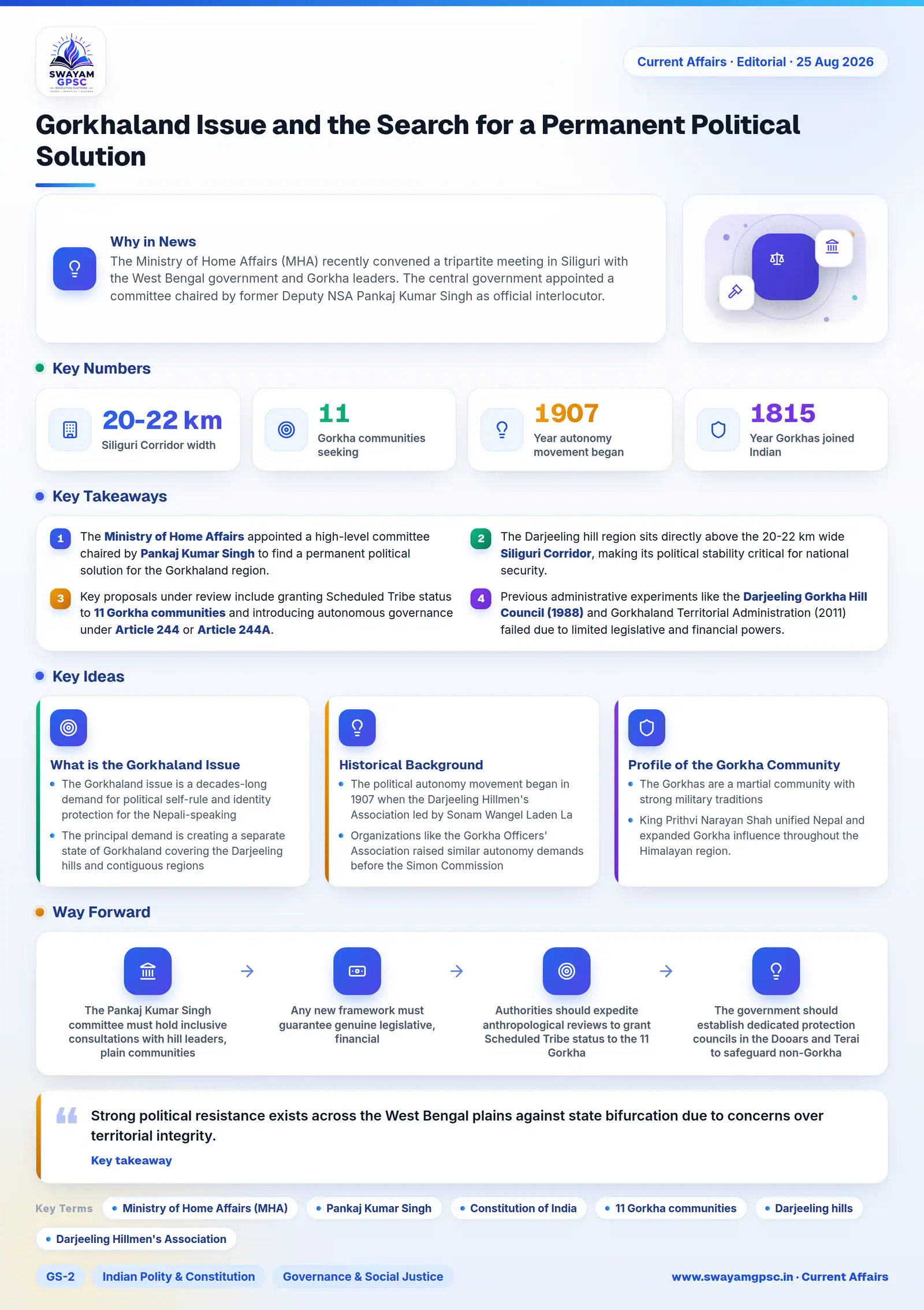
Gorkhaland Issue and the Search for a Permanent Political Solution
#GS-2 #Indian Polity & Constitution #Governance & Social Justice #Current Events #Federalism #Local Government #Gorkhaland Issue #Siliguri Corridor
Key takeaways
- The Ministry of Home Affairs appointed a high-level committee chaired by Pankaj Kumar Singh to find a permanent political solution for the Gorkhaland region.
- The Darjeeling hill region sits directly above the 20-22 km wide Siliguri Corridor, making its political stability critical for national security.
- Key proposals under review include granting Scheduled Tribe status to 11 Gorkha communities and introducing autonomous governance under Article 244 or Article 244A.
- Previous administrative experiments like the Darjeeling Gorkha Hill Council (1988) and Gorkhaland Territorial Administration (2011) failed due to limited legislative and financial powers.
Why in News
- The Ministry of Home Affairs (MHA) recently convened a tripartite meeting in Siliguri with the West Bengal government and Gorkha leaders.
- The central government appointed a committee chaired by former Deputy NSA Pankaj Kumar Singh as official interlocutor.
- This committee will draft an agreement and finalise modalities for a permanent political solution within the framework of the Constitution of India.
- The panel will examine regional governance, direct financial assistance, and a clear roadmap to grant Scheduled Tribe (ST) status to 11 Gorkha communities.
What is the Gorkhaland Issue
- The Gorkhaland issue is a decades-long demand for political self-rule and identity protection for the Nepali-speaking population in northern West Bengal.
- The principal demand is creating a separate state of Gorkhaland covering the Darjeeling hills and contiguous regions of the Terai and Dooars.
- Ethno-linguistic differences drive this movement because the local hill population feels culturally distinct from the Bengali-majority plains.
- Residents in the hills often face identity insecurity and social alienation, making political autonomy vital to affirm their identity as Indian citizens.
- The region complains of long-standing economic neglect despite generating substantial revenue through tea, timber, and tourism.
Historical Background and Administrative History
- The political autonomy movement began in 1907 when the Darjeeling Hillmen's Association led by Sonam Wangel Laden La petitioned British authorities.
- Organizations like the Gorkha Officers' Association raised similar autonomy demands before the Simon Commission in 1929.
- In 1947, the undivided Communist Party of India (CPI) submitted a memorandum to Jawaharlal Nehru demanding a separate region called Gorkhasthan.
- The agitation intensified in 1980 under the Gorkha National Liberation Front (GNLF) led by Subhas Ghising.
- The government established the Darjeeling Gorkha Hill Council (DGHC) in 1988, but it lacked legislative authority and financial independence.
- In 2011, a tripartite agreement created the Gorkhaland Territorial Administration (GTA) with broader administrative powers.
- The GTA failed to meet local aspirations due to bureaucratic friction with state officials, delayed funding, and lack of legislative control over land.
- In October 2025, the Centre appointed Pankaj Kumar Singh to lead fresh tripartite negotiations for a lasting administrative agreement.
Profile of the Gorkha Community
- The Gorkhas are a martial community with strong military traditions, taking their name from the historic Gorkha Kingdom in Nepal.
- King Prithvi Narayan Shah unified Nepal and expanded Gorkha influence throughout the Himalayan region.
- The term Gorkha represents a collective identity comprising diverse ethnic groups such as Gurungs, Magars, Rais, and Limbus.
- Following the Anglo-Nepal War (1814-1816), British military commanders began recruiting Gorkha soldiers into their army.
- Gorkha regiments have served as an integral part of the Indian Army since 1815.
Strategic and Geopolitical Sensitivities
- The Darjeeling hills sit directly above the narrow 20-22 km wide Siliguri Corridor, also known as the Chicken's Neck.
- This narrow strip serves as the sole land bridge connecting mainland India with its North-Eastern states.
- The region shares international borders with Nepal, Bhutan, and sits near Bangladesh, making local political stability critical for national security.
- Unrest or blockades along NH-10, which serves as the primary lifeline to Sikkim, create severe logistical challenges for military mobilization.
Possible Constitutional Options Under Consideration
- The Centre could establish a centrally administered Union Territory covering the hills, Terai, and Dooars under Article 3 of the Constitution.
- Parliament could create an autonomous sub-state within West Bengal using powers under Article 244A.
- The government could extend the Sixth Schedule (Article 244) to convert the GTA into an Autonomous District Council with legislative powers over land and taxes.
- Authorities could set up an enhanced statutory body with direct central funding and administrative links to the Ministry of Home Affairs.
Challenges in Solving the Gorkhaland Issue
- Strong political resistance exists across the West Bengal plains against state bifurcation due to concerns over territorial integrity.
- The foothill regions of Terai and Dooars feature complex demographics with mixed populations of Gorkhas, Adivasis, Rajbanshis, and Bengalis.
- Intra-hill political rivalries among groups like GJM, GNLF, Hamro Party, and Bharatiya Gorkha Prajatantrik Morcha hinder unified consensus.
- The local economy depends heavily on seasonal tourism and a struggling tea industry, requiring permanent central fiscal support.
Way Forward
- The Pankaj Kumar Singh committee must hold inclusive consultations with hill leaders, plain communities, and state authorities.
- Any new framework must guarantee genuine legislative, financial, and policing powers rather than changing administrative labels.
- Authorities should expedite anthropological reviews to grant Scheduled Tribe status to the 11 Gorkha sub-tribes.
- The government should establish dedicated protection councils in the Dooars and Terai to safeguard non-Gorkha minority communities.
- Economic initiatives must focus on eco-tourism, organic farming, tea worker land rights, and schemes like PM-DevINE and PRASAD.