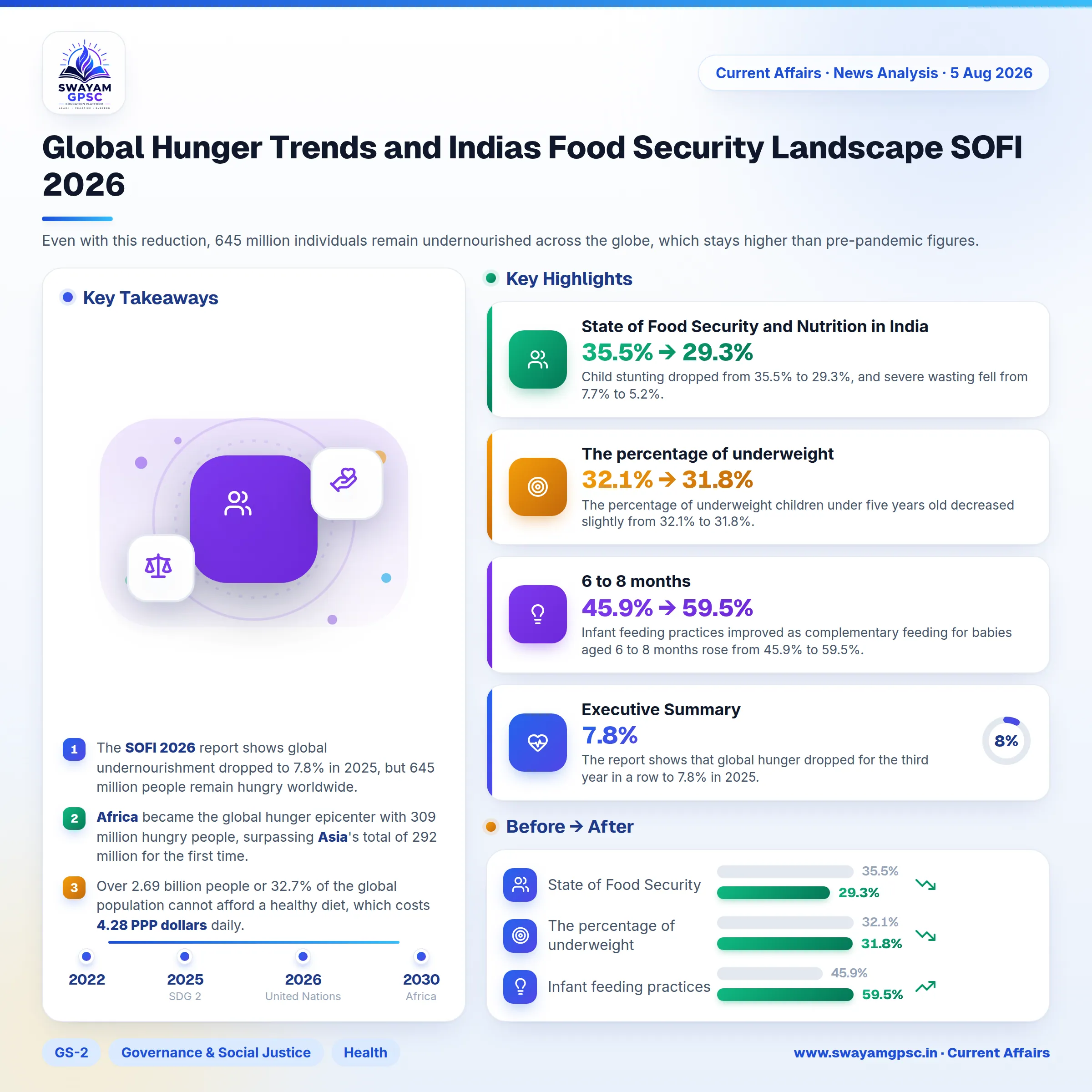
Global Hunger Trends and Indias Food Security Landscape SOFI 2026
#GS-2 #Governance & Social Justice #Health #Poverty #Hunger #Women #Vulnerable Sections #GS-3 #Economy #Agriculture #Food Security #Current Events #International #National #Issues Related to Children #Government Policies & Interventions
Key takeaways
- The SOFI 2026 report shows global undernourishment dropped to 7.8% in 2025, but 645 million people remain hungry worldwide.
- Africa became the global hunger epicenter with 309 million hungry people, surpassing Asia's total of 292 million for the first time.
- Over 2.69 billion people or 32.7% of the global population cannot afford a healthy diet, which costs 4.28 PPP dollars daily.
- India significantly helped reduce Southern Asia's undernourishment rate from 13.9% in 2021 to 9.3% in 2025.
- Under NFHS-6, child stunting in India dropped to 29.3%, while 57% of women still suffer from anaemia under NFHS-5.
Why in News
- A joint United Nations report titled The State of Food Security and Nutrition in the World 2026 revealed a historical shift in global hunger patterns. Africa has officially overtaken Asia as the region with the highest number of people experiencing hunger.
Executive Summary
- The report shows that global hunger dropped for the third year in a row to 7.8% in 2025. Despite this progress, 645 million people still suffer from undernourishment and 2.69 billion people cannot afford a healthy diet. This proves that having enough food availability is not sufficient to reach SDG 2.
- Governments must move away from calorie-focused farming towards nutrition-sensitive food systems. This requires diversifying crops, building better storage, making healthy food affordable, and expanding social safety nets through data-driven decisions.
Key Findings of the SOFI 2026 Report
- Global undernourishment dropped from 8.6% in 2022 to 7.8% in 2025, marking three consecutive years of decline.
- Even with this reduction, 645 million individuals remain undernourished across the globe, which stays higher than pre-pandemic figures.
- Africa became the global hunger epicenter with 309 million people or 20% of its population facing hunger, passing Asia at 292 million or 6%.
- Projections show that 56% of the total undernourished global population will reside in Africa by 2030.
- Severe conflicts in Sudan and the Democratic Republic of the Congo, along with climate change, high energy costs, and expensive fertilizers, destroyed food production across Africa.
- Global food insecurity improved as 2.1 billion people or 25.8% faced moderate or severe food insecurity in 2025, though levels remain higher than pre-pandemic times.
- High food inflation raised the Cost of a Healthy Diet to 4.28 PPP dollars per person every day in 2025.
- Nearly 2.69 billion people or 32.7% of the world population could not afford a healthy diet, with Africa experiencing the highest unaffordability at 66.6%.
- The UN Statistical Commission approved Minimum Dietary Diversity for Children and Women in March 2025 to track progress on SDG Target 2.2.
- Only 30.8% of children aged 6 to 23 months met minimum dietary diversity standards, showing almost no progress from 29.4% ten years ago.
- Around 62.7% of women aged 15 to 49 years achieved minimum dietary diversity, meaning nearly one out of three women lacks a healthy diet.
- World progress toward 2030 nutrition goals for stunting, wasting, anaemia, low birthweight, and obesity remains far too slow.
- Focusing policy only on staple grains while dealing with weak supply chains and high input costs makes nutritious food far too expensive.
India and the SOFI 2026 Report
- India drove progress in Southern Asia, helping lower regional undernourishment from 13.9% in 2021 to 9.3% in 2025.
- India plays a massive role in global stats, as excluding India would turn the lower-middle-income trend from an improvement into a worsening of diet affordability.
- India helps keep Southern Asia on track for 2030 targets regarding child stunting and overweight control, though maternal anaemia remains serious.
- Rising retail prices for fruits and vegetables drive up the overall cost of maintaining a healthy diet across South Asia.
About the SOFI Report
- The SOFI report is an annual study published jointly by the FAO, IFAD, UNICEF, WFP, and WHO.
- This report evaluates global progress toward reaching SDG 2.1 to end hunger and SDG 2.2 to eliminate all forms of malnutrition.
Cost of a Healthy Diet
- The FAO and the World Bank introduced the Cost of a Healthy Diet index in 2020.
- This index calculates the lowest daily cost needed to buy a balanced diet made of six essential food groups.
- The food basket provides 2,330 kilocalories per day based on core principles of adequate, balanced, diverse, and moderate nutrition.
- Calculations rely on Purchasing Power Parity dollars derived from the World Bank International Comparison Program.
State of Food Security and Nutrition in India
- India built the largest food safety net globally, protecting over 81 crore citizens under the NFSA 2013 and PMGKAY.
- The National Food Security & Nutrition Mission boosts crop yields while the TPDS covers 75% of rural and 50% of urban households with free grains.
- Combining strong agricultural output with fair grain distribution forms the foundation of national nutrition security.
- Data comparing NFHS-5 and NFHS-6 shows clear improvements in child health indicators across India.
- Child stunting dropped from 35.5% to 29.3%, and severe wasting fell from 7.7% to 5.2%.
- The percentage of underweight children under five years old decreased slightly from 32.1% to 31.8%.
- Infant feeding practices improved as complementary feeding for babies aged 6 to 8 months rose from 45.9% to 59.5%.
- Despite these gains, overall malnutrition rates stay high due to long-standing generational gaps in nutrition.
- The PM POSHAN scheme supplies hot meals to school students from Bal Vatika to Class VIII to boost health and attendance.
- According to NFHS-5, anaemia affects 57% of women aged 15 to 49 years and 67.1% of young children.
- Programs like Anemia Mukt Bharat and Rice Fortification work to eliminate hidden hunger caused by missing essential micronutrients.
Draft National Food Security Amendment Bill 2026
- The proposed bill changes Antyodaya Anna Yojana rations from 35 kg per family to 7 kg per person monthly.
- The central government aims to eliminate unfair per-person differences and match grain distribution with actual family sizes.
- Critics worry that smaller families with under five members will receive less total grain, harming vulnerable households.
Challenges in Indias Food Architecture
- Government procurement favors rice and wheat, which discourages farmers from growing pulses, oilseeds, and Shree Anna millets.
- Lack of cold storage and modern transport creates large post-harvest losses in perishable foods like milk, fruits, and vegetables.
- While welfare schemes provide calories, giving poor families daily access to protein-rich items like eggs and pulses remains difficult.
- Ration lists still rely on the 2011 Census, which leaves many migrant workers and newly poor urban families without benefits despite digital tools like ONORC.
- Over 50% of India's farmland depends directly on rainfall, leaving crop yields vulnerable to extreme weather caused by climate change.
Way Forward
- The government should shift research funds and farming incentives toward growing fruits, vegetables, pulses, and legumes.
- Investing in cold storage and transport can cut food costs because post-farm processes make up 70% to 75% of retail prices.
- Connecting rural farms directly to urban markets through tailored regional plans will lower prices for fresh produce.
- Welfare schemes must expand beyond basic food grains to subsidize nutrient-dense items like dairy, eggs, and pulses.
- Setting up real-time tracking of local food prices will help officials intervene quickly when healthy diets become unaffordable.
- Policy reforms should support small farmers, women, and youth while using true-cost accounting to protect the environment.
Conclusion
- Although world hunger declined for three straight years, healthy diets remain out of reach for almost one-third of global citizens.
- India must shift focus from calorie intake to diet diversity by strengthening PM POSHAN, Anemia Mukt Bharat, and local farm chains.