Global Gender Gap Index 2026: Key Findings and Lessons for India
#GS-1 #GS-2 #GS-3 #Indian Society #Women #Social Justice #Governance & Social Justice #Current Events #National #Economy #Employment #Global Gender Gap Index #World Economic Forum
Key takeaways
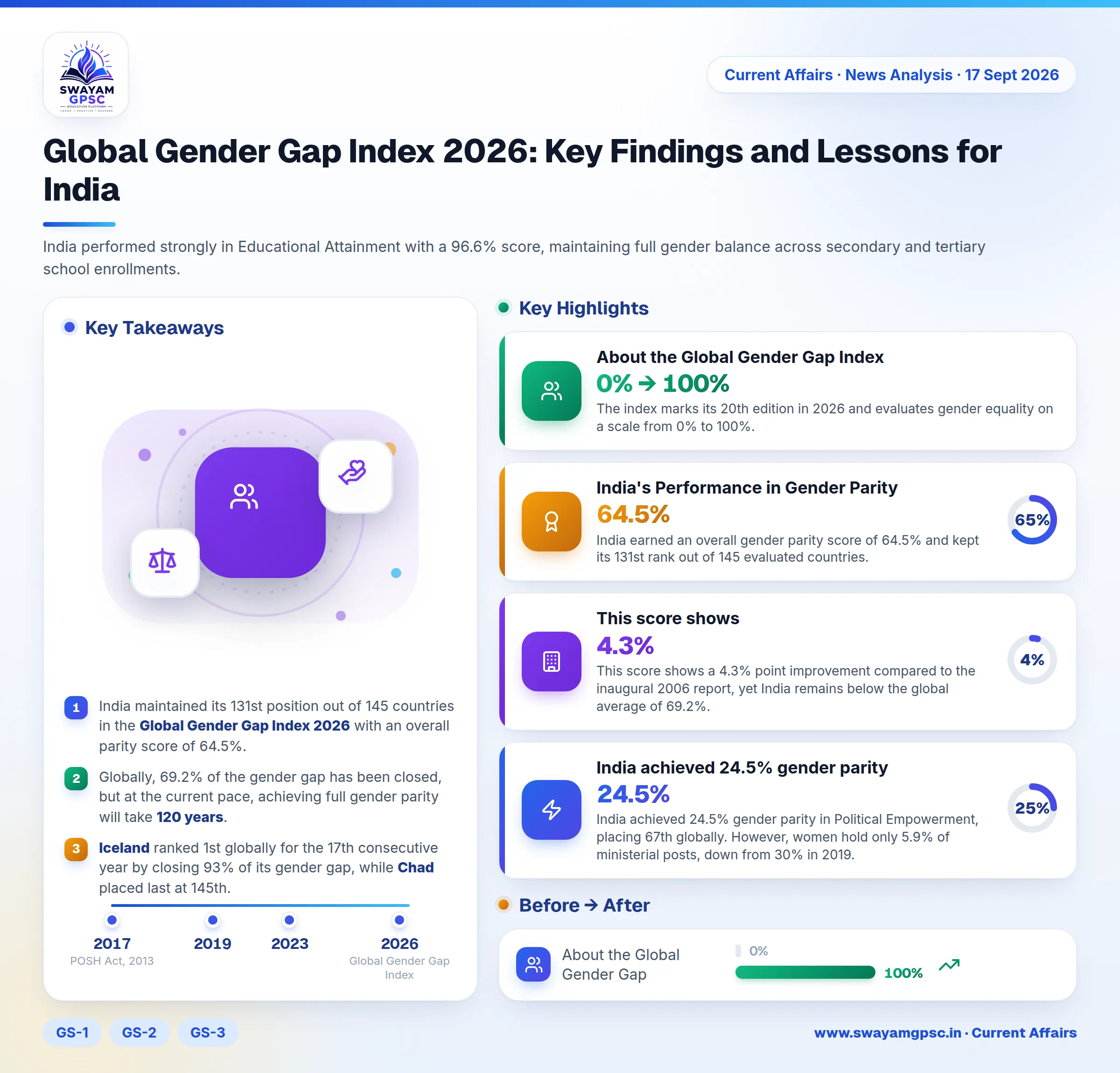
- India maintained its 131st position out of 145 countries in the Global Gender Gap Index 2026 with an overall parity score of 64.5%.
- Globally, 69.2% of the gender gap has been closed, but at the current pace, achieving full gender parity will take 120 years.
- Iceland ranked 1st globally for the 17th consecutive year by closing 93% of its gender gap, while Chad placed last at 145th.
- India achieved its highest score in Educational Attainment at 96.6%, but lags severely in Economic Participation at 41.2%.
- Closing India's workforce gender gap could increase the nation's GDP by 27% according to estimates by the International Monetary Fund (IMF).
Why in News
- India secured the 131st position among 145 nations in the Global Gender Gap Index 2026, which the World Economic Forum (WEF) published.
India's Performance in Gender Parity
- India earned an overall gender parity score of 64.5% and kept its 131st rank out of 145 evaluated countries.
- This score shows a 4.3% point improvement compared to the inaugural 2006 report, yet India remains below the global average of 69.2%.
- India achieved 24.5% gender parity in Political Empowerment, placing 67th globally. However, women hold only 5.9% of ministerial posts, down from 30% in 2019.
- Economic Participation remains India's weakest area, with women attaining only 41.2% parity with men in workforce opportunities.
- Although female representation in technical and professional positions doubled to 49.9% since 2006, women hold just 13.1% of senior leadership roles.
- India performed strongly in Educational Attainment with a 96.6% score, maintaining full gender balance across secondary and tertiary school enrollments.
- India scored 95.6% in Health and Survival, but the sex ratio at birth in 2026 is nearly one percentage point lower than in 2006.
Global Findings and Trends
- Iceland led the world for the 17th straight year by closing 93% of its gender gap, followed by Finland and Norway.
- Namibia ranked 4th globally to lead Sub-Saharan Africa, while Australia joined the top 10 countries for the first time.
- Chad ranked lowest at 145th, with Pakistan and Iran joining it in the bottom three ranks.
- The world has closed 69.2% of its total gender gap, but full equality will take 120 years at current progress rates.
- Women occupy 19.1% of corporate chief executive officer roles globally, while female political leadership has dropped back to 2016 levels.
- Women are twice as likely as men to pause their careers for childcare, often experiencing slower advancement upon returning to work.
- More than 80% of surveyed countries have instituted gender quotas since 1995 to boost female legislative representation.
- A major gap exists in technology, where women represent under 20% of artificial intelligence engineers globally.
About the Global Gender Gap Index
- The World Economic Forum (WEF), located in Geneva, publishes this report every year since its creation in 2006.
- The index marks its 20th edition in 2026 and evaluates gender equality on a scale from 0% to 100%.
- The Economic Participation and Opportunity subindex measures workforce rates, equal pay for equal work, and senior managerial positions.
- The Educational Attainment subindex checks female-to-male literacy rates alongside enrollment across primary, secondary, and higher education levels.
- The Health and Survival subindex examines the sex ratio at birth to track missing female births alongside healthy life expectancy.
- The Political Empowerment subindex tracks female representation in cabinet roles, parliamentary seats, and executive leadership over 50 years.
Challenges
- Data from the Periodic Labour Force Survey (PLFS) in August 2026 shows overall female labor participation at 34.8%.
- Rural female participation reached 39.4% due to distress-driven farm work, while urban participation stayed low at 25.4%.
- Unemployment rises among women with higher qualifications, showing that corporate workplaces fail to recruit and keep skilled female talent.
- Unpaid domestic responsibilities and caregiving restrict women from entering formal jobs, creating a severe motherhood penalty.
- Inadequate street lighting, unsafe public transit, and fear of violence limit the distance women can travel for work or study.
- Lack of smartphone ownership and poor digital literacy risk excluding women from modern digital jobs during the Fourth Industrial Revolution.
- Despite reserving 33% of local government seats under the 73rd and 74th Constitutional Amendments, male relatives often exercise actual political power.
- Protective laws like the Maternity Benefit (Amendment) Act, 2017 and POSH Act, 2013 suffer from weak enforcement across informal workplaces where 85% of working women are employed.
- Women from Scheduled Castes (SCs) and Scheduled Tribes (STs) face double discrimination from social background and gender in land ownership and pay.
- The National Family Health Survey (NFHS-5) reported that over 50% of women in India suffer from anemia, reducing productivity and health.
- Limited access to family planning and school hygiene facilities forces girls to drop out, cutting short their education and career prospects.
- Environmental degradation forces rural women to spend hours collecting water and firewood, increasing unpaid work and limiting employment time.
Way Forward
- India must adopt the 3R framework to recognize, reduce, and redistribute unpaid domestic work through public infrastructure and paternity leave.
- The government should replace full employer funding under the Maternity Benefit (Amendment) Act, 2017 with a state-backed maternity fund to prevent workplace hiring bias.
- Ministries need to practice outcome-based Gender-Responsive Budgeting rather than simply tracking monetary allocations.
- Implementing the Nari Shakti Vandan Adhiniyam, 2023 will bring more female lawmakers into Parliament and state assemblies.
- Creating targeted science scholarships and tech hiring incentives will help women acquire critical skills for digital economy roles.
- Public campaigns like Beti Bachao Beti Padhao must continue addressing social biases regarding daughter preference and female ownership of assets.
- Investing 2% of national gross domestic product into care infrastructure could generate 11 million jobs according to the International Labour Organization (ILO).
- Strengthened implementation of POSHAN Abhiyaan can improve nutrition outcomes and reduce anemia among adolescent girls and mothers.
- Expanding collateral-free credit through the Stand-Up India scheme will help women establish new business ventures.
Conclusion
- According to the International Monetary Fund (IMF), bringing women into the workforce at equal rates could boost India's economy by 27%.
- Achieving gender equality under SDG 5 remains an essential foundation for India to become a developed economy by Viksit Bharat 2047.