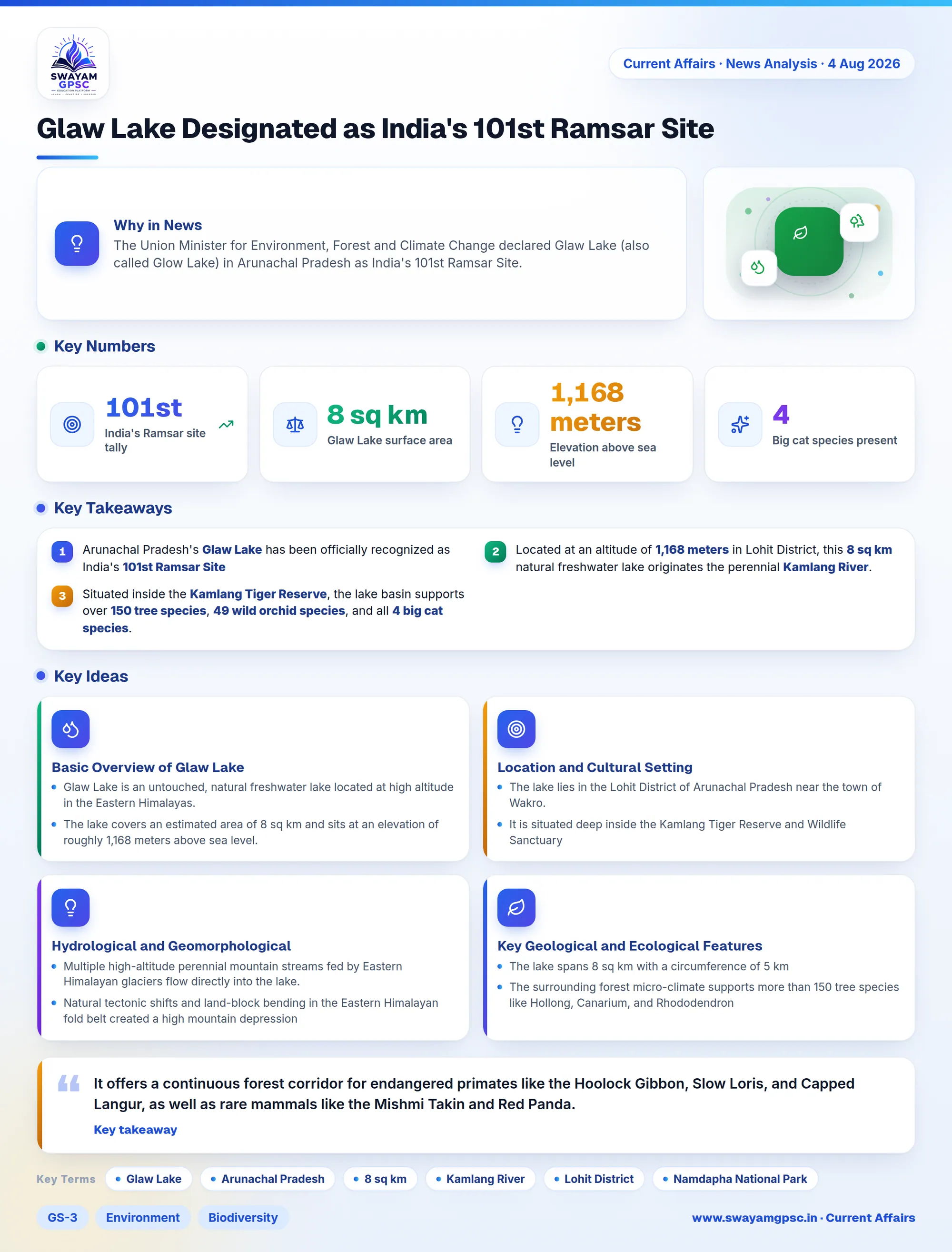
Glaw Lake Designated as India's 101st Ramsar Site
#GS-3 #Environment #Biodiversity #Current Events #National #Ramsar Sites #Arunachal Pradesh #Wildlife
Key takeaways
- Arunachal Pradesh's Glaw Lake has been officially recognized as India's 101st Ramsar Site, marking the state's very first international wetland designation.
- Located at an altitude of 1,168 meters in Lohit District, this 8 sq km natural freshwater lake originates the perennial Kamlang River.
- Situated inside the Kamlang Tiger Reserve, the lake basin supports over 150 tree species, 49 wild orchid species, and all 4 big cat species.
Why in News
- The Union Minister for Environment, Forest and Climate Change declared Glaw Lake (also called Glow Lake) in Arunachal Pradesh as India's 101st Ramsar Site.
- This announcement gives Arunachal Pradesh its first Ramsar Site and pushes India's total number of internationally protected wetlands beyond 100.
Basic Overview of Glaw Lake
- Glaw Lake is an untouched, natural freshwater lake located at high altitude in the Eastern Himalayas.
- The lake covers an estimated area of 8 sq km and sits at an elevation of roughly 1,168 meters above sea level.
- It acts as a primary water source for the perennial Kamlang River.
Location and Cultural Setting
- The lake lies in the Lohit District of Arunachal Pradesh near the town of Wakro.
- It is situated deep inside the Kamlang Tiger Reserve and Wildlife Sanctuary, between the Lang River to the north and Namdapha National Park to the south.
- The surrounding landscape forms the traditional homeland of the Miju Mishmi, Digaro Mishmi, and Idu Mishmi tribal communities.
Hydrological and Geomorphological Origin
- Multiple high-altitude perennial mountain streams fed by Eastern Himalayan glaciers flow directly into the lake.
- Natural tectonic shifts and land-block bending in the Eastern Himalayan fold belt created a high mountain depression that holds alpine runoff water.
Key Geological and Ecological Features
- The lake spans 8 sq km with a circumference of 5 km, serving as the main headwater for the Kamlang River in this biodiversity hotspot.
- The surrounding forest micro-climate supports more than 150 tree species like Hollong, Canarium, and Rhododendron, along with 49 recorded wild orchid species.
- This basin forms a rare eco-zone where all 4 big cat species live together: Bengal Tiger, Indian Leopard, Clouded Leopard, and Snow Leopard.
- It offers a continuous forest corridor for endangered primates like the Hoolock Gibbon, Slow Loris, and Capped Langur, as well as rare mammals like the Mishmi Takin and Red Panda.