Genetic Innovations and Gene Editing in Indian Agriculture
#GS-3 #Science & Technology #Economy #Biotechnology #Agriculture #Food Security #Climate Change
Key takeaways
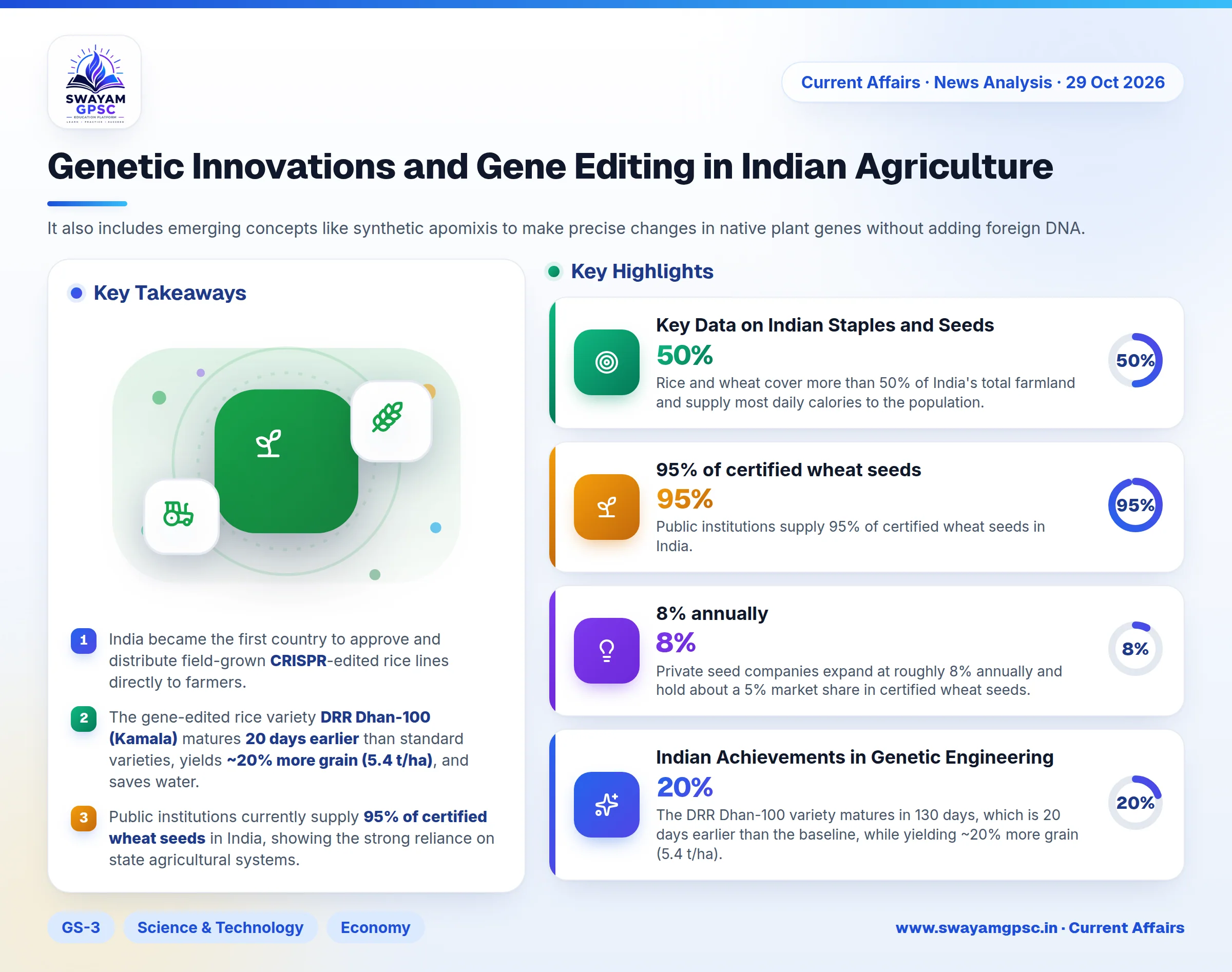
- India became the first country to approve and distribute field-grown CRISPR-edited rice lines directly to farmers.
- The gene-edited rice variety DRR Dhan-100 (Kamala) matures 20 days earlier than standard varieties, yields ~20% more grain (5.4 t/ha), and saves water.
- Public institutions currently supply 95% of certified wheat seeds in India, showing the strong reliance on state agricultural systems.
- Central agricultural authorities recently notified 184 new climate-resilient crop varieties across 25 crops to protect future food production.
- The Pusa DST Rice-1 variety offers 10% to 30% higher yields in salty and alkaline soils by editing the OsDST gene.
Why in News
- The former Principal Scientific Adviser emphasized using new genetic technologies like CRISPR gene editing and apomixis.
- These modern agricultural tools can protect India's essential staple crops against severe climate stress.
About Genetic Innovations in Indian Agriculture
- Modern genetic innovation uses molecular biology tools like CRISPR-Cas genome editing under SDN-1 and SDN-2 categories.
- It also includes emerging concepts like synthetic apomixis to make precise changes in native plant genes without adding foreign DNA.
Key Data on Indian Staples and Seeds
- Rice and wheat cover more than 50% of India's total farmland and supply most daily calories to the population.
- Public institutions supply 95% of certified wheat seeds in India.
- Private seed companies expand at roughly 8% annually and hold about a 5% market share in certified wheat seeds.
- Private companies lead the commercial hybrid rice market, while public research institutes focus on supporting small and marginal farmers.
- The National Seeds Corporation (NSC), founded in 1963, works with State Agricultural Universities to multiply breeder seeds into certified foundation seeds.
Indian Achievements in Genetic Engineering
- India became the first nation in the world to approve and distribute field-grown CRISPR-edited rice lines directly to farmers.
- Researchers at ICAR developed DRR Dhan-100 (Kamala), which targets a specific enzyme gene to increase grain spikelets.
- The DRR Dhan-100 variety matures in 130 days, which is 20 days earlier than the baseline, while yielding ~20% more grain (5.4 t/ha).
- Engineers at ICAR-IARI created Pusa DST Rice-1 by editing the OsDST gene, lowering leaf stomata count and increasing yields by 10% to 30% in saline and alkaline soils.
- Both DRR Dhan-100 and Pusa DST Rice-1 carry a clean molecular footprint because foreign gene-editing tools were completely bred out of the commercial seeds.
- Central agricultural authorities recently notified 184 new crop varieties across 25 crops, including climate-resilient wheat strains planned for release within three years.
Global Achievements in Crop Genetics
- Researchers at UC Davis achieved over 90% clonal seed efficiency using synthetic apomixis in rice, allowing hybrid vigor to pass down without seed segregation.
- Argentina's Bioceres Crop Solutions developed HB4 Drought-Tolerant Wheat using a sunflower gene (HaHB4), earning commercial approvals in Argentina, Brazil, Paraguay, and from the USDA in August 2024.
- International consortia between Australian plant breeders and biotech firms are carrying out open-field trials of CRISPR-edited wheat aiming for 10% yield gains.
Importance of Genetic Innovations
- Precision genetic tools strengthen climate resilience and protect crops against abiotic stress without lowering harvests.
- For example, Pusa DST Rice-1 shows over 65% plant survival in salty coastal soil, compared to less than 20% survival for traditional varieties.
- Shorter crop growth cycles improve resource efficiency by using less groundwater, electricity, and chemical fertilizer.
- For example, the 20-day shorter cycle of DRR Dhan-100 reduces groundwater extraction and cuts seasonal methane emissions from flooded fields.
- Apomixis helps small farmers by letting them save and replant high-yielding hybrid seeds every year without buying fresh commercial seeds.
- For example, small farmers growing rice and corn can retain strong hybrid yields across seasons without paying recurring retail costs.
- Advanced gene tools strengthen national food security by speeding up breeding cycles from decades to just a few weeks.
- For example, scientists can recreate helpful wild plant traits through precise CRISPR editing in weeks instead of waiting through years of cross-breeding.
Challenges Associated with Adoption
- Past public debates and slow regulatory approvals for transgenic crops turned talented Indian biology students away from agriculture toward biomedical fields.
- For example, university plant genetics departments struggle to attract doctoral students compared to human cellular and computer biology labs.
- Wheat has a complex hexaploid genome and self-pollinating flowers, making commercial hybrid wheat much harder to create than hybrid rice or Bt-cotton.
- Different global regulations on whether SDN-1 and SDN-2 gene-edited crops count as GMOs create obstacles for international trade.
- For example, Indian agricultural exporters face trade rejections in European or East Asian markets that follow strict testing protocols on gene-edited grain shipments.
- Translating laboratory discoveries to actual farm fields requires extensive testing across different weather zones and soil conditions.
- For example, lab-tested drought-resistant plants sometimes fail in real fields when hit by unexpected heavy rains or sudden pest attacks.
Way Forward
- Reinvest in foundational plant genetics by funding national research fellowships in plant physiology, genomics, and disease defense.
- Keep regulatory pathways clear and efficient by exempting SDN-1, SDN-2, and apomictic crops from heavy GM rules when no foreign DNA remains.
- Democratize intellectual property by allowing public research institutes like ICAR to share gene-edited parent seeds freely with domestic seed producers.
- Fast-track field trials for apomictic rice, corn, and sorghum across different agricultural zones to test seed performance over several generations.
- Strengthen delivery networks between the National Seeds Corporation (NSC) and private distributors to supply affordable gene-edited seeds to small farmers.
Conclusion
- Precision tools like CRISPR and apomixis offer clear paths to build climate-smart crops without inserting foreign DNA.
- Varieties like DRR Dhan-100 and Pusa DST Rice-1 prove that domestic research institutes can solve practical farm challenges.
- Expanding public investments in plant biology and streamlining seed delivery will protect national food security and support smallholder farmers.