Gen Z and the Transformation of Indian Politics
#GS-2 #Governance & Social Justice #Indian Polity & Constitution #Current Events #GS-3 #Economy #GS-1 #Indian Society #Education #Employment #National #Gen Z #Youth Politics
Key takeaways
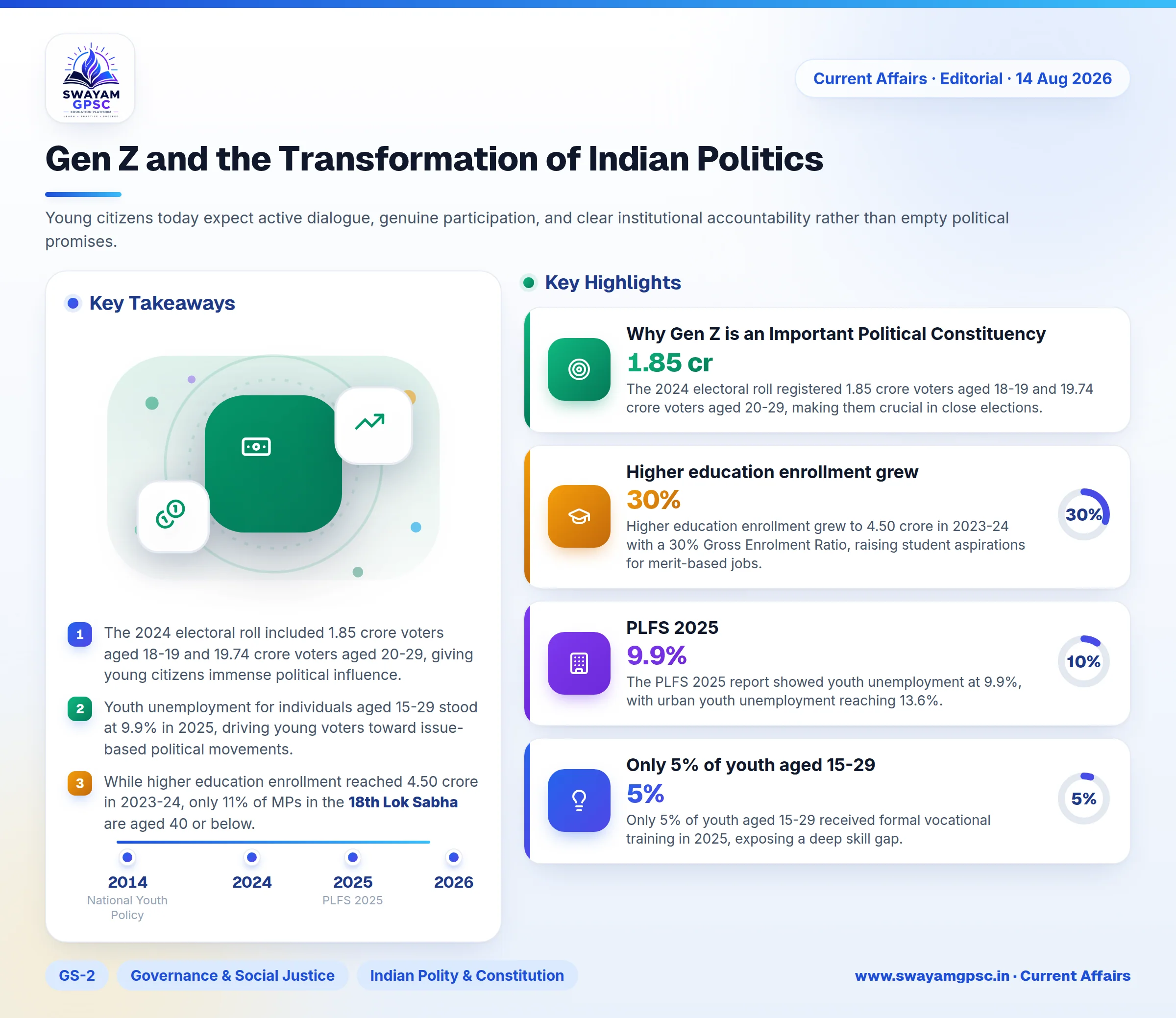
- The 2024 electoral roll included 1.85 crore voters aged 18-19 and 19.74 crore voters aged 20-29, giving young citizens immense political influence.
- Youth unemployment for individuals aged 15-29 stood at 9.9% in 2025, driving young voters toward issue-based political movements.
- While higher education enrollment reached 4.50 crore in 2023-24, only 11% of MPs in the 18th Lok Sabha are aged 40 or below.
- India recorded over 1.066 billion broadband subscriptions by March 2026, enabling rapid digital political mobilization across the country.
Why in News
- In July 2026, widespread youth protests over examination leaks and recruitment delays led to the resignation of the Education Minister.
- Memes created by the Cockroach Janta Party (CJP) sparked these nationwide protests, forcing the government to announce major examination reforms.
- This political movement highlighted how traditional political parties are struggling to connect with a new generation of youth voters.
- Young citizens today expect active dialogue, genuine participation, and clear institutional accountability rather than empty political promises.
What is Meant by Gen Z?
- India does not have a formal legal definition for Generation Z.
- Most global researchers define Gen Z as individuals born between 1997 and 2012.
- In contrast, the National Youth Policy, 2014 defines youth as individuals between 15 and 29 years of age.
- Therefore, Gen Z and youth are overlapping terms, with voting-age Gen Z citizens currently falling in the 18-29 age bracket.
Why Gen Z is an Important Political Constituency
- The 2024 electoral roll registered 1.85 crore voters aged 18-19 and 19.74 crore voters aged 20-29, making them crucial in close elections.
- Higher education enrollment grew to 4.50 crore in 2023-24 with a 30% Gross Enrolment Ratio, raising student aspirations for merit-based jobs.
- The PLFS 2025 report showed youth unemployment at 9.9%, with urban youth unemployment reaching 13.6%.
- Only 5% of youth aged 15-29 received formal vocational training in 2025, exposing a deep skill gap.
- India reached 1.066 billion broadband subscriptions by March 2026, though rural internet access still lags behind urban areas.
- In the 18th Lok Sabha, the average age of MPs is 56 years, and only 11% of members are aged 40 or below.
Emerging Features of Gen Z Politics
- Young citizens focus on specific issues like exam leaks, climate change, or corruption rather than sticking to a political party.
- Digital networks allow youth to immediately respond to, critique, and fact-check political messages in real time.
- Memes and satire serve as effective political tools that lower participation costs and challenge institutional authority.
- Young voters value political figures who appear unscripted, honest, and directly accessible on digital platforms.
- Modern political movements blend online digital grievances with rapid offline street protests to pressure public institutions.
Why Traditional Parties Struggle to Connect
- Traditional political parties rely on top-down hierarchies, whereas young voters operate through flat, online networks.
- Political parties run youth wings but rarely give young leaders actual authority over policy or candidate selection.
- Rising education levels have increased career expectations, making recruitment delays and exam leaks feel like direct attacks on merit.
- Government institutions respond slowly over months, creating frustration among youth who expect real-time solutions.
- Personal experiences with public services, job insecurity, and safety matter more to young voters than traditional political labels.
Lessons from Global Gen Z Movements
- In 2024, student protests in Bangladesh over job quotas escalated into a broader movement that brought down the government.
- Youth-led online campaigns in Kenya during 2024 forced the President to withdraw a proposed tax bill.
- Public anger over social media bans and corruption in Nepal in 2025 resulted in the Prime Minister's resignation.
- Protests in Indonesia during 2026 over fuel prices led the government to officially engage with student leaders.
- India's 2026 exam protests showed that aspirational democracies must establish trustworthy grievance systems to handle youth demands.
How Gen Z Politics Can Strengthen Indian Democracy
- Young voters shift attention away from caste and religious identity toward employment, governance, and administrative performance.
- Digital tools like the ECI's cVIGIL App allow citizens to report Model Code of Conduct violations instantly during elections.
- Campus movements advocate for inclusive policies, gender equality, Human Rights, and better mental health support.
- Youth-led think tanks and data journalists simplify complex Union budgets, forcing parties to present concrete policy manifestos.
- Young citizens challenge family-driven political dynasties by demanding open competition and merit-based leadership.
- Youth activists treat climate change as an urgent emergency, pushing cities to conduct environmental audits and control Air Pollution.
- Gen Z uses digital platforms to defend constitutional principles, including the Basic Structure doctrine, Freedom of Speech, and Secularism.
Challenges
- Online movements often struggle to translate temporary public anger into long-term institutional policy changes.
- Leaderless movements make negotiations difficult and leave protests vulnerable to political hijacking.
- Social media algorithms favor dramatic emotional content, which can increase political polarization and echo chambers.
- AI-generated deepfakes and spread of misinformation undermine public trust in democratic institutions.
- Sharing posts online can lead to performative activism without real civic participation like voting or community work.
- Viral news trends fade quickly, creating strong public focus initially but weak follow-through on policy implementation.
- Digital discussions disproportionately reflect urban and English-speaking populations, excluding digitally disconnected rural citizens.
- Unorganized crowd movements risk turning violent if peaceful democratic discipline is not maintained.
Way Forward
- Political parties must pair young digital leaders with experienced lawmakers to combine fresh ideas with legislative experience.
- Governments must protect the constitutional right to peaceful dissent so young citizens do not lose trust in democracy.
- Platforms like MyGov India should host governance hackathons to invite youth solutions for public policy problems.
- Political parties should establish open primary elections and give genuine decision-making roles to youth leaders.
- Developing digital participation tools allows citizens to monitor government performance continuously.
- Educational programs must build digital literacy and critical thinking to help youth identify misinformation and fake news.
Conclusion
- Generation Z is transforming Indian democracy by demanding active participation, transparency, and personal dignity.
- To build a strong constitutional democracy, India must channel youth energy from street protests into constructive policy solutions.