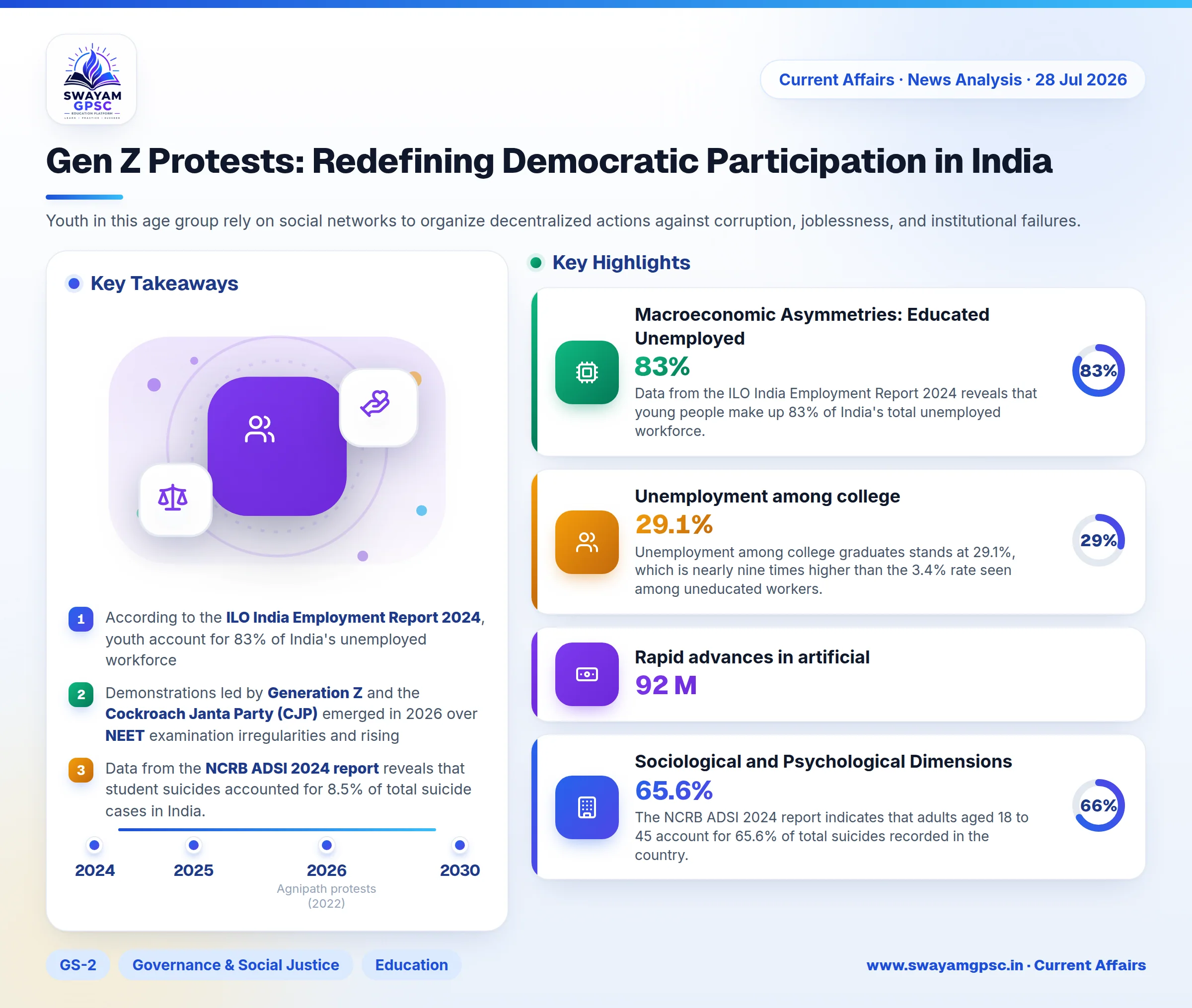
Gen Z Protests: Redefining Democratic Participation in India
#GS-2 #Governance & Social Justice #Education #Indian Society #Vulnerable Sections #GS-3 #Economy #Employment #Current Events #National #Issues Related to Children #Effects of Globalization on Indian Society
Why in News
- Young citizens from **Generation Z** launched nation-wide demonstrations under the banner of the **Cockroach Janta Party (CJP)**.
- These protests focused on irregularities in the **National Eligibility-cum-Entrance Test (NEET)**, high graduate unemployment, and rising costs of education.
- This wave of youth activism mirrors political movements in **Bangladesh**, **Nepal**, **Indonesia**, and **Peru**, placing administrative accountability back at the center of public discussion.
Gen Z and Global Politics
- **Generation Z**, also called **Zoomers**, includes people born between the mid-1990s and early 2010s who grew up with digital technology.
- Youth in this age group rely on social networks to organize decentralized actions against corruption, joblessness, and institutional failures.
- Sustained youth mobilization has forced governments across multiple countries to reverse controversial policies or step down from power.
- In **Bangladesh**, student-led protests against job quotas led to the removal of **Sheikh Hasina**, after which **Muhammad Yunus** took charge as interim leader.
- Anti-corruption demonstrations in **Nepal** changed the political leadership and brought youth-supported figures into administrative roles.
- Protests in **Indonesia** over official privileges during economic distress forced lawmakers to roll back several controversial measures.
- Public anger over crime and political instability in **Peru** intensified frequent changes in top political leadership.
- Demonstrations in **India** regarding **NEET** exam leaks led authorities to accept key demands, including the resignation of the **Education Minister**.
Evolution of Youth Movements in India
- Campus politics in the **1950s** and **1960s** centered on ideological debates led by organizations like the **Students' Federation of India (SFI)** and **Akhil Bharatiya Vidyarthi Parishad (ABVP)**.
- Key developments during this period included the **Anti-Hindi Agitation (1965)** in Tamil Nadu and the Marxist-Leninist **Naxalbari Movement (1967)**.
- Student activism in the **1970s** expanded beyond universities to protest against rising inflation, political corruption, and authoritarian administration.
- Major actions included Gujarat's **Nav Nirman Andolan (1974)** and the **Jayaprakash Narayan (JP) Movement (1974-75)**, which influenced the political environment before the **Emergency (1975-77)**.
- Youth actions during the **1980s** and **1990s** focused on regional identities, migration issues, and social justice policies.
- Notable developments included the **Assam Agitation (1979-85)** led by the **All Assam Students' Union (AASU)** that created the **Assam Accord (1985)**, alongside the **Anti-Mandal Commission Protests (1990)**.
- Expanded internet access in the **2000s** and **2010s** shifted youth campaigns toward civil rights, administrative transparency, and public accountability.
- The **Anna Hazare Movement (2011)** rallied millions for the **Jan Lokpal Bill**, while the **Nirbhaya Protests (2012)** prompted major legal updates for women's safety.
- Present-day protests in the **2020s** are issue-specific and digitally organized around education integrity, job creation, and governance rights.
- Key examples include the **Anti-CAA/NRC campus protests (2019-20)**, **Agnipath protests (2022)**, and the **2026 Cockroach Janta Party (CJP)** demonstrations over **NEET** paper leaks.
Major Shifts in Youth Movements
- Leadership styles shifted from prominent individuals like **Jayaprakash Narayan** and **Anna Hazare** toward leaderless, digitally coordinated campaign networks.
- Young activists moved away from rigid political ideologies toward specific issues like exam integrity, employment generation, and climate policy.
- Modern youth movements operate outside traditional political parties, utilizing digital satire, memes, and viral posts to build widespread support.
- Protesters now combine social media outreach with ground-level demonstrations instead of depending solely on extended street strikes.
- University campus discussions have expanded into nationwide debates on education policy, economic growth, and democratic accountability.
Macroeconomic Asymmetries: Educated Unemployed
- Economic growth in India has failed to generate sufficient formal jobs to absorb the growing number of young candidates entering the labor market.
- Data from the **ILO India Employment Report 2024** reveals that young people make up **83%** of India's total unemployed workforce.
- Unemployment among college graduates stands at **29.1%**, which is nearly nine times higher than the **3.4%** rate seen among uneducated workers.
- Rapid advances in artificial intelligence create additional employment challenges, with the **World Economic Forum's Future of Jobs Report 2025** projecting **92 million** job displacements globally by **2030**.
- Available new positions remain concentrated in the **gig economy**, leaving young workers without steady incomes, pension protection, or career security.
- The rapid spread of private colleges has generated many academic degrees without delivering practical skills needed in modern job markets.
Institutional Decay and Compromised Meritocracy
- Competitive entrance tests like **NEET** and **UPSC** represent the primary pathway for middle-class students to secure upward social mobility.
- Frequent exam paper leaks, proxy test takers, and long recruitment delays destroy public faith in state-managed merit systems.
- Weak official oversight combined with high commercialization in coaching hubs has transformed education into a costly commercial enterprise.
Sociological and Psychological Dimensions
- Young citizens experience deep structural anxiety when societal expectations of financial success cannot be reached through existing institutional options.
- Regular exposure to wealthy lifestyles on social media increases feelings of personal deprivation among young individuals.
- High education loan debts combined with competitive exam failures create severe mental stress for young aspirants across the country.
- The **NCRB ADSI 2024 report** indicates that adults aged **18 to 45** account for **65.6%** of total suicides recorded in the country.
- Student suicides reached **8.5%** of all reported suicide cases in **2024**, with high numbers occurring in coaching hubs like **Kota**, **Chennai**, and **Thrissur**.
- Repeated test cancellations and hiring delays cause valuable talent and middle-class youth to seek opportunities abroad, accelerating brain drain.
Political Economy and Democratic Alienation
- Mainstream political mandates prioritize identity politics and welfare populism while ignoring young workers' concerns about housing, inflation, and jobs.
- State agencies frequently respond to peaceful youth assemblies by issuing restrictions under **Section 163 of the BNSS**, blocking internet access, and monitoring online activities.
- Treating public dissent as a law-and-order issue deepens political alienation among young citizens.
Measures Needed to Address Youth Discontent
- India should implement a **Youth in All Policies (YiAP)** framework similar to **Finland's Youth Policy** to review how public decisions affect young people.
- The government should support emerging sectors like the **Orange Economy**, **Creator Economy**, **Sports Economy**, **Care Economy**, **Space Economy**, and **Green Economy** with targeted investments.
- Establishing a **National Youth Council** based on **Singapore's National Youth Council** and expanding **Youth Parliaments** will give youth a direct voice in policymaking.
- Strengthening fast-track courts under the **Public Examinations (Prevention of Unfair Means) Act, 2024** will speed up trial proceedings for exam paper leak cases.
- Reforming the **National Testing Agency (NTA)** into an independent body using blockchain verification and encrypted digital testing will restore trust in entrance exams.
- Carrying out the **National Education Policy (NEP) 2020** with courses in artificial intelligence, practical skills, and mandatory apprenticeships will boost graduate employability.
- Setting up a national student health program based on **Australia's Headspace** will offer counseling and stress management in universities and coaching institutions.
- Expanding **PARAKH** and encouraging skill-based recruitment will reduce student dependence on high-stakes single entrance examinations.
- Upgrading the **MyGov** digital portal using **Taiwan's vTaiwan model** will enable young citizens to participate directly in policy drafting.
- Building **Youth Innovation Missions** alongside **Atal Innovation Mission** and **Startup India** will encourage young founders to solve social challenges.
- Creating a **National Youth Strategy 2047** based on the **European Union Youth Strategy (2019-2027)** will set clear targets for youth development.
- Providing financial incentives for labor-intensive industries like textiles, footwear, and tourism alongside the **Production Linked Incentive (PLI) Scheme** will generate quality employment.
- Implementing the **Code on Social Security, 2020** through specialized welfare boards will offer health coverage and financial protection to gig workers.
Conclusion
- Youth demonstrations should be viewed as constructive democratic feedback channels rather than simple law-and-order disruptions.
- Channeling the energy and problem-solving skills of young citizens will allow India to convert its demographic advantage into a youth dividend for **Viksit Bharat 2047**.