Future Roadmap for India's Iron and Steel Industry
#GS-1 #Geography #Resources #Industries #GS-2 #Governance & Social Justice #Government Policies & Interventions #GS-3 #Economy #Infrastructure #Growth & Development #Environment #Climate Change #Sustainable Development #Science & Technology #Energy
Key takeaways
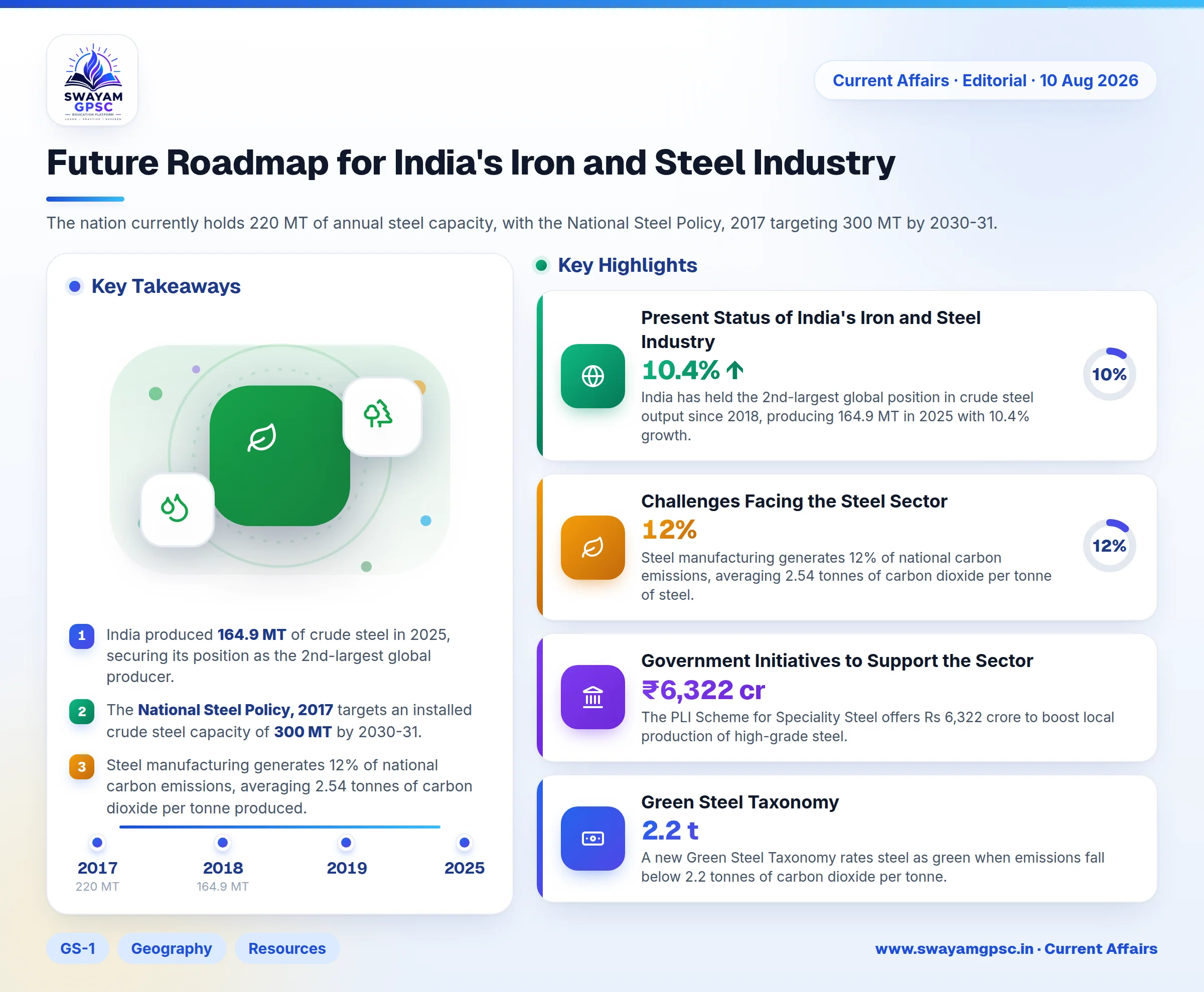
- India produced 164.9 MT of crude steel in 2025, securing its position as the 2nd-largest global producer.
- The National Steel Policy, 2017 targets an installed crude steel capacity of 300 MT by 2030-31.
- Steel manufacturing generates 12% of national carbon emissions, averaging 2.54 tonnes of carbon dioxide per tonne produced.
- India imported over 58 MT of coking coal in 2023-24 to meet domestic industrial demands.
- The government allocated Rs 6,322 crore under the PLI Scheme for Speciality Steel to promote high-value manufacturing.
Why in News
- Economic reforms after 1991 shifted India's steel industry from state control to private investment.
- India became the 2nd-largest crude steel producer globally in 2025, making 164.9 MT behind China's 960.8 MT.
- Future success requires boosting plant capacity, cutting coking coal imports, making speciality steel, and lowering carbon emissions.
Present Status of India's Iron and Steel Industry
- India has held the 2nd-largest global position in crude steel output since 2018, producing 164.9 MT in 2025 with 10.4% growth.
- The nation currently holds 220 MT of annual steel capacity, with the National Steel Policy, 2017 targeting 300 MT by 2030-31.
- Domestic per capita steel usage sits at 100 kg, which the government plans to increase to 158 kg by 2030-31.
- State-run firms like SAIL, RINL, and NMDC Steel operate alongside private giants like Tata Steel, JSW Steel, and Jindal Steel.
- More than 1,000 manufacturers produce steel using both primary blast furnaces and secondary electric arc or induction furnaces.
Location Factors of the Iron and Steel Industry
- Steel making loses weight during production, so plants sit near bulky inputs to cut transport costs.
- Integrated facilities cluster around raw material reserves in the Chota Nagpur Plateau across Jharkhand, Odisha, Chhattisgarh, and West Bengal.
- Cooling blast furnaces requires massive water supplies from major rivers like the Damodar, Subarnarekha, Brahmani, and Mahanadi.
- Transporting raw supplies and finished products relies heavily on key rail lines like Howrah-Nagpur and nearby seaports.
- Modern scrap-based plants now open closer to major consuming markets, including automotive clusters in western and southern India.
- Densely populated hinterlands provide a steady supply of affordable skilled and semi-skilled workers.
Major Integrated Steel Plants of India
- TISCO in Jamshedpur was founded in 1907 by Jamshedji Tata near the Subarnarekha and Kharkai rivers.
- IISCO in Burnpur uses water from the Damodar River and operates under public ownership by SAIL.
- Visvesvaraya Iron and Steel in Bhadravati started in 1923 and gets water from the Bhadra River.
- Bhilai Steel Plant in Chhattisgarh was set up with assistance from the USSR during the Second Five-Year Plan.
- Rourkela Steel Plant in Odisha was built with West Germany collaboration along the Brahmani River.
- Durgapur Steel Plant in West Bengal was developed with help from the United Kingdom near the Damodar River.
- Bokaro Steel Plant in Jharkhand was established with USSR support near the Bokaro and Damodar rivers.
- Visakhapatnam Steel Plant in Andhra Pradesh serves as India's first shore-based facility with direct seaport access.
Strategic Importance of Iron and Steel Industry
- Steel fuels key infrastructure like railways, highways, ports, and bridges while linking strongly to manufacturing industries.
- The goal of reaching 300 MT capacity attracts massive private investments into mining, equipment, and downstream processing.
- High-grade domestic steel supports defense and energy projects, including submarines, nuclear plants, and electric vehicles for Atmanirbhar Bharat.
- Integrated steel hubs drive regional growth and generate massive direct and indirect jobs in areas like Bhilai, Rourkela, and Hazira.
- Renewable energy technologies like wind turbines and solar frameworks require vast amounts of steel to clean the economy.
Challenges Facing the Steel Sector
- India imported more than 58 MT of coking coal in 2023-24 because domestic coal has high ash levels.
- Steel manufacturing generates 12% of national carbon emissions, averaging 2.54 tonnes of carbon dioxide per tonne of steel.
- Small and medium producers struggle to fund cleaner technologies for their coal-based furnaces without financial help.
- Foreign suppliers still provide high-value materials like grain-oriented electrical steel, automotive grades, and specialized aerospace alloys.
- Surplus global supply leads to cheap imports, prompting officials to propose a 12% safeguard duty for 200 days in 2025.
- Mining and smelting cause deforestation, water pollution, and land damage in resource-rich regions across the country.
- Technical gaps remain in advanced methods like green hydrogen reduction, carbon capture, and artificial intelligence automation.
Government Initiatives to Support the Sector
- The National Steel Policy, 2017 sets clear targets for 300 MT capacity and higher per capita consumption by 2030-31.
- The PLI Scheme for Speciality Steel offers Rs 6,322 crore to boost local production of high-grade steel.
- The DMI&SP Policy mandates that government procurement projects give priority to domestically produced iron and steel.
- The Steel Scrap Recycling Policy, 2019 establishes formal recycling centers to increase domestic scrap supplies for furnaces.
- A new Green Steel Taxonomy rates steel as green when emissions fall below 2.2 tonnes of carbon dioxide per tonne.
- The official Green Steel Roadmap outlines clean pathways using renewable power, natural gas, scrap, and carbon capture.
- The National Green Hydrogen Mission aims to replace coking coal with hydrogen in future steel manufacturing.
Way Forward
- Expansion plans must align with actual market demand and raw material availability to prevent excessive industry debt.
- Existing blast plants should focus on energy recovery, while new units must shift toward electric arc furnaces and green hydrogen.
- Government agencies should adopt green procurement policies that offer price support for verified low-emission steel products.
- Establishing a Green Steel Technology Upgradation Fund will help smaller producers modernize their plants with cleaner machinery.
- Improving coal washing facilities and forming international alliances will reduce dependency on foreign coking coal.
- Building green industrial clusters will allow plants to share renewable energy, hydrogen supplies, and steel slag waste.
- Producers should shift focus from cheap production to high-quality metallurgy, following successful models like Japan.
Conclusion
- India must look beyond volume targets to build a sustainable, technologically advanced, and self-reliant steel sector.