First Potential Exomoon Discovered Around a Brown Dwarf
#GS-3 #Science & Technology #Space #Current Events #International #Brown Dwarf #Exomoon
Key takeaways
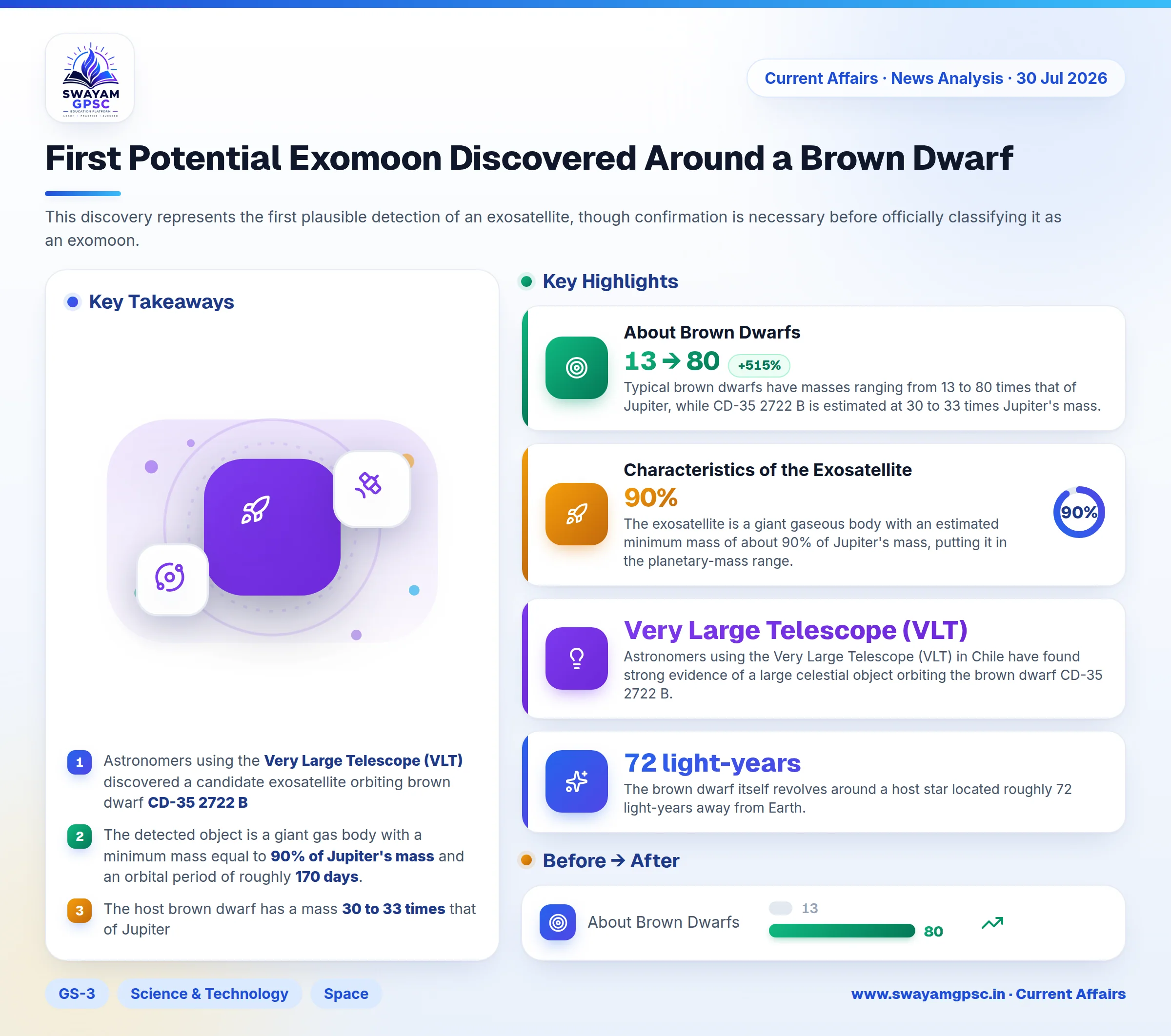
- Astronomers using the Very Large Telescope (VLT) discovered a candidate exosatellite orbiting brown dwarf CD-35 2722 B, located 72 light-years from Earth.
- The detected object is a giant gas body with a minimum mass equal to 90% of Jupiter's mass and an orbital period of roughly 170 days.
- The host brown dwarf has a mass 30 to 33 times that of Jupiter, placing it in the category of failed stars that cannot sustain hydrogen fusion.
- Future observations with the upcoming Extremely Large Telescope (ELT) will help confirm this exosatellite and search for smaller moons beyond our solar system.
Why in News
- Astronomers using the Very Large Telescope (VLT) in Chile have found strong evidence of a large celestial object orbiting the brown dwarf CD-35 2722 B.
- The brown dwarf itself revolves around a host star located roughly 72 light-years away from Earth.
- Because this newly detected companion orbits a body that revolves around a star, scientists describe it as an exosatellite and a candidate exomoon.
- This discovery represents the first plausible detection of an exosatellite, though confirmation is necessary before officially classifying it as an exomoon.
Method of Detection
- Researchers detected this body using the radial velocity method, which tracks subtle gravitational movements.
- This technique measures the slight wobble of a host body caused by the gravitational pull of an orbiting companion.
- By studying the size and period of this wobble, scientists can estimate the orbiting body's mass and orbital path.
Characteristics of the Exosatellite
- The exosatellite is a giant gaseous body with an estimated minimum mass of about 90% of Jupiter's mass, putting it in the planetary-mass range.
- It follows an eccentric orbit around CD-35 2722 B and completes one full revolution in roughly 170 days.
Understanding Exomoons
- An exomoon is generally understood to be a natural satellite that orbits a planet or another body outside our solar system.
- Currently, no universally accepted formal definition exists for an exomoon within the scientific community.
About Brown Dwarfs
- Brown dwarfs are intermediate celestial objects with masses falling between giant planets and small stars.
- They form like stars but lack sufficient mass to trigger sustained hydrogen fusion in their core, which is why scientists call them failed stars.
- Typical brown dwarfs have masses ranging from 13 to 80 times that of Jupiter, while CD-35 2722 B is estimated at 30 to 33 times Jupiter's mass.
Future Prospects
- The European Southern Observatory's upcoming Extremely Large Telescope (ELT) will offer significantly higher sensitivity and light collection capability.
- This advanced telescope will allow astronomers to discover smaller exomoons and study similar planetary systems in greater detail.