Evaluating India's Employment Scenario: Key Challenges and Policy Solutions
#GS-3 #Economy #Employment #Governance & Social Justice #Women #Current Events #National #Skill Development #Human Resource
Key takeaways
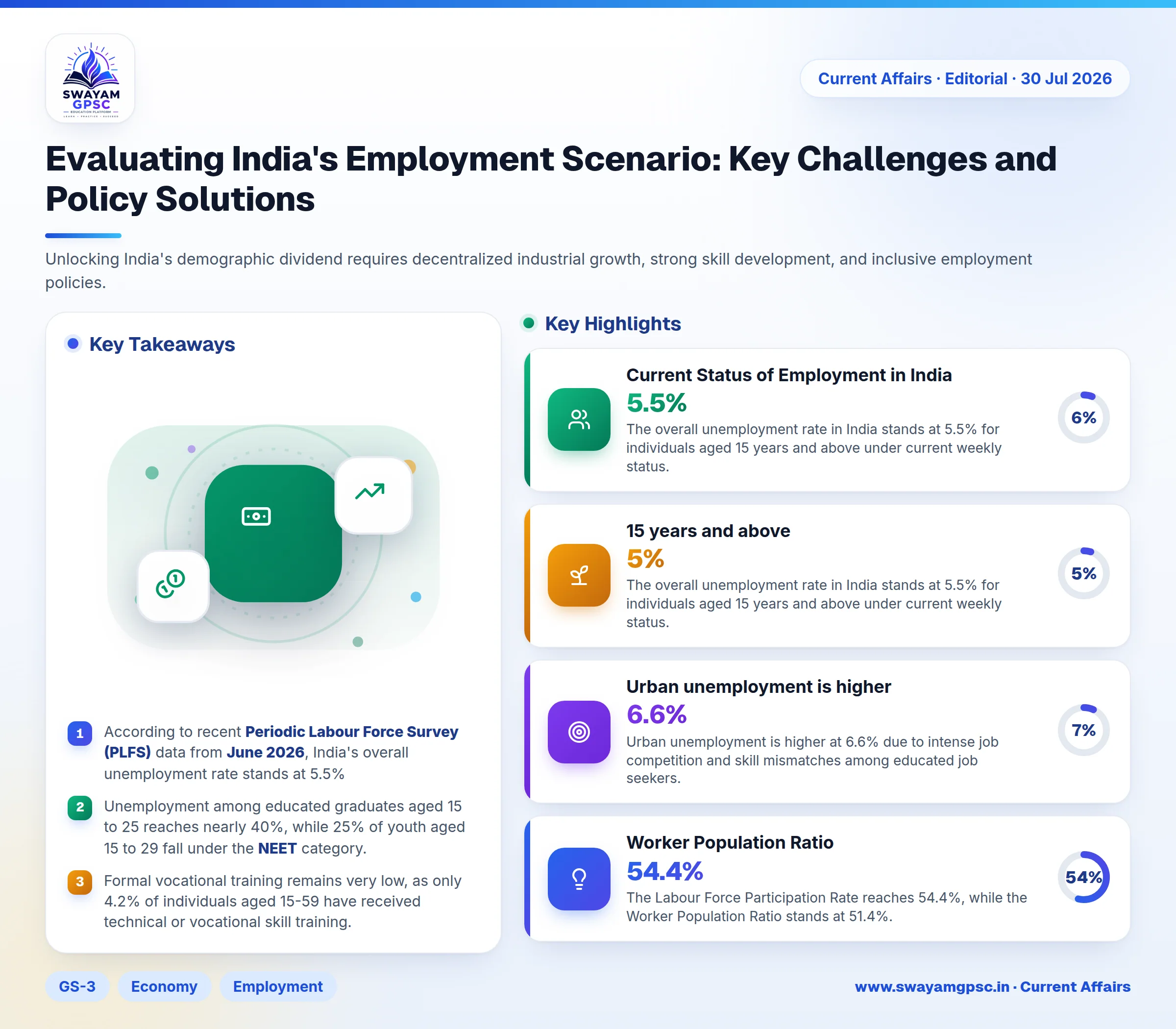
- According to recent Periodic Labour Force Survey (PLFS) data from June 2026, India's overall unemployment rate stands at 5.5%, with urban unemployment reaching 6.6% and rural unemployment at 5%.
- Unemployment among educated graduates aged 15 to 25 reaches nearly 40%, while 25% of youth aged 15 to 29 fall under the NEET category.
- Formal vocational training remains very low, as only 4.2% of individuals aged 15-59 have received technical or vocational skill training.
- Self-employment accounts for 56.2% of total employment, while regular salaried jobs account for 23.6%, with only 4 out of 100 graduate jobs offering formal contracts and social security.
- Nearly 44% of non-working women cite domestic care responsibilities as their main barrier to entering the workforce, compared to just 0.5% of men.
Why in News
- Young people in India are protesting because stable salaried jobs are becoming scarce across the country.
- Recent youth protests highlight deep structural problems in the labor market rather than simple issues with public examination leaks.
- India faces high youth unemployment, a large population out of work and training, and low vocational skill training.
- Unlocking India's demographic dividend requires decentralized industrial growth, strong skill development, and inclusive employment policies.
Current Status of Employment in India
- Key labor market indicators rely on Usual Status for annual trends and Current Weekly Status for short-term trends.
- The overall unemployment rate in India stands at 5.5% for individuals aged 15 years and above under current weekly status.
- Rural unemployment remains lower at 5% because agriculture absorbs a major portion of the rural workforce.
- Urban unemployment is higher at 6.6% due to intense job competition and skill mismatches among educated job seekers.
- The Labour Force Participation Rate reaches 54.4%, while the Worker Population Ratio stands at 51.4%.
- Agriculture continues to employ the largest share of workers at 43% to 44% of the workforce.
- Employment in manufacturing has grown slowly to 12.1%, while the service sector has increased to 13.1%.
- Regular salaried employment has nudged upward to 23.6%, while self-employment has moderated slightly to 56.2%.
- The rural female labor participation rate ranges between 36% and 38%, whereas the urban female rate tracks lower at 24% to 25%.
Key Concerns Related to Employment
- Rapid expansion of higher education has created a severe gap because high-skilled formal job creation remains very slow.
- The unemployment rate reaches nearly 40% among educated young graduates aged 15 to 25.
- About 21% of youth aged 15 to 24 and 25% of those aged 15 to 29 belong to the NEET category.
- Many discouraged youth stop searching for jobs completely, which removes them from official unemployment registers.
- Only 4.2% of people aged 15 to 59 have received formal vocational or technical training.
- Most job growth occurs in low-productivity informal work where small enterprises cannot offer secure positions.
- Only 4 out of every 100 graduate jobs provide a formal contract, paid leave, and social security benefits.
- Nearly 44% of non-working women cite domestic care duties as their main obstacle, compared to 0.5% of men.
- Urban self-employed men work 17.5 hours more per week than self-employed women due to unrecorded female domestic work.
- Women earn only 76% of male wages in salaried jobs, 69% in casual labor, and 36% in self-employment.
- High self-employment numbers of 56.2% mask widespread disguised unemployment in low-return trading and farming.
Way Forward and Key Policy Measures
- The government should establish non-metro University Townships along industrial corridors like the Delhi-Mumbai Industrial Corridor to reduce migration.
- India can expand the creative digital economy by setting up AVGC Content Creator Labs in schools and colleges.
- Industrial training institutes should adopt a flexible hub-and-spoke model managed directly by industry partners.
- Specialized institutions should train personnel for tourism, sports, and hospitality to convert unorganized recreation into structured employment.
- Viability Gap Funding should support safe working women's hostels and childcare clusters in every industrial district.
- Developing regional green manufacturing hubs can transition small enterprises toward low-carbon production and create green jobs.
- Upgrading institutions for Allied Health Professionals will enable Indian healthcare workers to fill global labor shortages.
Conclusion
- Structural challenges like high graduate unemployment and low skill training hinder India's job market growth.
- Policymakers must move beyond basic aggregate numbers to build targeted industrial corridors, green hubs, and care infrastructure.