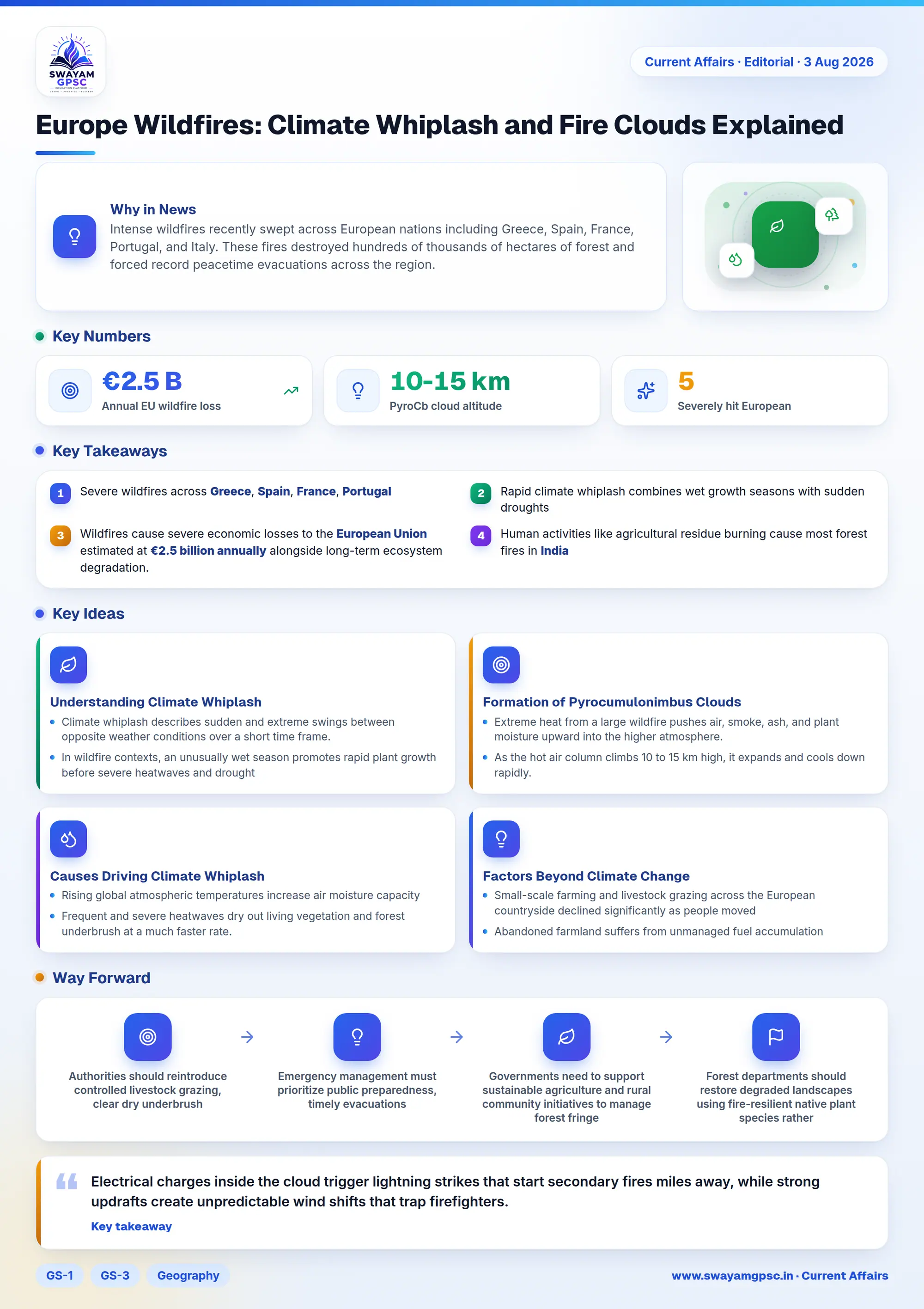
Europe Wildfires: Climate Whiplash and Fire Clouds Explained
#GS-1 #GS-3 #Geography #Disaster Geography #Environment #Climate Change #Disaster Management #Disaster Preparedness #Current Events #International #Europe Wildfires #Pyrocumulonimbus
Key takeaways
- Severe wildfires across Greece, Spain, France, Portugal, and Italy are evolving into sixth-generation blazes that create localized weather systems.
- Rapid climate whiplash combines wet growth seasons with sudden droughts, pushing air and moisture 10 to 15 km high to form pyrocumulonimbus (PyroCb) clouds.
- Wildfires cause severe economic losses to the European Union estimated at €2.5 billion annually alongside long-term ecosystem degradation.
- Human activities like agricultural residue burning cause most forest fires in India, unlike Europe where lightning from fire clouds plays a key role.
Why in News
- Intense wildfires recently swept across European nations including Greece, Spain, France, Portugal, and Italy.
- These fires destroyed hundreds of thousands of hectares of forest and forced record peacetime evacuations across the region.
- Modern European wildfires move faster and burn hotter due to climate change, volatile weather patterns, and shifting land usage.
- Instead of normal seasonal events, these blazes turn into high-intensity sixth-generation fires that generate localized weather systems, destroy ecosystems, and release massive amounts of carbon dioxide.
Understanding Climate Whiplash and Fire Clouds
- Climate whiplash describes sudden and extreme swings between opposite weather conditions over a short time frame.
- In wildfire contexts, an unusually wet season promotes rapid plant growth before severe heatwaves and drought immediately follow.
- This abrupt weather transition dries out new vegetation and turns it into a continuous layer of highly flammable fuel.
- A pyrocumulonimbus (PyroCb) cloud is a fire-generated thunderstorm that forms directly above massive, high-intensity wildfires.
Formation of Pyrocumulonimbus Clouds
- Extreme heat from a large wildfire pushes air, smoke, ash, and plant moisture upward into the higher atmosphere.
- As the hot air column climbs 10 to 15 km high, it expands and cools down rapidly.
- Moisture inside the rising air condenses around microscopic smoke and ash particles.
- The condensing moisture creates towering thunderstorm clouds that produce lightning, erratic wind gusts, and light rain.
- Electrical charges inside the cloud trigger lightning strikes that start secondary fires miles away, while strong updrafts create unpredictable wind shifts that trap firefighters.
Causes Driving Climate Whiplash and Fire Clouds
- Rising global atmospheric temperatures increase air moisture capacity, which intensifies both extreme rainfall and subsequent drought cycles.
- Frequent and severe heatwaves dry out living vegetation and forest underbrush at a much faster rate.
- Unusually wet weather periods cause explosive growth among grasses, shrubs, and young trees, creating large fuel volumes.
- The decline of traditional agriculture leaves dense layers of dry underbrush across rural areas, fueling fires hot enough to create PyroCb clouds.
Factors Beyond Climate Change
- Small-scale farming and livestock grazing across the European countryside declined significantly as people moved to urban areas.
- Abandoned farmland suffers from unmanaged fuel accumulation, where natural vegetation creates thick and unbroken layers of flammable brush.
- Strict fire suppression of minor routine fires creates a paradox by letting dense vegetation build up over time.
- When a fire eventually escapes suppression efforts, the accumulated fuel causes it to burn with unprecedented heat and intensity.
Consequences of European Wildfires
- Wildfires cause severe economic losses to the European Union amounting to an estimated €2.5 billion annually through damaged infrastructure and lost tourism revenue.
- Massive blazes degrade ecosystems, ruin fragile habitats, cause long-term soil damage, and release large carbon emissions into the atmosphere.
- Toxic smoke plumes travel thousands of kilometers, creating public health hazards and degrading regional air quality.
Comparison with Wildfires in India
- Human activities cause the vast majority of forest fires in India, including crop residue burning, collection of non-timber forest produce, and accidental sparks.
- European blazes are frequently amplified by natural lightning generated from fire clouds.
- In India, fire risk concentrates heavily in the Northeast, parts of Odisha and Chhattisgarh, and Himalayan states like Uttarakhand and Himachal Pradesh during dry summer months.
Way Forward
- Authorities should reintroduce controlled livestock grazing, clear dry underbrush, and create natural firebreaks to break up continuous fuel layers.
- Emergency management must prioritize public preparedness, timely evacuations, and early warning systems alongside standard firefighting efforts.
- Governments need to support sustainable agriculture and rural community initiatives to manage forest fringe areas and stop land abandonment.
- Forest departments should restore degraded landscapes using fire-resilient native plant species rather than flammable monoculture trees.