The Ethanol Imperative for Viksit Bharat
#GS-2 #GS-3 #Government Policies & Interventions #Environmental Pollution & Degradation #Economy #Infrastructure #Agriculture #Environment #Sustainable Development
Key takeaways
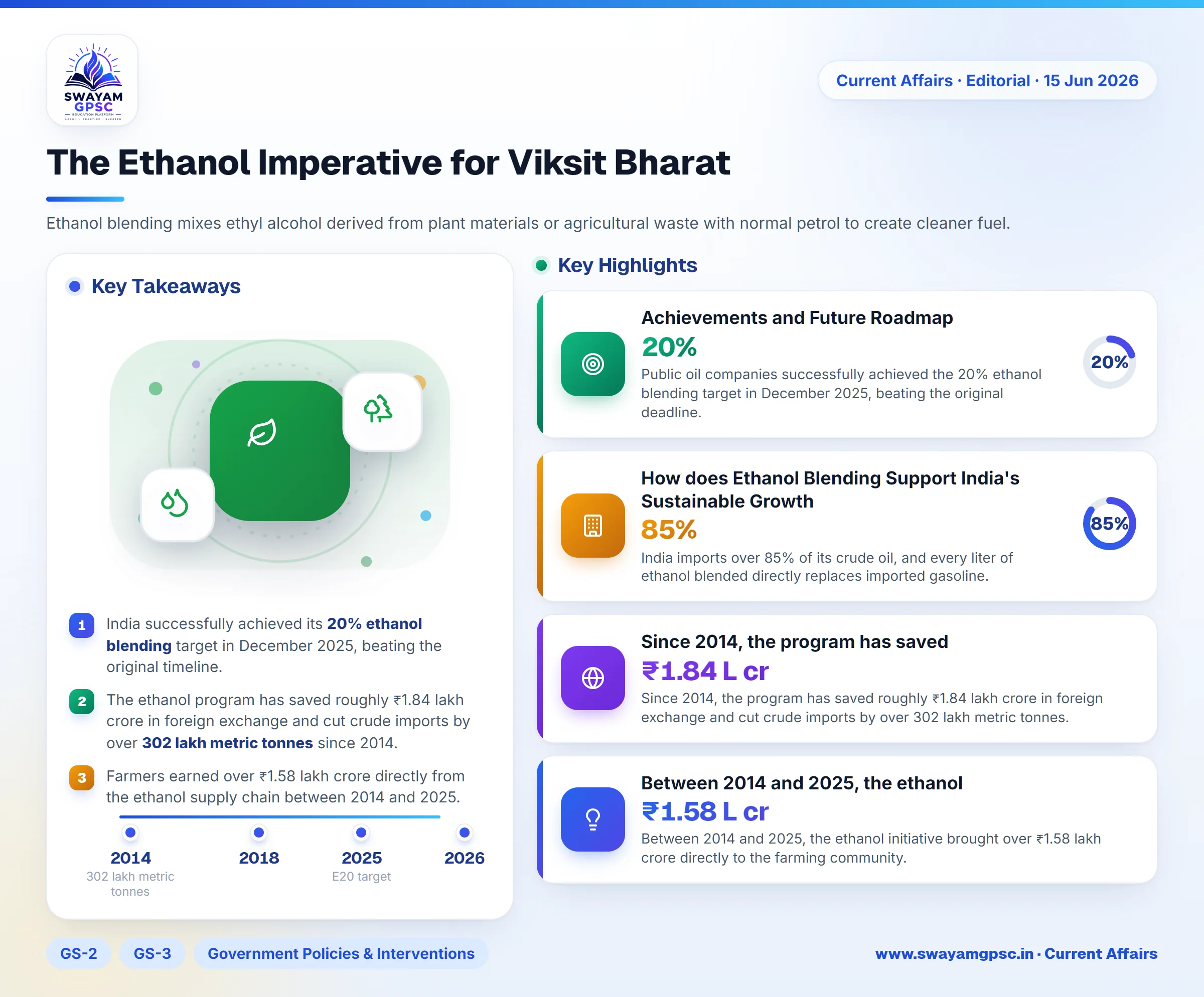
- India successfully achieved its 20% ethanol blending target in December 2025, beating the original timeline.
- The ethanol program has saved roughly ₹1.84 lakh crore in foreign exchange and cut crude imports by over 302 lakh metric tonnes since 2014.
- Farmers earned over ₹1.58 lakh crore directly from the ethanol supply chain between 2014 and 2025.
- Sugarcane-based ethanol requires 2,860 litres of water per litre, while rice-based ethanol consumes up to 10,790 litres.
- Ethanol production capacity reached 20 billion litres by November 2025, far exceeding the 10 to 11 billion litres needed for E20.
Why in News
- A recent editorial published in The Hindu Business Line on 15/06/2026 examines India's current progress in ethanol blending.
- The author argues that India must transition from simple volume targets to a sustainable framework for long-term success.
- Priority must be given to 2G technology, water conservation, and smart resource management to avoid future ecological crises.
What is Ethanol Blending?
- Ethanol blending mixes ethyl alcohol derived from plant materials or agricultural waste with normal petrol to create cleaner fuel.
- The resulting mixture is called E-fuel, where the number following the letter E shows the exact percentage of ethanol present.
- Standard fuel mixtures include E10, E15, and E85, with higher blends requiring specialized engines to avoid damage.
- Bioethanol production begins by turning sugars or starches from sugarcane and grains into fermentable sugars for 1G ethanol.
- Yeast helps ferment these sugars inside bioreactors, followed by distillation and dehydration to remove water for petrol mixing.
- India is now moving toward 2G ethanol using agricultural crop residues, which needs an extra step to break tough plant fibers.
- The National Policy on Biofuels (2018) and later updates form the main legal framework for pricing and distribution.
- The government advanced the E20 target to 2025, pushing oil companies and industries to move faster.
- Financial incentives like interest subventions on bank loans help entrepreneurs build or expand modern distilleries across the country.
- The government offers nil central excise duty for higher blends like E22, E25, E27, and E30 to encourage future use.
Achievements and Future Roadmap
- Public oil companies successfully achieved the 20% ethanol blending target in December 2025, beating the original deadline.
- Rules for E100 fuel are now cleared, and automakers are encouraged to build Flex-Fuel Vehicles (FFVs).
- Future growth depends heavily on scaling up 2G refineries so that fuel production does not compete with food crops.
How does Ethanol Blending Support India's Sustainable Growth Agenda?
- India imports over 85% of its crude oil, and every liter of ethanol blended directly replaces imported gasoline.
- Since 2014, the program has saved roughly ₹1.84 lakh crore in foreign exchange and cut crude imports by over 302 lakh metric tonnes.
- Mixing ethanol helps protect the domestic economy from global oil price jumps and regional Middle East tensions.
- Ethanol serves as a buffer supply, letting the country handle global oil shortages without severe economic shocks.
- The program helps farmers earn extra income, turning them from simple food providers into energy providers.
- Between 2014 and 2025, the ethanol initiative brought over ₹1.58 lakh crore directly to the farming community.
- Thousands of new distilleries have opened up in rural and semi-urban areas, creating steady local jobs and business growth.
- Sugar mills earned over ₹1.29 lakh crore from ethanol sales over ten years from 2014-15 to 2024-25, improving their finances.
- New investments worth over ₹42,000 crore came into rural districts for setting up modern distillery units.
- Ethanol burns cleaner than petrol, helping reduce harmful tailpipe emissions like carbon monoxide and hydrocarbons.
- The initiative has cut cumulative carbon dioxide emissions by over 909 lakh metric tonnes since 2014, supporting India's Net Zero goals.
- Using agricultural waste for 2G ethanol stops farmers from burning stubble, turning farm waste into valuable fuel.
- India's first bamboo-based bioethanol plant opened in Golaghat, Assam, marking a major milestone for advanced biofuels.
- Consistent demand for ethanol encourages major automakers to build vehicles that can run on any blend up to E85 or E100.
Challenges
- Many buyers worry about how higher ethanol blends will affect the long-term health of their vehicle engines.
- A recent survey shows that 43% of car buyers are delaying purchases because they are confused about future fuel rules.
- Ethanol has lower energy energy density than petrol, meaning vehicles give lower mileage and require more fuel for the same distance.
- Owners of older vehicles report extra repair costs of up to ₹25,000 since early 2025 due to engine wear.
- Making 2G ethanol from crop waste requires a massive amount of energy, consuming between 25 and 130 kWh per kilogram.
- Distillation alone accounts for 40 to 60 percent of the total energy needed during the conversion process.
- Diverting food grains like maize and rice to fuel creates direct friction with the animal feed and poultry industries.
- The poultry sector uses nearly 60% of India's maize, and competition with distilleries pushed prices up to ₹26 to ₹30 per kg during 2024-25.
- Distilleries faced a maize shortage of 17 million tonnes in 2025-26, forcing India to import maize instead of exporting it.
- Production capacity reached 20 billion litres by November 2025, which is much higher than the 10 to 11 billion litres actually needed for E20.
- Capacity is expected to grow by another 15% in 2026-27, leaving half of the production capacity without enough demand.
- While oil imports drop, India ends up importing more fertilizers and natural gas to grow sugarcane and maize.
- The policy displaces land that should be used for oilseeds and pulses, making India import those items instead.
- Sugarcane-based ethanol requires 2,860 litres of water per litre, while maize needs 4,093 litres and rice needs up to 10,790 litres.
- In Maharashtra, sugarcane takes up over 50% of irrigation water even though it covers less than 10% of the farmland.
- Energy-heavy farming practices and refinery processes mean the fuel is not entirely carbon-neutral yet.
- Studies show that sugarcane-syrup distilleries release about 4.42 kg of CO2 for every single litre of ethanol produced.
Way Forward
- Retail fuel stations should install multi-grade dispensers so motorists can easily choose fuel that matches their vehicle engine.
- The government should use Production-Linked Incentives to help automakers build affordable Flex-Fuel Vehicles.
- Financial subsidies and grants must shift toward Second-Generation ethanol refineries to protect food security.
- District-level aggregator hubs should be set up to collect and store agricultural waste, ensuring a steady supply for 2G plants.
- A dynamic pricing model should be created to protect farmer incomes while staying linked to global crude oil trends.
- A National Biofuel Engine Research Center should be established to develop low-cost retrofitting kits for older vehicles.
- The government should provide Viability Gap Funding to build moisture-controlled storage facilities to keep ethanol stable during transport.