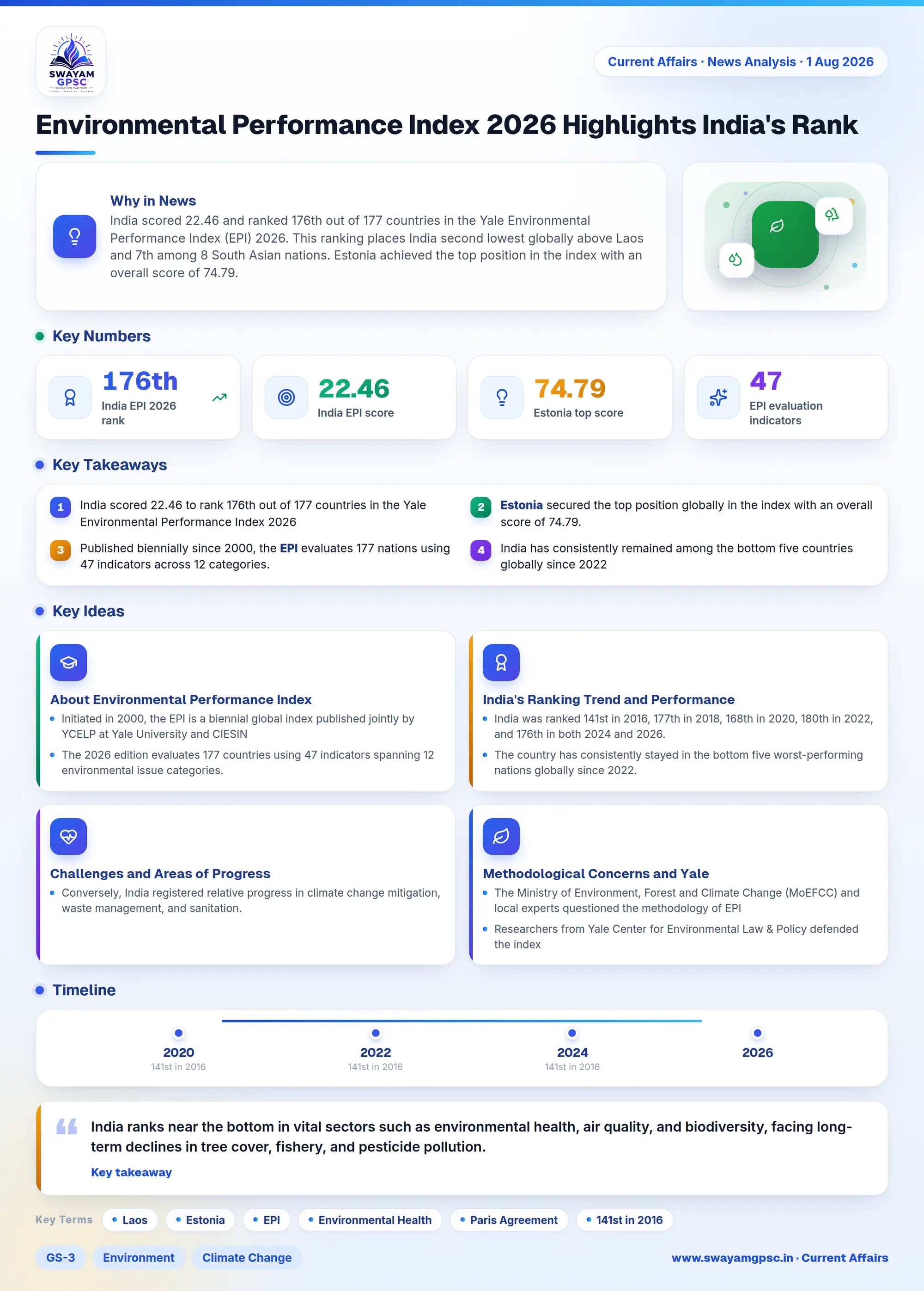
Environmental Performance Index 2026 Highlights India's Rank
#GS-3 #Environment #Climate Change #Biodiversity #Current Events #National
Key takeaways
- India scored 22.46 to rank 176th out of 177 countries in the Yale Environmental Performance Index 2026, placing second lowest globally above Laos.
- Estonia secured the top position globally in the index with an overall score of 74.79.
- Published biennially since 2000, the EPI evaluates 177 nations using 47 indicators across 12 categories.
- India has consistently remained among the bottom five countries globally since 2022, despite progress in climate change mitigation and sanitation.
- The Ministry of Environment, Forest and Climate Change (MoEFCC) criticized the ranking methodology for ignoring India's population size and historical emission levels.
Why in News
- India scored 22.46 and ranked 176th out of 177 countries in the Yale Environmental Performance Index (EPI) 2026.
- This ranking places India second lowest globally above Laos and 7th among 8 South Asian nations.
- Estonia achieved the top position in the index with an overall score of 74.79.
About Environmental Performance Index
- Initiated in 2000, the EPI is a biennial global index published jointly by YCELP at Yale University and CIESIN at Columbia University.
- The 2026 edition evaluates 177 countries using 47 indicators spanning 12 environmental issue categories.
- These indicators fall under three main policy goals: Environmental Health, Ecosystem Vitality, and Climate Change.
- The index acts as an international standard to track global progress toward the UN Sustainable Development Goals (SDGs), the Paris Agreement, and the Kunming-Montreal Global Biodiversity Framework.
India's Ranking Trend and Performance
- India was ranked 141st in 2016, 177th in 2018, 168th in 2020, 180th in 2022, and 176th in both 2024 and 2026.
- The country has consistently stayed in the bottom five worst-performing nations globally since 2022.
Challenges and Areas of Progress
- India ranks near the bottom in vital sectors such as environmental health, air quality, and biodiversity, facing long-term declines in tree cover, fishery, and pesticide pollution.
- Conversely, India registered relative progress in climate change mitigation, waste management, and sanitation.
Methodological Concerns and Yale Defense
- The Ministry of Environment, Forest and Climate Change (MoEFCC) and local experts questioned the methodology of EPI, pointing out that it ignores India's population size, development level, historical emissions, and the principle of Common but Differentiated Responsibilities (CBDR).
- Researchers from Yale Center for Environmental Law & Policy defended the index, stating it assesses current environmental reality to guide immediate policy decisions rather than focusing on future promises or historical blame.