Empowering Informal Women Workers Through Gender-Responsive AI Governance
#GS-2 #Governance & Social Justice #Women #Vulnerable Sections #GS-3 #Science & Technology #Artificial Intelligence #Economy #Employment #Current Events #National
Why in News
- Policy experts have renewed focus on ensuring that AI productivity gains benefit informal women workers across India.
- Expanding digital technology without gender-responsive AI governance and design will deepen existing socio-economic inequalities.
Understanding AI for Informal Women Workers
- Integrating AI into this sector means using technologies like real-time advisories, natural language processing, and automated decision-making to boost productivity in farming, domestic work, and small enterprises.
- Gender-responsive AI tools expand economic opportunities by matching local dialects, land access arrangements, and physical mobility limits rather than replacing human workers.
Key Data and Statistics
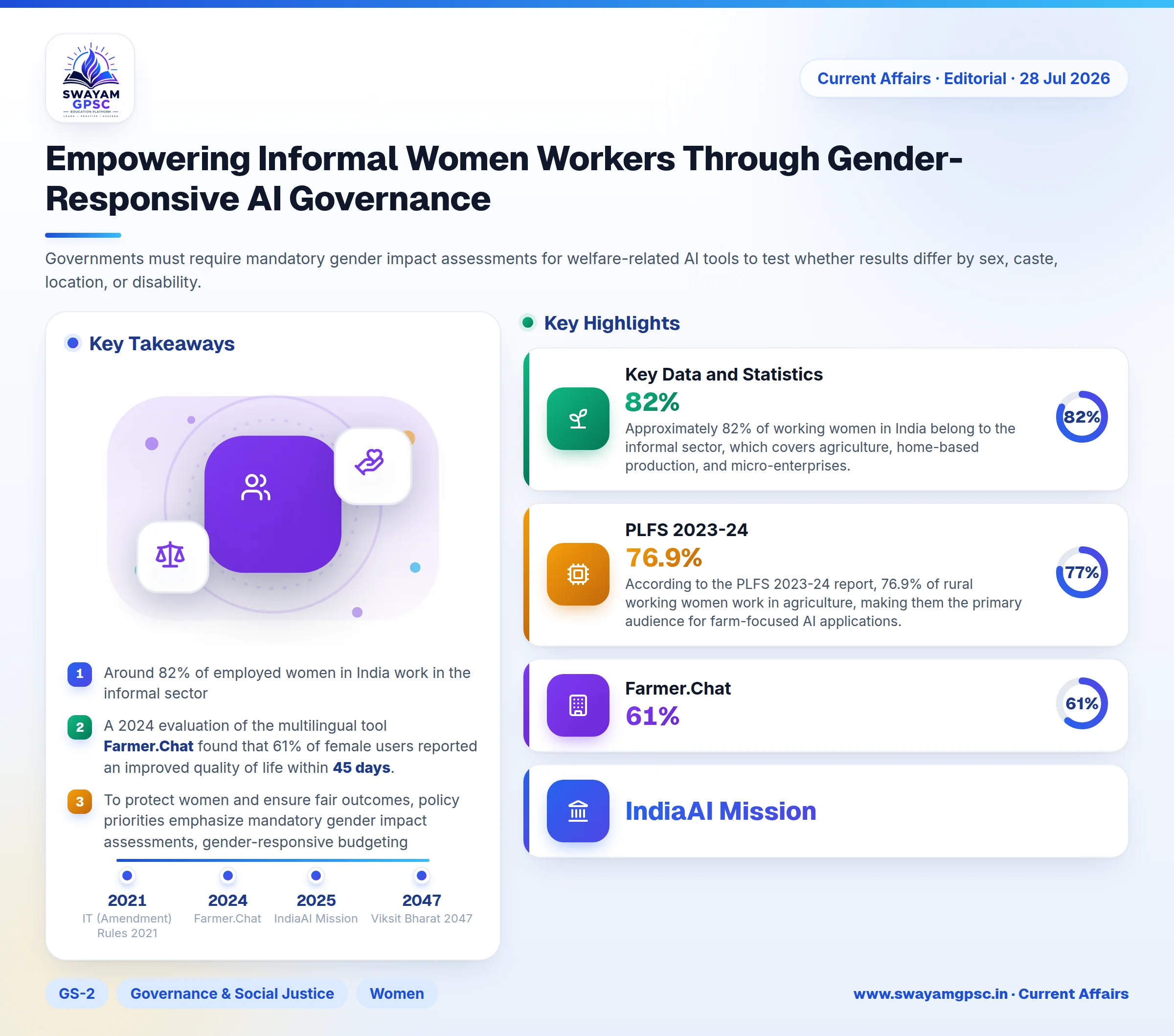
- Approximately **82%** of working women in India belong to the informal sector, which covers agriculture, home-based production, and micro-enterprises.
- According to the **PLFS 2023-24** report, **76.9%** of rural working women work in agriculture, making them the primary audience for farm-focused AI applications.
- A **2024** study on the multilingual AI tool **Farmer.Chat** across **12** states showed that **61%** of female users reported a better quality of life within **45 days**, engaging **2 to 3** times more than male users.
- India possesses foundational digital infrastructure, including the **IndiaAI Mission**, the **BHASHINI** multilingual platform, and national **AI Governance Guidelines** released in **November 2025**.
Governance Priorities for Empowering Women
- Governments must require mandatory gender impact assessments for welfare-related AI tools to test whether results differ by sex, caste, location, or disability.
- Authorities should apply gender-responsive budgeting to public AI spending, pinpointing access barriers and directing funds toward corrective actions.
- Digital literacy needs to be integrated into existing community infrastructure such as **DAY-NRLM**, **DDU-GKY**, **Skill India**, and **Mission Shakti’s Sakhi** networks.
- Policy rules must establish online safety as a baseline requirement by enforcing the **IT (Amendment) Rules 2021** and mandating labels on synthetic AI content to stop tech-facilitated violence.
Challenges
- Unrepresentative training data causes AI systems to amplify traditional gender stereotypes, algorithmic bias, and digital exclusion.
- The lack of transparency in black-box automated decisions for credit scores, job allocations, or welfare distribution reduces trust among marginalized communities.
- Digital violence, including harassment, deepfakes, and non-consensual images, creates a chilling effect that discourages women from using online economic spaces.
- Standard digital interfaces usually ignore the tight schedules, limited formal literacy, and regional language needs of informal female workers.
Way Forward
- Government bodies should enforce inclusive procurement standards that demand gender testing, regional language integration, and clear explainability for all AI platforms.
- Development teams need to scale up local voice-based interfaces through **BHASHINI** to provide tailored crop, credit, and market advisories to women farmers.
- Training initiatives organized through **Self-Help Groups (SHGs)** must focus on outcome-based skills like navigating online services or finding better-paying opportunities.
- Government agencies should implement inter-ministerial cyber reforms recommended by the **National Commission for Women** to establish fast, local-language grievance systems for online safety.
Conclusion
- The true success of India's AI vision for **Viksit Bharat 2047** depends on reaching women at the base of the economic pyramid.
- Combining gender-focused design, strong digital safety, and community skilling will turn AI into a driver of inclusive growth.