Emerging Geopolitics in West Asia and India's Options
#GS-2 #Current Events #International #Foreign Policy #West Asia #Strategic Autonomy
Key takeaways
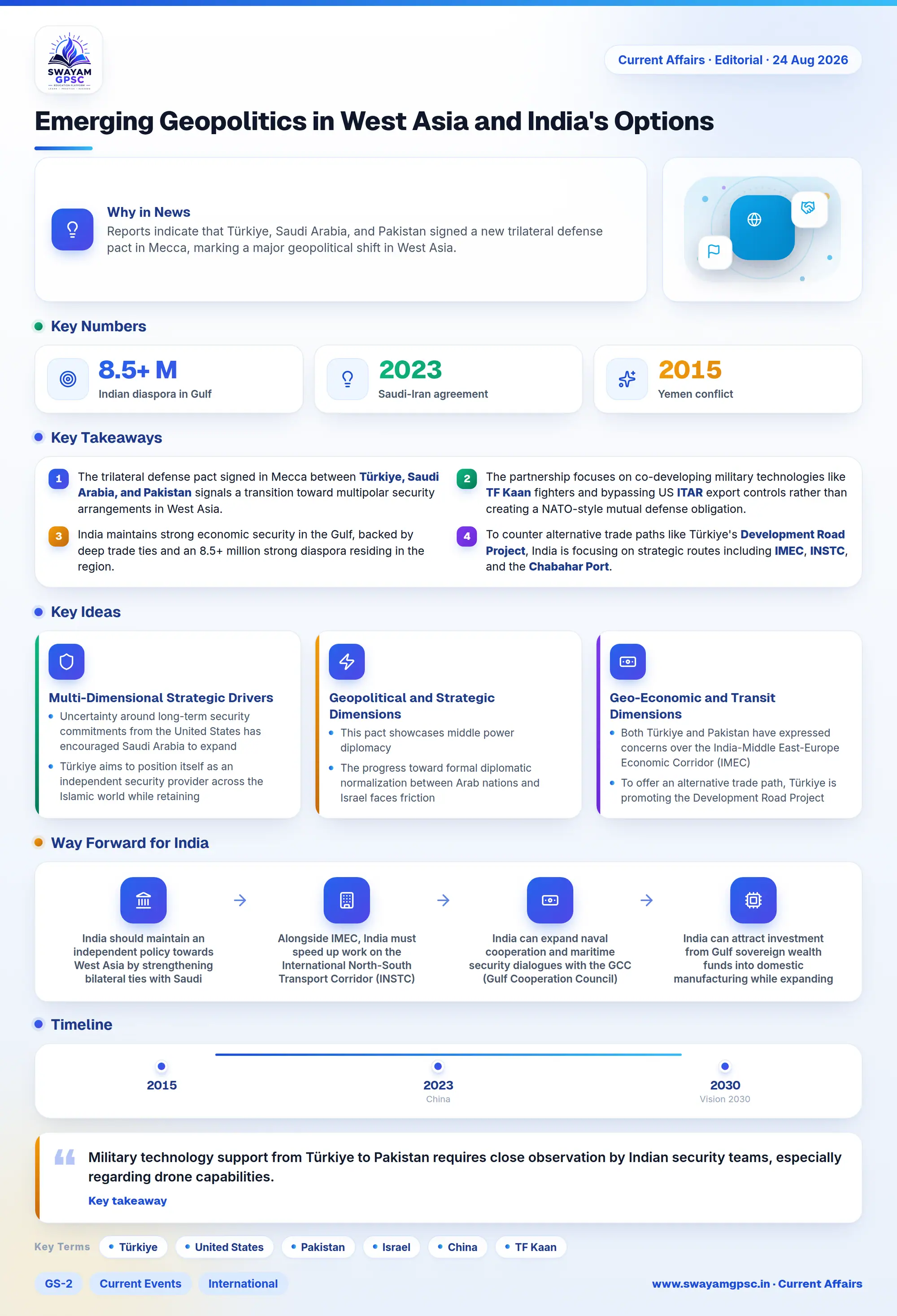
- The trilateral defense pact signed in Mecca between Türkiye, Saudi Arabia, and Pakistan signals a transition toward multipolar security arrangements in West Asia.
- The partnership focuses on co-developing military technologies like TF Kaan fighters and bypassing US ITAR export controls rather than creating a NATO-style mutual defense obligation.
- India maintains strong economic security in the Gulf, backed by deep trade ties and an 8.5+ million strong diaspora residing in the region.
- To counter alternative trade paths like Türkiye's Development Road Project, India is focusing on strategic routes including IMEC, INSTC, and the Chabahar Port.
Why in News
- Reports indicate that Türkiye, Saudi Arabia, and Pakistan signed a new trilateral defense pact in Mecca, marking a major geopolitical shift in West Asia.
- This agreement connects a major NATO member with advanced defense capabilities like Türkiye, an economic leader like Saudi Arabia, and a nuclear state like Pakistan in a multipolar structure.
- The arrangement emphasizes strategic autonomy and collaborative defense production instead of acting as an aggressive military alliance.
Multi-Dimensional Strategic Drivers
- Uncertainty around long-term security commitments from the United States has encouraged Saudi Arabia to expand its security partners across Eurasia.
- Türkiye aims to position itself as an independent security provider across the Islamic world while retaining its formal membership in NATO.
- Facing financial stress, Pakistan seeks economic support, steady oil supplies, and technological access by aligning with Gulf and Turkish defense setups.
Geopolitical and Strategic Dimensions
- This pact showcases middle power diplomacy, where nations build flexible working partnerships based on specific shared goals rather than permanent geopolitical blocs.
- The progress toward formal diplomatic normalization between Arab nations and Israel faces friction, turning focus toward broader regional peace efforts.
- By avoiding anti-Iran statements, this alliance fits alongside the 2023 peace agreement between Riyadh and Tehran brokered by China.
Geo-Economic and Transit Dimensions
- Both Türkiye and Pakistan have expressed concerns over the India-Middle East-Europe Economic Corridor (IMEC) because it bypasses Ankara.
- To offer an alternative trade path, Türkiye is promoting the Development Road Project, which connects the Gulf to Europe through Iraq.
Defence and Technological Dimensions
- Partner nations plan to co-develop advanced defense platforms like the TF Kaan fifth-generation fighter jet, uncrewed drones, and specialized missile systems.
- This shared development reduces their exposure to American export regulations under ITAR (International Traffic in Arms Regulations).
Global Perspectives: Major Powers' Calculation
- The United States faces a dilemma because re-engaging militarily in West Asia distracts from its focus on the Indo-Pacific region.
- Israel faces diplomatic hurdles in forming a united regional front against opponents as Gulf partners focus on balanced external relationships.
- China supports this trilateral arrangement because it weakens Western dominance and connects with its Global Security Initiative (GSI) and Belt and Road Initiative (BRI).
Implications for India
- Military technology support from Türkiye to Pakistan requires close observation by Indian security teams, especially regarding drone capabilities.
- India's connections with Saudi Arabia and the UAE remain strong, backed by major trade ties and over 8.5+ million Indian citizens working in the region.
- India uses a multi-aligned strategy to maintain active individual relationships with Israel, Iran, Saudi Arabia, the US, and Russia at the same time.
Operational Limitations
- This Mecca pact does not feature a NATO Article 5 mutual defense guarantee, so no member is required to enter another country's war.
- Past security arrangements between Riyadh and Islamabad did not lead to Pakistani troops joining Gulf conflicts, such as the 2015 war in Yemen.
- Economic weaknesses in Pakistan and high inflation in Türkiye limit the long-term funding available for massive joint military ventures.
- The Vision 2030 plan of Saudi Arabia relies on economic stability, while Islamabad and Ankara pursue different security and ideological objectives.
Way Forward for India
- India should maintain an independent policy towards West Asia by strengthening bilateral ties with Saudi Arabia, Türkiye, Iran, and Israel separately.
- Alongside IMEC, India must speed up work on the International North-South Transport Corridor (INSTC) and Chabahar Port to reach Eurasian markets.
- India can expand naval cooperation and maritime security dialogues with the GCC (Gulf Cooperation Council) to safeguard Arabian Sea trade routes.
- India can attract investment from Gulf sovereign wealth funds into domestic manufacturing while expanding non-oil trade and DPI (Digital Public Infrastructure) platforms.
Conclusion
- The new agreement among Türkiye, Saudi Arabia, and Pakistan reflects a shift toward regional self-reliance, requiring India to pursue active economic and strategic diplomacy.