Elias 2-24 b: Discovery of the Youngest Known Exoplanet
#GS-3 #Science & Technology #Space #Current Events #International #Exoplanet #Elias 2-24 b #NASA
Key takeaways
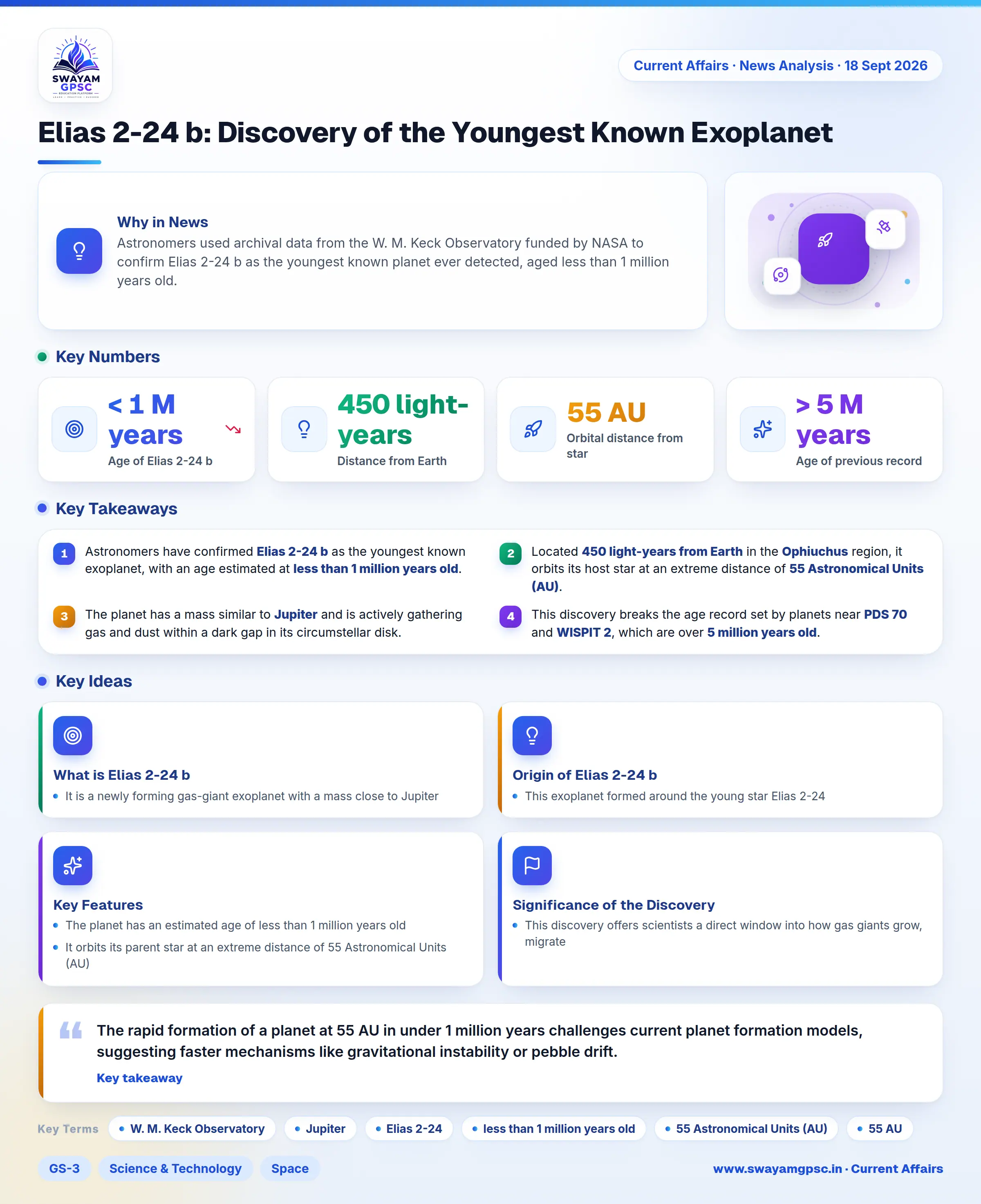
- Astronomers have confirmed Elias 2-24 b as the youngest known exoplanet, with an age estimated at less than 1 million years old.
- Located 450 light-years from Earth in the Ophiuchus region, it orbits its host star at an extreme distance of 55 Astronomical Units (AU).
- The planet has a mass similar to Jupiter and is actively gathering gas and dust within a dark gap in its circumstellar disk.
- This discovery breaks the age record set by planets near PDS 70 and WISPIT 2, which are over 5 million years old.
Why in News
- Astronomers used archival data from the W. M. Keck Observatory funded by NASA to confirm Elias 2-24 b as the youngest known planet ever detected, aged less than 1 million years old.
What is Elias 2-24 b
- It is a newly forming gas-giant exoplanet with a mass close to Jupiter, caught in the earliest stages of planetary birth while still embedded inside a disk of gas, dust, and rock.
Origin of Elias 2-24 b
- This exoplanet formed around the young star Elias 2-24, located approximately 450 light-years from Earth within the Ophiuchus star-forming region.
Key Features
- The planet has an estimated age of less than 1 million years old, easily breaking the previous age record held by planets around PDS 70 and WISPIT 2, which are over 5 million years old.
- It orbits its parent star at an extreme distance of 55 Astronomical Units (AU), which equals roughly 55 times the distance between Earth and the Sun.
- The planet sits directly inside a dark ringed gap in its surrounding disk, actively accumulating gas and dust to build its outer atmosphere.
- Researchers identified the planet using high-contrast coronagraphy to block starlight, revealing infrared signatures in archival images taken between 2018 and 2020.
Significance of the Discovery
- The rapid formation of a planet at 55 AU in under 1 million years challenges current planet formation models, suggesting faster mechanisms like gravitational instability or pebble drift.
- This discovery offers scientists a direct window into how gas giants grow, migrate, and clear out space during the early evolution of solar systems.