Double Fortified Salt: A Simple Solution to Combat Anaemia
#GS-2 #Governance & Social Justice #Health #GS-3 #Economy #Food Security #Anaemia Mukt Bharat #Double Fortified Salt #PM POSHAN #ICDS #FSSAI
Key takeaways
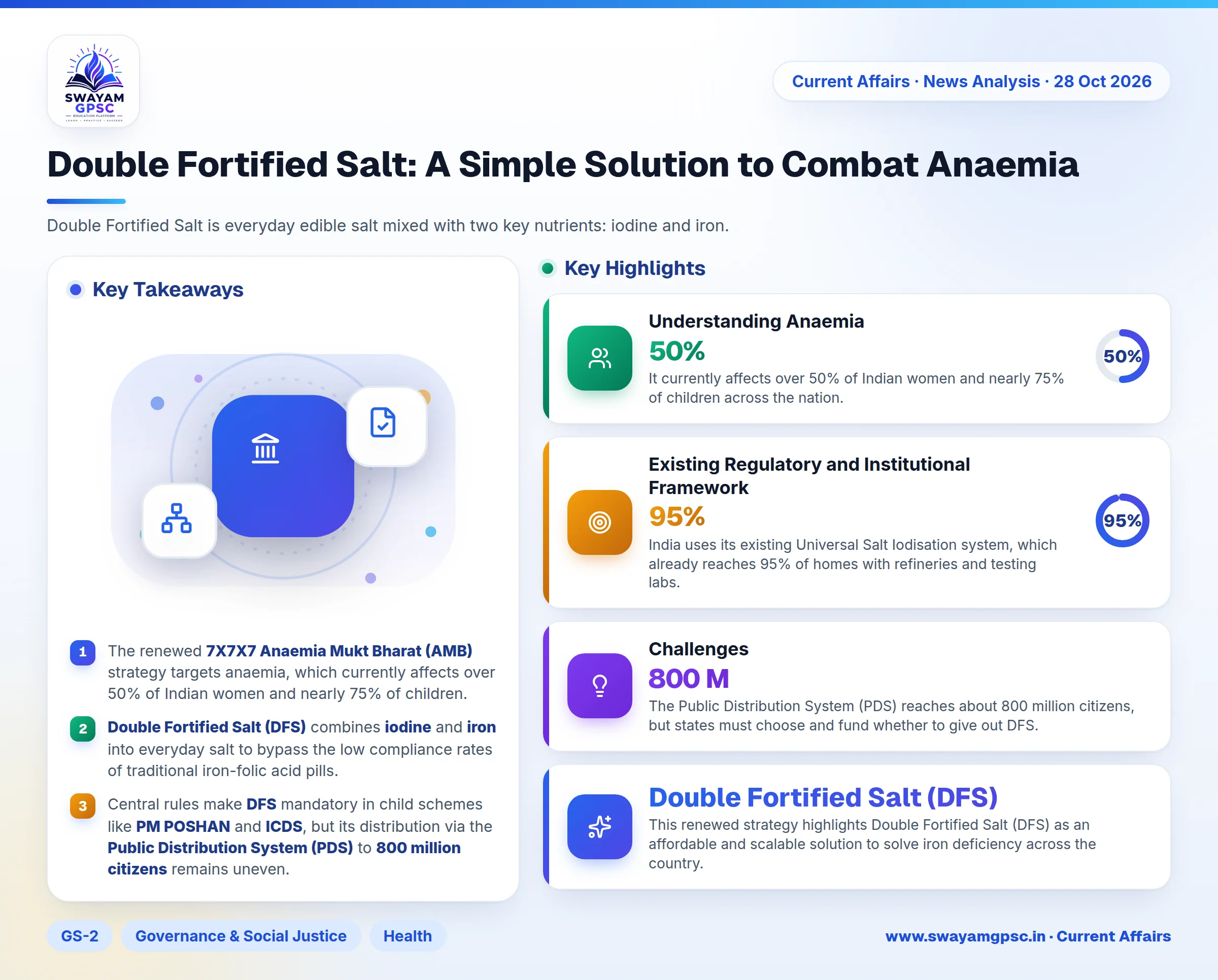
- The renewed 7X7X7 Anaemia Mukt Bharat (AMB) strategy targets anaemia, which currently affects over 50% of Indian women and nearly 75% of children.
- Double Fortified Salt (DFS) combines iodine and iron into everyday salt to bypass the low compliance rates of traditional iron-folic acid pills.
- Central rules make DFS mandatory in child schemes like PM POSHAN and ICDS, but its distribution via the Public Distribution System (PDS) to 800 million citizens remains uneven.
- Manufacturing DFS requires advanced encapsulation techniques to avoid food discoloration and must include pre-screening in tribal areas to protect people with Sickle Cell Disease or Thalassemia.
Why in News
- The Indian government has renewed its 7X7X7 Anaemia Mukt Bharat (AMB) strategy to focus on underused health interventions.
- This renewed strategy highlights Double Fortified Salt (DFS) as an affordable and scalable solution to solve iron deficiency across the country.
Understanding Anaemia
- Anaemia is a major health issue where the body lacks enough healthy red blood cells or hemoglobin to carry oxygen to tissues.
- It currently affects over 50% of Indian women and nearly 75% of children across the nation.
- This widespread health problem increases maternal mortality, slows mental growth in children, and passes poor nutrition down through generations.
What is Double Fortified Salt (DFS)?
- Double Fortified Salt is everyday edible salt mixed with two key nutrients: iodine and iron.
- The iodine prevents goiter and mental disabilities, while the iron fights off microcytic iron-deficiency anaemia.
- People consume salt daily in steady amounts regardless of income, so DFS works better than traditional iron pills.
Existing Regulatory and Institutional Framework
- The Food Safety and Standards Authority of India (FSSAI) sets strict rules for making and mixing Double Fortified Salt.
- These standards require using special iron compounds like encapsulated ferrous fumarate or ferric pyrophosphate to stop food from darkening or losing iodine.
- Central guidelines mandate using DFS in key child feeding schemes like PM POSHAN for schools and ICDS for young children.
- The 7X7X7 Anaemia Mukt Bharat strategy guides these efforts by connecting 7 beneficiary groups, 7 interventions, and 7 institutional mechanisms.
- India uses its existing Universal Salt Iodisation system, which already reaches 95% of homes with refineries and testing labs.
Challenges
- The Public Distribution System (PDS) reaches about 800 million citizens, but states must choose and fund whether to give out DFS.
- Because of this financial choice, only a few states distribute DFS through local fair-price shops today.
- Early versions of this salt caused food to turn dark or change taste because raw iron reacted with iodine.
- This bad taste and dark color caused some rural families to stop using the salt during early field trials.
- Giving extra iron without testing can harm people who carry blood conditions like Thalassemia major or Sickle Cell Disease.
- Programs under the National Sickle Cell Anaemia Elimination Mission must mark salt packages carefully in tribal areas.
- Private shops mostly sell plain iodized salt, while high-quality DFS stays expensive or hard to find in regular markets.
- Health officials struggle to promote iron-fortified salt while also asking people to eat less total salt to prevent high blood pressure.
Way Forward
- The government should add DFS directly to the central National Food Security Act (NFSA) to help pay for state distribution costs.
- Factories should focus salt processing in main coastal states like Gujarat and Tamil Nadu to keep quality high and costs low.
- Producers must use strong packaging and lipid-coated ferrous fumarate to shield salt against moisture and color changes.
- Local health workers should test families for Sickle Cell traits so affected people receive safe, non-fortified salt options.
- Community workers like ASHA and Anganwadi staff should run cooking tests to show families that the salt is safe to use.
Conclusion
- Double Fortified Salt offers an effective way to fix national iron deficiency without relying on daily medicine pills.
- Expanding this program across the nation requires combining regular PDS sales with strict quality controls.
- Scaling up DFS will help India achieve an Anaemia Mukt Bharat and set an example for other developing nations.