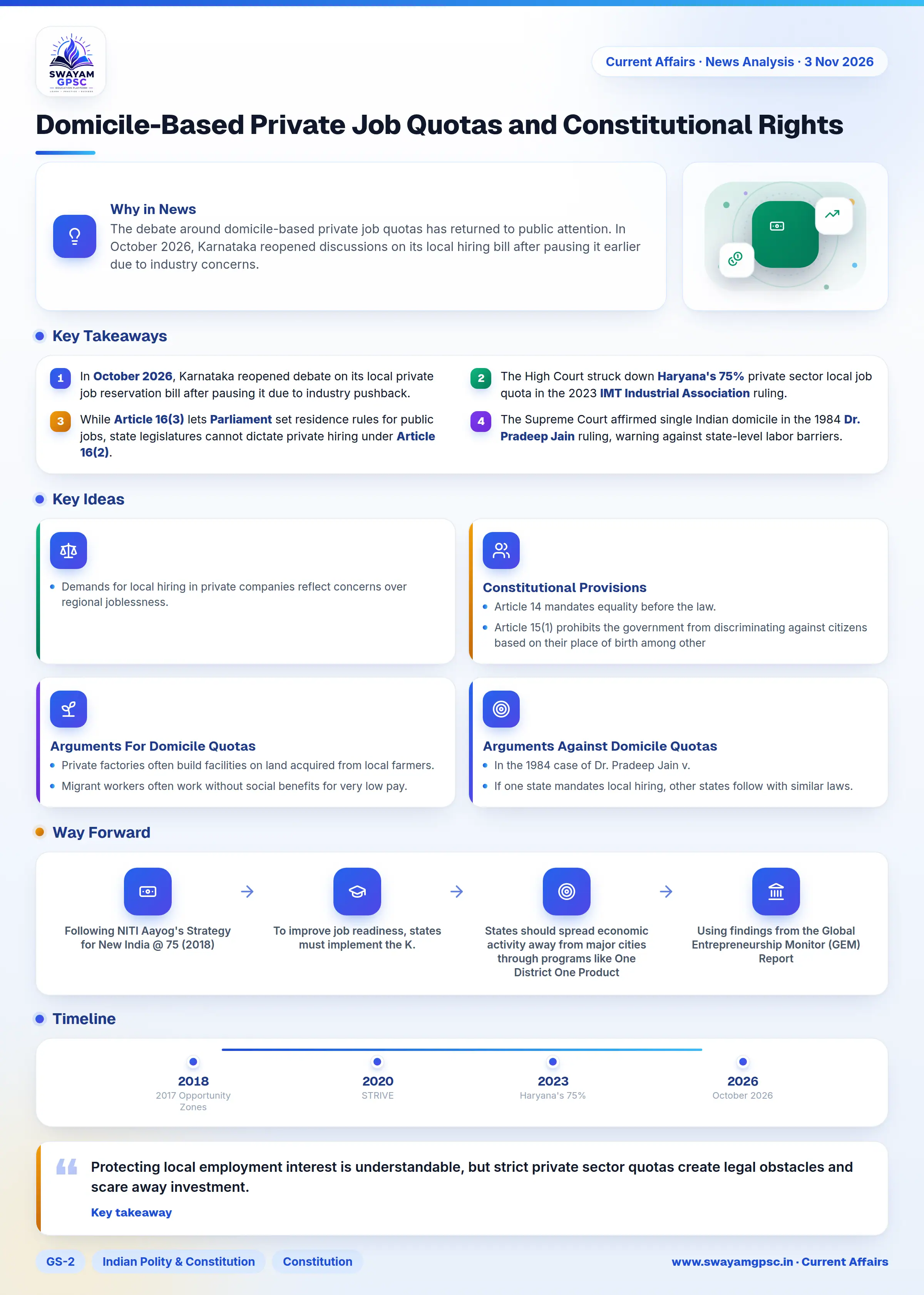
Domicile-Based Private Job Quotas and Constitutional Rights
#GS-2 #Indian Polity & Constitution #Constitution #Fundamental Rights #GS-3 #Economy #Employment #Growth #Human Resource
Key takeaways
- In October 2026, Karnataka reopened debate on its local private job reservation bill after pausing it due to industry pushback.
- The High Court struck down Haryana's 75% private sector local job quota in the 2023 IMT Industrial Association ruling.
- While Article 16(3) lets Parliament set residence rules for public jobs, state legislatures cannot dictate private hiring under Article 16(2).
- The Supreme Court affirmed single Indian domicile in the 1984 Dr. Pradeep Jain ruling, warning against state-level labor barriers.
Why in News
- The debate around domicile-based private job quotas has returned to public attention. In October 2026, Karnataka reopened discussions on its local hiring bill after pausing it earlier due to industry concerns.
Summary
- Demands for local hiring in private companies reflect concerns over regional joblessness. However, these quotas create constitutional issues and disrupt free movement of workers across states.
- Instead of enforcing rigid local quotas, governments should focus on skill building, regional business growth, and inter-state cooperation to generate sustainable jobs.
Constitutional Provisions on Employment
- Article 14 mandates equality before the law. Laws restricting private jobs to local residents create unfair geographic distinctions that often fail court standards for reasonable classification.
- Article 15(1) prohibits the government from discriminating against citizens based on their place of birth among other grounds.
- Article 16(2) bars discrimination based on residence or place of birth in government employment.
- Article 16(3) provides the only exception by authorizing Parliament alone, rather than state legislatures, to set residence rules for specific government positions.
- Article 19(1)(d) and (e) ensure every citizen can move freely and settle anywhere in India. Local job quotas directly restrict these constitutional freedoms.
- Article 19(1)(g) guarantees the right to practice any trade or business. Forcing companies to follow local hiring quotas limits their freedom to recruit based on merit.
- Article 371 allows special local job preferences under specific provisions like Article 371D for Andhra Pradesh and Telangana, but this requires Presidential approval and remains an exception.
Arguments For Domicile Quotas
- Private factories often build facilities on land acquired from local farmers. Supporters argue companies owe steady employment to families displaced by these industrial projects.
- Migrant workers often work without social benefits for very low pay. This wage pressure lowers overall pay standards and forces local workers out of the market.
- Rising costs and low returns in farming force rural youth to search for factory and office jobs. State governments face heavy pressure to secure local employment and prevent social unrest.
- Uncontrolled worker migration places heavy stress on housing, roads, and healthcare in major cities like Bengaluru and Gurugram. Local job quotas help manage city population growth.
- Hiring local workers in customer service and retail roles improves local language communication and reduces friction between residents and migrants.
Arguments Against Domicile Quotas
- In the 1984 case of Dr. Pradeep Jain v. Union of India, the Supreme Court affirmed that India has a single national citizenship. State-level hiring barriers weaken national unity and run counter to the Ek Bharat Shreshtha Bharat initiative.
- If one state mandates local hiring, other states follow with similar laws. In the 2023 case of IMT Industrial Association v. State of Haryana, the Punjab and Haryana High Court invalidated Haryana's 75% private reservation law, warning against building artificial barriers between states.
- Spreading local job quotas across multiple states limits labor movement and breaks India's national job market into isolated segments.
- Strict hiring quotas reduce business efficiency, add compliance costs, and bring back intrusive government inspections over company hiring choices.
- Industries need specialized technical skills that local pools may lack. Forcing companies to hire unneeded skills hurts their competitiveness and drives Foreign Direct Investment (FDI) to states with flexible rules.
- State legislatures lack constitutional authority to regulate hiring in private firms based on residence. Enforcing local quotas in private businesses represents an improper use of state legislative power.
Way Forward
- Following NITI Aayog's Strategy for New India @ 75 (2018), states should offer tax cuts and financial bonuses to businesses that hire and train local workers voluntarily, mirroring the 2017 Opportunity Zones model in the United States.
- To improve job readiness, states must implement the K. Kasturirangan Committee's (NEP 2020) recommendations by adding vocational training in schools and expanding programs like Pradhan Mantri Kaushal Vikas Yojana (PMKVY) and STRIVE.
- States should spread economic activity away from major cities through programs like One District One Product (ODOP) and the Shyama Prasad Mukherji Rurban Mission to create jobs in smaller towns.
- Using findings from the Global Entrepreneurship Monitor (GEM) Report, states should assist local entrepreneurs through the PM Vishwakarma Scheme and MUDRA Yojana to help small businesses expand and employ local residents.
- Following recommendations from the Punchhi Commission (2010), states should use the Inter-State Council under Article 263 to build national consensus and keep state hiring policies aligned with India's single market.
Conclusion
- Protecting local employment interest is understandable, but strict private sector quotas create legal obstacles and scare away investment. Focusing on skill training, wider regional development, and federal cooperation offers a far more effective way to create jobs while preserving national growth.