Disinvestment Strategy: Objectives, Challenges, and Future Roadmap
#GS-3 #Economy #Disinvestment #PSE Policy #Asset Monetisation #IDBI Bank
Key takeaways
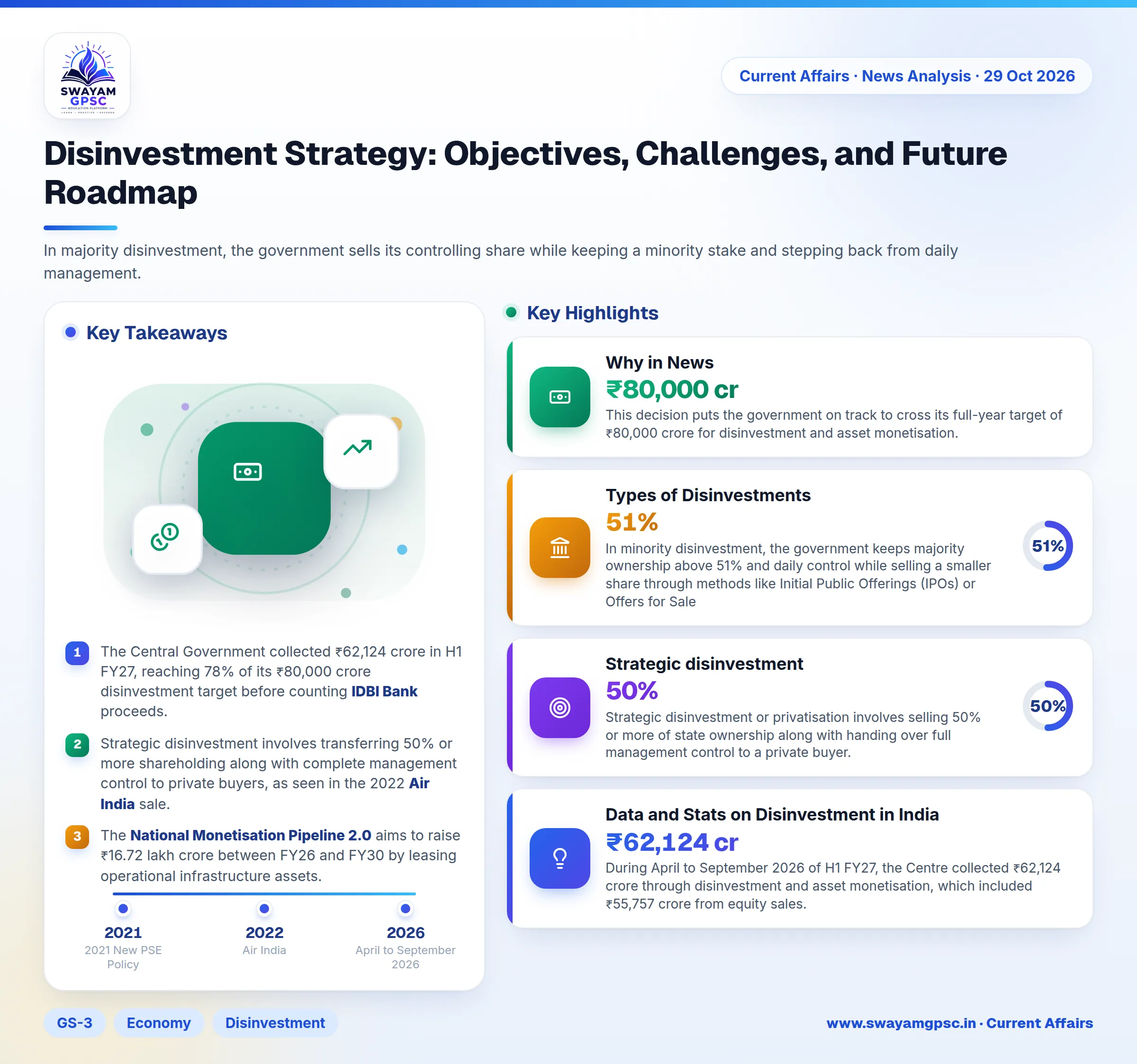
- The Central Government collected ₹62,124 crore in H1 FY27, reaching 78% of its ₹80,000 crore disinvestment target before counting IDBI Bank proceeds.
- Strategic disinvestment involves transferring 50% or more shareholding along with complete management control to private buyers, as seen in the 2022 Air India sale.
- The National Monetisation Pipeline 2.0 aims to raise ₹16.72 lakh crore between FY26 and FY30 by leasing operational infrastructure assets.
- Reducing state ownership down to 51% across listed CPSEs can unlock approximately ₹9 lakh crore while retaining majority government control.
- Disinvestment collections missed targets in FY23 (₹30,184 crore vs ₹65,000 crore) and FY24 (₹15,220 crore) due to market volatility and valuation delays.
Why in News
- The Union Government approved a strategic stake sale in IDBI Bank.
- This decision puts the government on track to cross its full-year target of ₹80,000 crore for disinvestment and asset monetisation.
What is Disinvestment?
- Disinvestment means the government sells or dilutes its equity stake in Public Sector Enterprises (PSEs) and state-owned financial institutions.
- This process helps mobilize non-debt capital receipts, improves asset utilization, and strengthens corporate governance through market competition.
Types of Disinvestments
- In minority disinvestment, the government keeps majority ownership above 51% and daily control while selling a smaller share through methods like Initial Public Offerings (IPOs) or Offers for Sale (OFS).
- In majority disinvestment, the government sells its controlling share while keeping a minority stake and stepping back from daily management.
- Strategic disinvestment or privatisation involves selling 50% or more of state ownership along with handing over full management control to a private buyer.
- Asset monetisation unlocks value from working public assets through long-term leases, concession frameworks, or trusts like InvITs and REITs without selling ownership.
Data and Stats on Disinvestment in India
- During April to September 2026 of H1 FY27, the Centre collected ₹62,124 crore through disinvestment and asset monetisation, which included ₹55,757 crore from equity sales.
- Disinvestment collections reached 78% of the ₹80,000 crore budget target for FY27 even before counting the IDBI Bank funds.
- Capital expenditure grew by over 18% while the fiscal deficit hit 42% of Budget Estimates, even though tax revenue grew by 3.4% and non-tax revenue grew by 3.2%.
- The National Monetisation Pipeline 2.0 targets ₹16.72 lakh crore between FY26 and FY30, building on the 90% target completion achieved in Phase 1.
Disinvestment as a Key Economic Strategy
- Disinvestment brings in non-debt capital receipts to fund public infrastructure without raising government debt or crowding out private sector borrowing.
- For example, money raised from selling shares in IDBI Bank directly funds transport logistics and energy infrastructure while keeping borrowing costs stable.
- Exposing state-owned businesses to private management and public market accountability boosts overall productivity and profits.
- For example, Air India expanded its fleet and modernized operations under Tata Group management after its 2022 strategic sale.
- This strategy supports the 2021 New PSE Policy, which calls for minimal state presence in strategic sectors and exiting non-strategic areas completely.
- For example, selling shares in IDBI Bank reduces the government footprint in the financial services sector.
- Listing state enterprises on stock markets encourages public shareholding and gets retail investors involved in capital markets.
- For example, the 2022 Life Insurance Corporation (LIC) IPO brought millions of first-time retail investors into Indian stock markets.
- Monetising mature assets allows the government to reinvest capital into new construction projects through structured programs.
- For example, the National Highways Infra Trust (NHAI InvIT) collects money from existing toll roads to fund new Bharatmala expressways.
Challenges to Disinvestment in India
- Volatile stock markets make valuing public assets difficult, which can lead to political criticism over low prices.
- For example, changing commodity prices repeatedly delayed share sales for state-owned oil companies and public insurers.
- Trade unions often protest against sales because workers fear losing job security, pension benefits, or affirmative action quotas.
- For example, banking and insurance unions staged nationwide strikes and wore black badges to oppose the IDBI Bank stake sale.
- Strict regulatory checks and multi-agency clearances can scare away potential global investors.
- For example, long due-diligence checks by the RBI delayed the approval process for private buyers acquiring banks.
- Separating legacy debts, old tax disputes, and non-core real estate from public companies takes a long time.
- For example, the government had to create a Special Purpose Vehicle called AIAHL to hold debt and non-core real estate before completing the Air India sale.
- Relying too much on a few large sales creates fiscal risks if those specific deals fail to close on time.
- For example, disinvestment collections fell short in FY23 at ₹30,184 crore against a ₹65,000 crore target, and reached only ₹15,220 crore in FY24.
Way Forward
- The government should shift to a market-responsive model that sells assets when private equity and institutional demand are high.
- Creating a rolling 3-year disinvestment calendar will give investors enough time for research and lead to better price offers.
- Reducing government shareholding down to 51% in listed CPSEs can raise nearly ₹9 lakh crore while keeping public control.
- Setting up an independent asset management board can speed up legal clearances and coordinate transaction schedules effectively.
- Building clear social security plans and voluntary retirement options will address worker concerns and build support among trade unions.
Conclusion
- The strategic sale of IDBI Bank and raising over ₹62,000 crore show that disinvestment is turning into a tool for structural economic reform.
- Adopting a market-led model with transparent rules will help release trapped capital while maintaining fiscal control and boosting long-term infrastructure investment.