Digitising India's Agriculture
#GS-2 #GS-3 #Government Policies & Interventions #E-Technology in the Aid of Farmers #Agricultural Marketing #Economy #Infrastructure #Agriculture #Science & Technology #ICT
Key takeaways
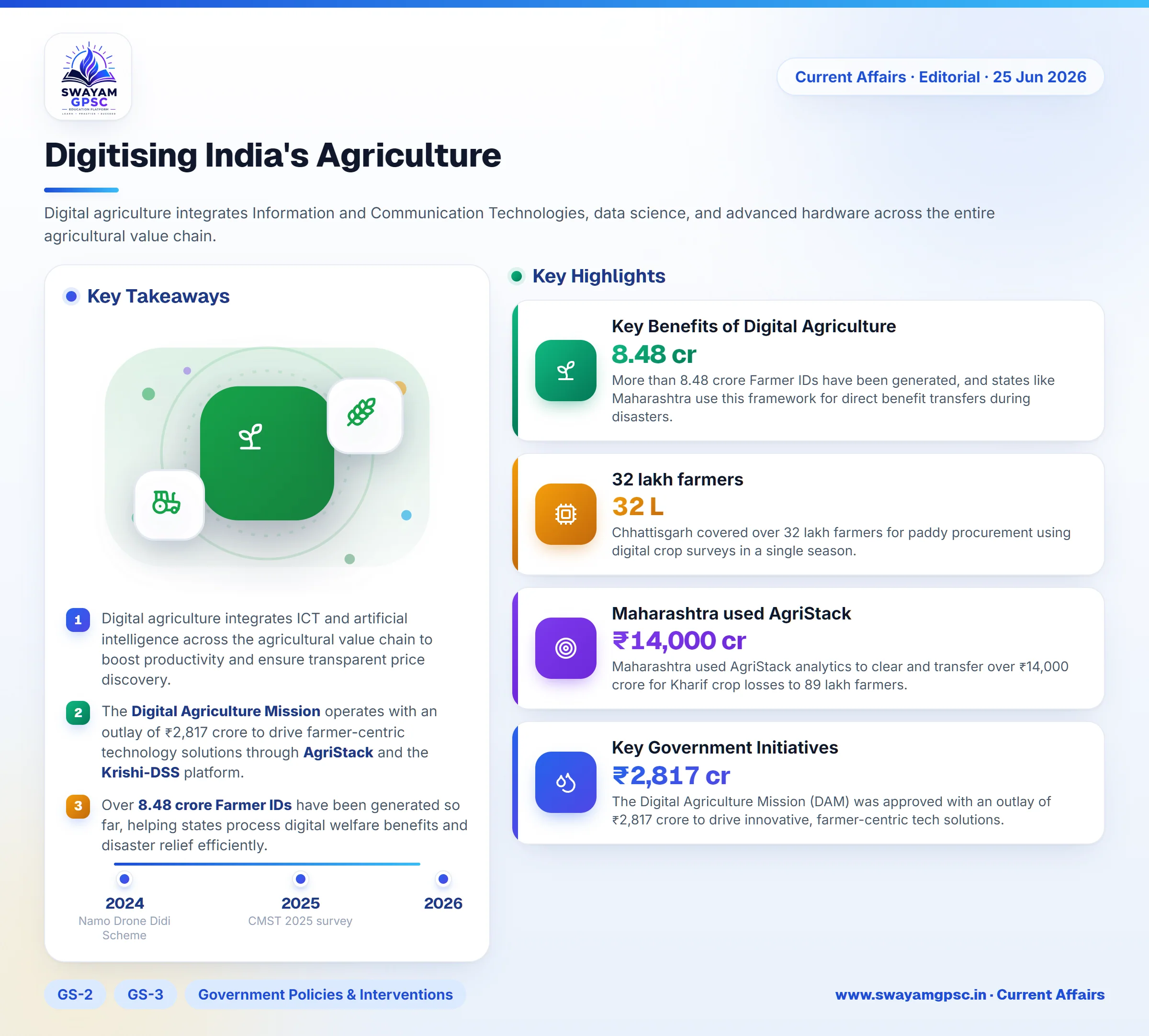
- Digital agriculture integrates ICT and artificial intelligence across the agricultural value chain to boost productivity and ensure transparent price discovery.
- The Digital Agriculture Mission operates with an outlay of ₹2,817 crore to drive farmer-centric technology solutions through AgriStack and the Krishi-DSS platform.
- Over 8.48 crore Farmer IDs have been generated so far, helping states process digital welfare benefits and disaster relief efficiently.
- Small and marginal farmers account for 86% of India's farming community, operating on average landholdings of just 1.08 hectares.
- Only 8% of rural households have broadband connections, highlighting a major infrastructure gap that hinders real-time precision farming.
Why in News
- A recent editorial in The Hindu Business Line discusses the digital transformation of Indian agriculture.
- While digital public infrastructure can modernise farming, severe disparities in smartphone access and high costs threaten to worsen rural inequalities.
- To truly empower smallholders, India needs inclusive, localised, and well-regulated technological frameworks.
Digital Agriculture
- Digital agriculture integrates Information and Communication Technologies, data science, and advanced hardware across the entire agricultural value chain.
- It transforms traditional farming into a data-driven, hyper-connected, and automated ecosystem from farm to fork.
- The first pillar is Data Capture, which uses hardware like satellite multi-spectral imaging, drone sensors, and soil moisture probes to harvest information.
- The second pillar is Intelligence, which uses cloud-computing and AI models to turn raw field data into mobile advisories and predictive planting patterns.
- The third pillar is Action and Logistics, which executes insights through autonomous machinery, blockchain traceability, and digital marketplaces.
- Precision agriculture focuses strictly on the field using GPS tractor guidance and variable-rate fertilizer applicators.
- Digital agriculture includes precision farming but expands across the entire value chain, covering seed research, cultivation, logistics, smart warehousing, and e-commerce.
Key Benefits of Digital Agriculture
- The creation of Digital Public Infrastructure through AgriStack removes predatory middlemen and provides frictionless institutional credit.
- By linking data across a Farmers Registry, Geo-Referenced Village Maps, and a Crop Sown Registry, farmers can access credit instantly.
- More than 8.48 crore Farmer IDs have been generated, and states like Maharashtra use this framework for direct benefit transfers during disasters.
- Artificial Intelligence platforms combine satellite datasets, IoT field sensors, and weather parameters to push tailored advisories to farmers.
- In Tamil Nadu, farmers using solar-powered AI precision farming systems developed by startups like *Farm Again* doubled coconut yields while saving over 400,000 cubic meters of water.
- The National Pest Surveillance System (NPSS) uses machine learning to support 65+ crops and over 400 pest types via over 10,000 rural extension workers.
- Soil fertility maps help farmers apply nutrients using variable-rate application methods, reducing the risk of chemical overuse.
- The Namo Drone Didi Scheme aims to provide drones to 15000 selected Women SHGs from 2024 to 2026 to offer affordable spray services.
- The e-NAM platform and Kisan Saarthi tools allow smallholders to check terminal prices across multiple states for better price discovery.
- The SATHI portal establishes a unified National Seed Grid where farmers can scan QR codes to verify quality certifications and seed origins.
- Merging digital crop surveys with satellite remote sensing allows insurance networks to run automated assessments of weather damage.
- Chhattisgarh covered over 32 lakh farmers for paddy procurement using digital crop surveys in a single season.
- Maharashtra used AgriStack analytics to clear and transfer over ₹14,000 crore for Kharif crop losses to 89 lakh farmers.
Key Government Initiatives
- The Digital Agriculture Mission (DAM) was approved with an outlay of ₹2,817 crore to drive innovative, farmer-centric tech solutions.
- The Farmers Registry under AgriStack generates an 11-digit unique digital identity linked to PM-KISAN, Kisan Credit Cards (KCC), and Minimum Support Price (MSP) procurements.
- Geo-Referenced Village Maps link physical field boundaries with precise geographic coordinates for parcel-level transparency.
- The Digital Crop Survey (DCS) has surveyed over 28.5 crore crop plots to provide ground-truth planting data.
- The Krishi Decision Support System (Krishi-DSS) layers satellite imagery, weather models, and groundwater trends onto a unified map.
- Soil profile maps on a 1:10,000 scale for approximately 142 million hectares of agricultural land have been envisaged, with 29 million hectares already mapped.
- Bharat-VISTAAR is an AI-powered helpdesk expanding to support 11 languages to provide instant agricultural answers.
- Agri Param is an agricultural large language model running across 22 Indian languages to translate complex data into spoken advice.
- Kisan e-Mitra is an AI-powered chatbot handling an average of 8,000 daily queries regarding agricultural schemes.
- The Digital General Crop Estimation Survey (DGCES) digitizes crop-cutting experiments using mobile geotagging and machine learning.
- The National Agriculture Market (e-NAM) networks over 1,600 APMC mandis to create a unified national trading market.
- The Sub-Mission on Agricultural Mechanization (SMAM) provides fiscal subsidies to scale up precision machinery through FPO-led Custom Hiring Centers.
Challenges
- According to the Agriculture Census 2015-16, 86% of Indian farmers are small and marginal, operating on an average landholding size of just 1.08 hectares.
- These fragmented plots make heavy capital equipment like high-end drones and GPS-guided tractors operationally inefficient.
- Digital welfare systems use land titles as primary identifiers, systematically excluding tenant farmers and sharecroppers who lack formal lease documents.
- According to an NSO survey, tenant holdings increased from 9.9% in 2002-03 to 17.3% in 2018-19, reaching 42% in Andhra Pradesh.
- Hardware like multi-spectral drone cameras and IoT sensors carry prohibitive initial costs that resource-poor farmers cannot absorb.
- Private venture capital remains concentrated in downstream e-marketplaces rather than upstream hardware, restricting low-cost tool availability.
- Many remote farming belts suffer from erratic power grids and unstable rural internet connectivity, hindering real-time precision farming.
- Only 8% of rural households have broadband connections, and tele-density remains below 50 in Madhya Pradesh, Bihar, Uttar Pradesh, Jharkhand, and Chhattisgarh.
- Agricultural datasets remain fragmented across institutional silos managed by the IMD, SLUSI, and the PMFBY ecosystem.
- A CMST 2025 survey by the NSO reveals that 39% of rural adults are functionally digitally illiterate.
- Smartphone ownership stands at only 44% for Scheduled Tribes and 47% for Scheduled Castes, compared to 57% for other castes.
- Under AgriStack, central aggregation of state-collected granular data creates federal friction regarding data ownership and privacy risks.
Way Forward
- State governments should launch localised API proxy gateways that securely connect regional land registries directly to private agritech systems.
- Upgrade Krishi Vigyan Kendras (KVKs) into digital experience centres equipped with variable-rate fertilizer applicators and drone simulators.
- Deploy low-power wide-area networks across rural panchayats using existing BharatNet fibre infrastructure to eliminate ongoing cellular costs.
- Restructure equipment subsidies into a performance-based model where farmers sharing verified operational data receive direct cash back.
- Organize Farmer Producer Organisations (FPOs) into data-sharing cooperatives that license anonymized local soil and yield data to agritech firms.
- Launch a vocational program to train rural youth as certified digital krishi entrepreneurs offering on-demand diagnostic and spraying services.
- Establish regulatory sandboxes that enable financial institutions to use alternative data underwriting models for unbanked farmers.