Democratizing AI for Inclusive Growth in India
#GS-3 #Science & Technology #Artificial Intelligence #IT & Computers #Digital Public Infrastructure #Micro, Small, and Medium Enterprises #India Stack #Bhashini #NPCI #AIRAWAT
Key takeaways
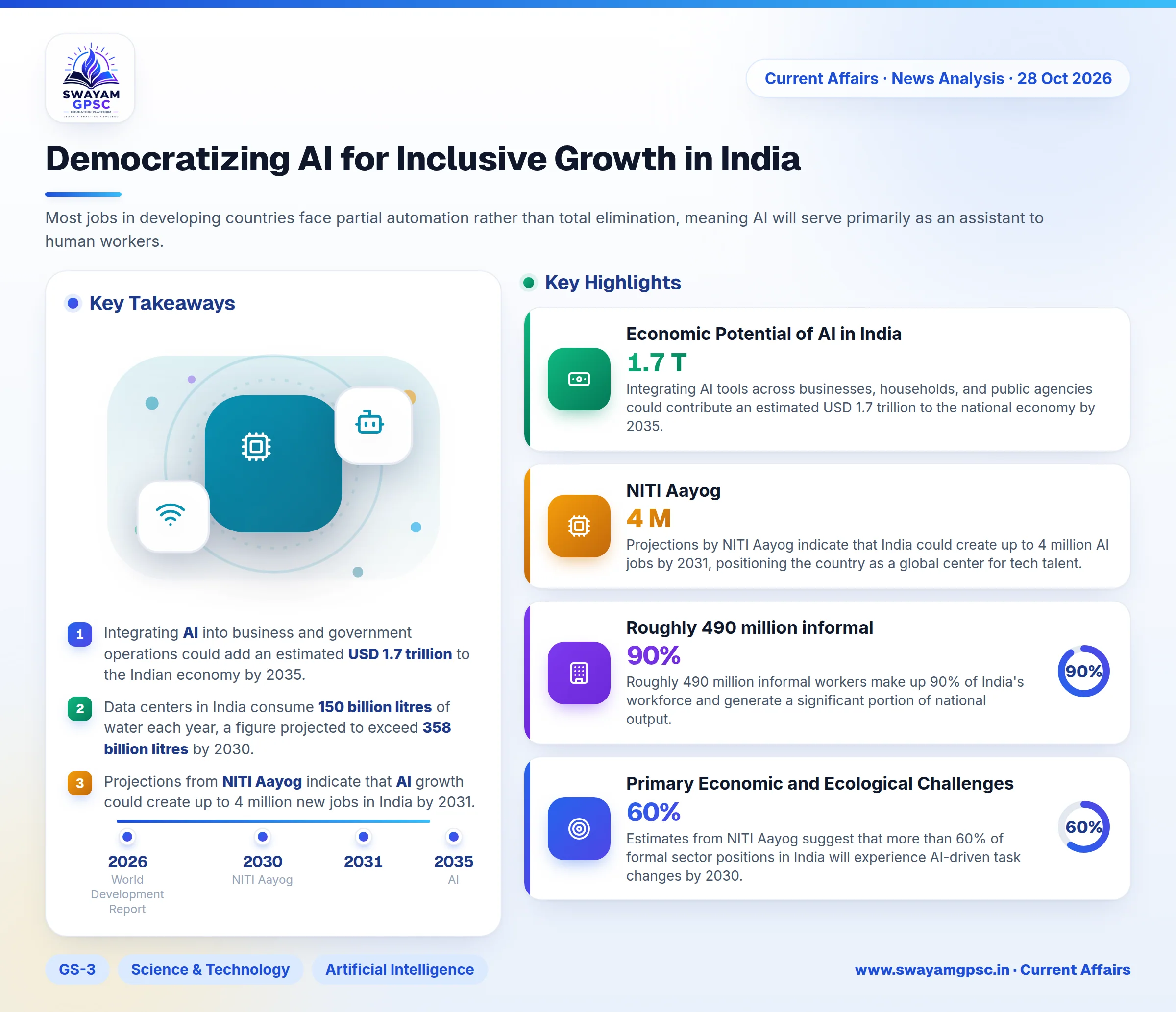
- Integrating AI into business and government operations could add an estimated USD 1.7 trillion to the Indian economy by 2035.
- Data centers in India consume 150 billion litres of water each year, a figure projected to exceed 358 billion litres by 2030.
- Projections from NITI Aayog indicate that AI growth could create up to 4 million new jobs in India by 2031.
- The IndiaAI Datasets Platform (AI Kosha) provides domestic startups access to over 5,500 non-personal public datasets to train locally relevant models.
- The IndiaAI Mission was approved in March 2024 with a budget allocation of Rs 10,371.92 crore over five years to build computing infrastructure and expand technical skills.
Why in News
- Global discussions around Artificial Intelligence (AI) are shifting focus from simply building basic computer infrastructure to creating practical applications that promote inclusive growth.
- India is uniquely positioned to lead this global transition by applying lessons from its successful Digital Public Infrastructure (DPI) model to broaden access to AI and foster balanced economic development.
Summary
- Deploying AI technologies can accelerate economic expansion in India, raise productivity across MSMEs, modernize farming and healthcare operations, and generate fresh employment opportunities.
- However, potential job losses, expanding digital divides, and corporate monopolies present significant hurdles to widespread adoption.
- To overcome these challenges, India must build on its DPI achievements and the IndiaAI Mission to lower access barriers, expand national computing resources, boost AI skills, and champion responsible, sustainable implementation.
Economic Potential of AI in India
- Integrating AI tools across businesses, households, and public agencies could contribute an estimated USD 1.7 trillion to the national economy by 2035.
- India's unique economic landscape makes it ideal for low-cost, targeted, and practical AI solutions.
- These affordable tools help Micro, Small, and Medium Enterprises (MSMEs) automate accounting, track inventory, and inspect product quality, helping them compete with large corporations.
- Although AI alters existing jobs, it creates entirely new job roles in India, including AI conversation designers, ethical AI specialists, AI trainers, and operators who control maintenance robots remotely.
- Projections by NITI Aayog indicate that India could create up to 4 million AI jobs by 2031, positioning the country as a global center for tech talent.
- Most jobs in developing countries face partial automation rather than total elimination, meaning AI will serve primarily as an assistant to human workers.
- For instance, tools developed by Wadhwani AI assist ASHA workers in conducting initial health screenings for tuberculosis, while customized digital advisories help farmers manage crops.
- Roughly 490 million informal workers make up 90% of India's workforce and generate a significant portion of national output.
- Tailored guidance, digital tools, and targeted training powered by AI can boost the earning power, market access, and financial stability of these informal workers.
Primary Economic and Ecological Challenges
- Studies from IIT Madras reveal that AI automates specific work tasks before replacing whole positions.
- This shift restricts entry-level hiring because AI handles simple coding and routine data entry, leaving recent graduates with fewer job openings while a small group of senior experts commands high pay.
- Estimates from NITI Aayog suggest that more than 60% of formal sector positions in India will experience AI-driven task changes by 2030.
- Running AI data centers requires huge amounts of natural resources, creating serious environmental stress.
- Data centers across India consume nearly 150 billion litres of water each year, a figure expected to rise past 358 billion litres by 2030.
- More than 70% of this data center capacity sits in water-scarce urban hubs like Chennai, Bengaluru, Mumbai, and Hyderabad.
- This heavy usage has sparked local protests over risks to municipal drinking water supplies and farm irrigation.
- Key resources like advanced computer chips, large computing facilities, venture capital, and top researchers remain concentrated among a few Western technology firms.
- Relying on foreign firms creates strategic vulnerabilities and risks creating market dominance that domestic firms cannot challenge.
- Without reliable electricity, fast internet, affordable devices, and local language datasets, AI advances will benefit only wealthy urban residents and widen social inequality.
- Many AI pilot projects fail to expand nationally because they lack long-term funding, institutional leadership, shared technical standards, and clear evaluations of real-world impact.
Lessons from India's DPI Model
- The development of India Stack demonstrates that technology initiatives do not have to increase social inequality.
- Applying open-source foundational models, such as Bhashini for regional languages, lets local developers create targeted solutions without building systems from scratch, much like UPI created an open protocol for payments.
- Establishing strong public institutions, similar to how NPCI manages digital payments, allows the government to build underlying systems like the National Data Governance Framework and public computing hubs like AIRAWAT while private firms build consumer services.
- Lowering basic infrastructure costs and mandating shared standards can reduce individual transaction costs close to zero, encouraging startups to build affordable services for low-income populations in farming, education, and healthcare.
Measures Needed to Maximise and Democratise AI Impact
- Regulators should base approvals for AI infrastructure on regional environmental capacity, requiring zero-liquid-discharge systems and recycled water to protect local water supplies.
- Government authorities must quickly implement the IndiaAI Mission to provide discounted access to Graphics Processing Units (GPUs) and national computing networks for domestic startups and research institutions.
- Following the World Development Report 2026 framework of Adopt, Adapt, Advance, India should focus on practical, localized AI tools rather than expensive frontier models.
- The national platform Bharat VISTAAR should deploy localized voice assistants to give farmers personalized weather and crop advice regardless of their reading ability.
- To upgrade rural healthcare, public agencies should deploy proven domestic technologies like Cerebra AI, which demonstrated 94% accuracy in detecting tuberculosis in Uttar Pradesh.
- Expanding the IndiaAI Datasets Platform (AI Kosha), which hosts over 5,500 public datasets across agriculture and health, will help local startups train models without relying on foreign data.
- Setting up portable social safety nets that follow workers across jobs will protect gig and informal workers from economic instability caused by AI workforce changes.
- Expanding the Rs 1 lakh crore Deep-Tech Fund of Funds alongside the Anusandhan National Research Foundation (ANRF) will attract private investment into domestic research and development.
- Setting up computing labs in Tier-2 and Tier-3 cities through ITIs under the IndiaAI FutureSkills initiative will shift technical education from basic coding toward AI literacy and prompt engineering.
- Using programs like the MSDE-WEF India Skills Accelerator alongside research fellowships will help retain skilled workers and capture projected deep-tech jobs by 2031.
- Establishing clear self-assessment guides and ethical standards under the IndiaAI Mission and the planned Digital India Act will help reduce algorithmic bias and prevent fake digital content.
Conclusion
- While adoption of AI is inevitable, government policies will shape its ultimate direction and impact on society.
- India can transition from using foreign tools to designing inclusive tech systems that help all citizens prosper during Amrit Kaal.